Message to drone delivery companies: Keep it down

Add Axios as your preferred source to
see more of our stories on Google.
Illustration: Maura Losch/Axios
Drone delivery companies are scrambling to turn down the volume as neighborhood opposition threatens to ground their expansion plans.
Why it matters: Getting regulatory approval to fly is one thing. Convincing homeowners to tolerate buzzing drones overhead is another.
Driving the news: Amazon last week abandoned plans for a drone delivery hub in suburban Boston after residents and lawmakers raised concerns about noise, safety and privacy.
- The company withdrew its application in Westborough, Massachusetts, but left open the possibility of returning.
Meanwhile, rival Zipline says it has taught its drones to fly more quietly.
- Zipline's "dynamic flying" software lets each drone pick the quietest route in real time based on wind, speed and altitude, allowing drones to glide more efficiently, like a bird, instead of relying on noisy propellers.
- The upgrade reduces total sound exposure per flight by 68% and peak sound levels by 24%, according to Zipline's modeling.
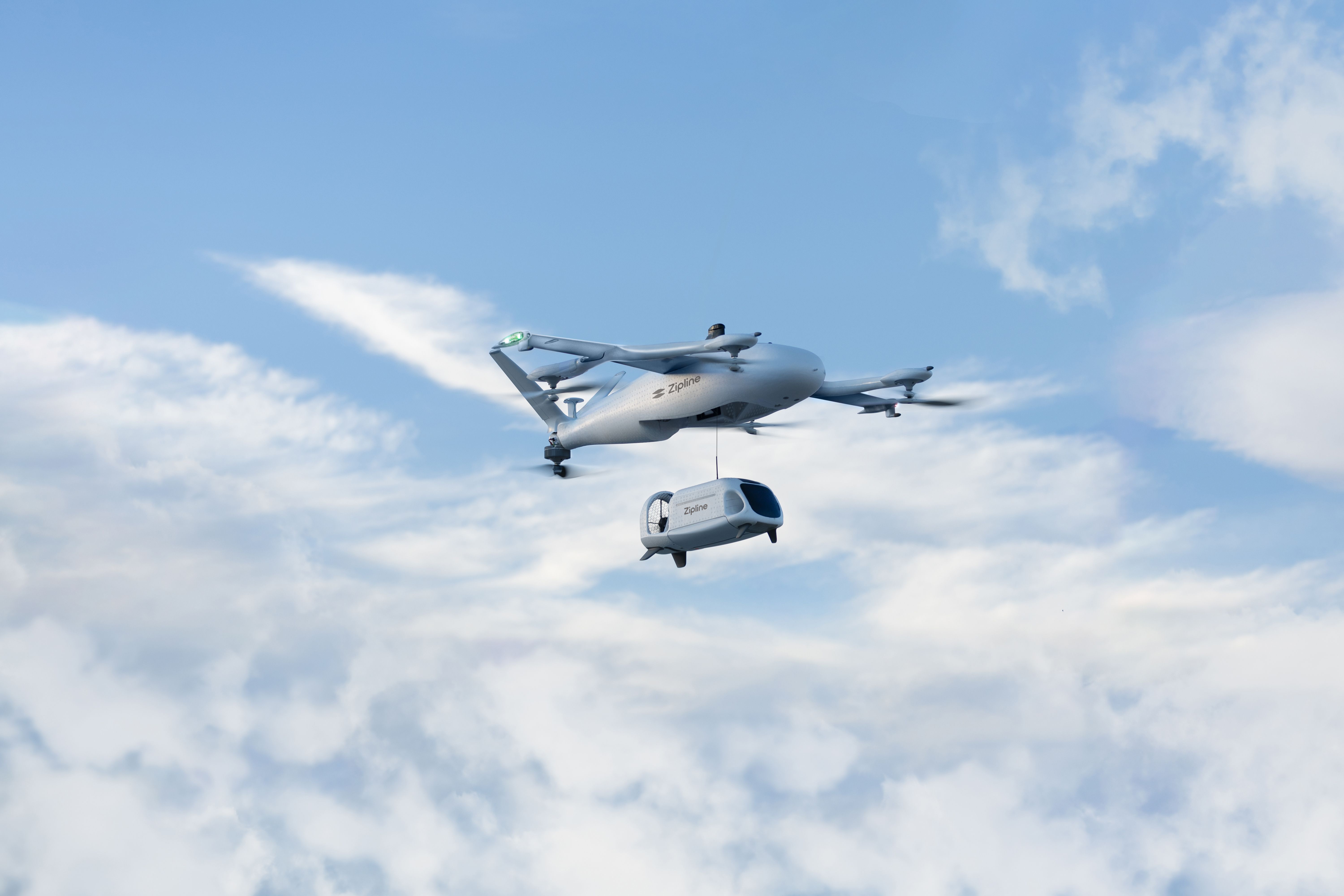
How it works: The drone uses gravity and wind to do some of the work its motorized propellers would otherwise do.
- It might dip its nose to pick up speed, like a bike coasting downhill, or tilt upwards to slow gently rather than braking with its motors.
- Zipline's unique design makes it possible. Unlike most drones, which have multiple propellers thumping the air to keep them aloft, its Zip drone has wings and glides like a plane.
- And the Zip hovers higher in the air than other drones, using a tethered droid to lower the package to the ground. After delivery, the droid returns to the belly of the Zip, which flies away.
The big picture: Other drone operators are also trying to blend into the neighborhood.
- Alphabet's Wing uses low-pitch propellers and flies higher above homes, lowering packages on a tether.
- DoorDash's new delivery drone uses six slow-spinning propellers designed to produce less noise.
Reality check: Quieter doesn't necessarily mean quiet. As drone deliveries multiply, even relatively unobtrusive aircraft could become an unwelcome neighborhood nuisance.
The bottom line: The drone delivery race may ultimately be won by whoever makes the least noise.
