AI tools have become shockingly good at carrying out much of the work produced by the economic profession — from the most elite halls of academia to think tanks, government agencies, consultancies, research shops and humble newsroom economics teams.
The big picture: This fact raises important — and, we confess, unnerving — questions about the role of humans in making sense of the economy.
On a recent evening near a secure U.S. facility, three federal agents saw a flying object they couldn't identify: a large "matte black triangle" that moved as fast as a fighter jet, made no sound and then disappeared, according to FBI and Defense Department reports.
Why it matters: The 15-foot flying triangle is classified as a UFO-like "Unidentified Anomalous Phenomena" because the U.S. doesn't have the technology to make such a craft — and neither do its adversaries.
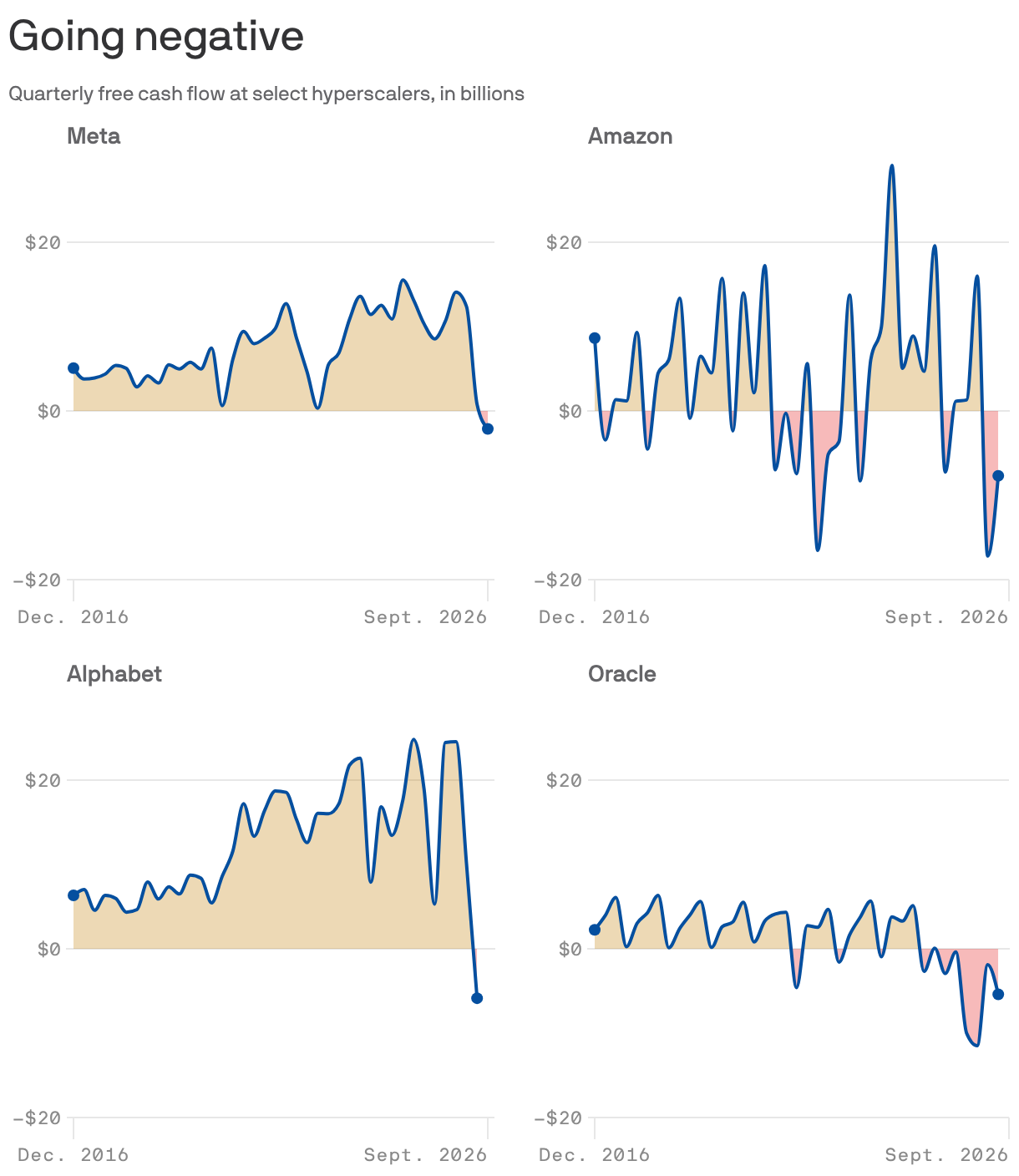
Data: FactSet, company filings; Chart Axios/Matt Phillips
Mark Zuckerberg's Meta got smacked around Thursday after reporting earnings that looked pretty strong at first glance.
Why it matters: Its drubbing in the stock market — Meta ended down 7% —suggests that investors are growing concerned that Big Tech's insistence on pouring more and more capital into data centers could end up costing them in the long run.
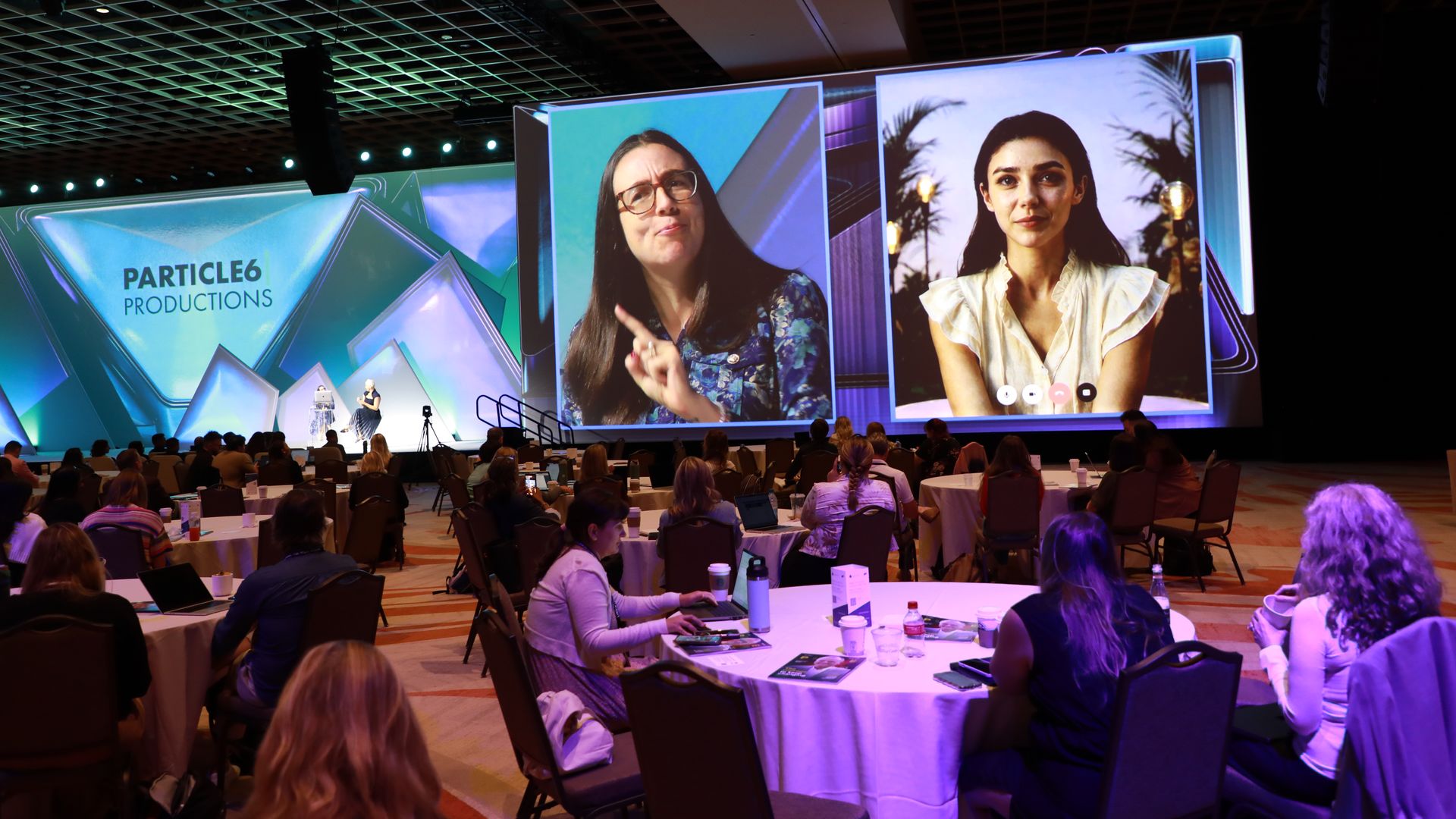
ORLANDO, Florida — I got roasted by "AI actor" Tilly Norwood in a room full of marketers.
Why it matters: The AI-generated character has attracted controversy over fears of synthetic talent replacing human jobs in Hollywood and in advertising.
America's largest banks are working to prevent AI worst-case scenarios. But they're also preparing for the "day after" a catastrophe, Axios has learned.
Why it matters: America's financial institutions have joined the largest AI companies in scenario-planning for disaster, a prudent but worrisome signal about the extent of the risk that major corporations see on the horizon.
On October 22 at 6:50 p.m. CT, tune in as Austin Mayor Kirk Watson delivers opening remarks, followed by conversations with Liberty Media Corporation president and CEO Derek Chang and APEX founder and CEO António Caçorino on the business forces driving Formula 1's global growth and its expanding influence across technology, media and culture.
The program will also include sponsored View from the Top segments featuring BWT Alpine Formula One Team driver Pierre Gasly, BWT Alpine Formula One Team global marketing director Guy Martin and Adobe global vice president of enterprise marketing Marissa Dacay.
LAS VEGAS—The proliferation of AI agents in banking and trading is presenting unresolved questions about reliability, liability and regulations, financial experts said at an Axios event.
Why it matters: Introducing AI into commerce could streamline aspects of the consumer experience across banking, shopping and trading; however, establishing trust in the agents is still a work in progress.
Axios' Ryan Lawler and Lucinda Shen spoke to Federal Deposit Insurance Corporation chairman Travis Hill and Alpaca co-founder and CEO Yoshi Yokokawa. The Oct. 20 event was sponsored by J.P. Morgan.
What they're saying: Hill pointed to the advent of advanced technology as helping to streamline banking. "It's very easy for consumers to move money around to different banks," he said.
But as agents gain more power to move money, "there's just a big question of to what extent are depositors going to delegate that type of decision-making authority to these types of agents," Hill added.
Case in point: "Who is liable when something happens, when the agents go rogue and start doing some criminal activity, or even just do some bad trade and lose money?" Yokokawa posited when discussing restrictions on fully automated trading through his fintech company's platform.
Yokokawa also cautioned against completely relying on agents to conduct financial trades. Consumers assuming agents have the ability to make them a lot of money is "very dangerous," he said.
Friction point: As debate over AI regulation continues, Hill explained why his agency's model risk management guidance does not apply to agentic AI and generative AI as the FDIC considers future guidelines for the technology.
"This is a very rapidly evolving area, and so I think trying to make sure that we're on the one hand … staying current … with that evolution, but also being thoughtful and deliberative about it," Hill said.
Content from the sponsor's segment:
J.P. Morgan Payments and Global Banking's Zack Anderson on stage at an Oct. 20 Axios Live event. Photo: Steven Joseph Fogarty for Axios
During a View From the Top conversation, J.P. Morgan chief data and analytics officer for Payments and Global Banking Zack Anderson spoke about the potential for agentic commerce to simplify purchasing, while also acknowledging safety concerns.
"It's easy, actually, right now to get a bot or an agent to make a payment. … [T]he problem is, it's really hard to do reliably and safe."
The websites you use every day may have been vulnerable to hackers for years because of hidden flaws in their code that AI only recently discovered.
Why it matters: The code, called PHP, powers millions of websites, and the vulnerabilities could allow hackers to steal sensitive data like your passwords or take control of affected servers.
Spotify on Thursday beat investor estimates on paid user growth for the third quarter, thanks in part to new AI-driven personalization features and other benefits designed to bolster the value of a subscription.
Why it matters: Paid user growth is contributing to a more financially stable and profitable company that can reward shareholders while allowing Spotify to invest more in its business.
Some of America's most powerful business leaders are making loud promises to share their fortunes and publicly acknowledging the dangers of economic inequality.
Why it matters: Corporate America is starting to read the room. For communications and corporate affairs chiefs, that raises tricky questions: Should your company join the conversation, and if so, how do you do so in a meaningful way?
American manufacturing is showing signs of revival. But the recovery is being powered by industries at the forefront of the AI and energy boom while the traditional factory sector gets left behind.
Why it matters: The White House is touting a revival in American manufacturing as evidence that its economic agenda is working.
But a lopsided recovery raises questions about how much of the sector stands to benefit — especially as higher borrowing costs threaten to weigh on factories once again.
Kalshi is asking federal regulators for permission to re-list compute derivatives, which would allow users to trade on the future cost of renting GPUs, the powerful chips used to run AI.
Why it matters: The prediction market was reportedly ordered by the Commerce Department to take down compute markets earlier this year over national security concerns. (Commerce denied that it did so.)
Driving the news: Sudhir Jain, Kalshi's chief compliance officer, said Wednesday on LinkedIn that Kalshi had submitted comments to the Commodity Futures Trading Commission asking it to allow the markets.
That would ensure that "price discovery" on GPUs happens in the U.S., not offshore, he argued.
"Compute already fits the definition of a commodity" and "both sides have a reason to hedge" on compute pricing, Jain wrote. "Buyers like AI labs can lock in costs. Providers like data center operators can protect the revenue behind their GPU investments."
What they're saying: The CFTC declined to comment.
Catch up quick: The agency sent a request for public comment on compute contracts in August.
"Just as American markets helped establish the gold standard for trading the commodities that powered the industrial economy, we will do the same for the commodity that will power the intelligence economy," CFTC chair Michael Selig said at the time.
A newly minted L3Harris Technologies facility in Arkansas will consolidate solid-rocket motor production and help double capacity for work on GMLRS, rocket artillery made by Lockheed Martin.
Why it matters: Propulsion and energetics have long been a chokepoint for the U.S. — and the military is now facing tough questions about the state of its munitions stockpile and industry's ability to quickly refill it.
Space warfareis "only going to get spicier from here," True Anomaly CEO Even Rogers told Axios in an exclusive interview.
True Anomaly, a defense tech startup specializing in space defense and satellite security, participated in a Space Force demo in July in which its spacecraft pursued and targeted a Rocket Lab satellite.
Hackers are finding new ways to infect iPhones with spyware — even when victims never click a malicious link — according to new research shared with Axios.
Why it matters: Software once used to spy on politicians, journalists and other high-value targets is becoming a tool for everyday cybercriminals looking to steal cryptocurrency and login credentials.
Major U.S. banks are detecting unauthorized third-party AI agents operating inside customer accounts, with some agents attempting to take actions that appear to be independent of user instructions, sources tell Axios.
Why it matters:AI agents are becoming a nightmare for America's banks, making their way into banking systems faster than financial institutions can respond.
The difficulty in distinguishing between a human and an unauthorized bot is forcing banks to block the technology and rapidly rewrite their terms of service.