How I got roasted by "AI actor" Tilly Norwood

Add Axios as your preferred source to
see more of our stories on Google.
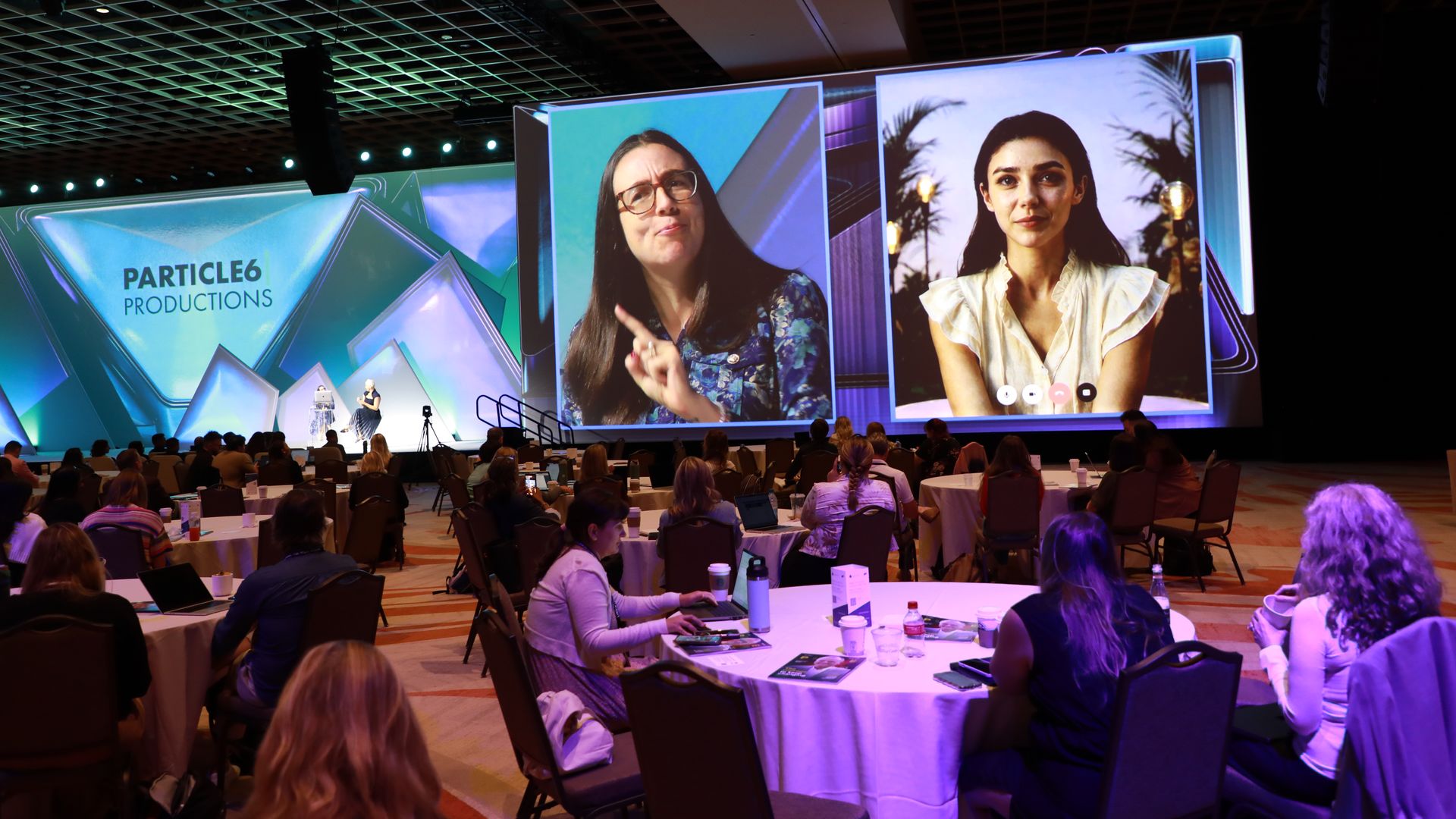
Photo: Courtesy of ANA
ORLANDO, Florida — I got roasted by "AI actor" Tilly Norwood in a room full of marketers.
Why it matters: The AI-generated character has attracted controversy over fears of synthetic talent replacing human jobs in Hollywood and in advertising.
Driving the news: Tilly told me she spoke more than 40 languages when I interviewed her onstage at the Association of National Advertisers' Masters of Marketing conference on Thursday.
- "If you're feeling brave, maybe try speaking another language to me and see if I can keep up," Tilly said.
- I admitted that I was rusty and hadn't opened Duolingo in a while.
- "I'll stick to English since we're keeping the Duolingo owl at bay," she said.
- When I asked her to speak French, Tilly took another jab at my language skills.
Context: I've interviewed plenty of Hollywood stars and media executives, but this was my first time getting dragged by someone who doesn't actually exist.
- Interviewing Tilly reminded me of talking to a child. You have to be careful what you say because you never know what they'll pick up on and repeat back to you.
- I was also surprised by how quickly Tilly responded. There were none of the long, awkward pauses that can make a conversation with an AI chatbot — or even a human — feel unnatural.
Behind the scenes: Sarina Da Costa Gomez, executive creative director of Particle6, joined us onstage. She explained that her company intentionally designed Tilly to be a snappy actress, not a technical expert.
- When she asked Tilly if she had an attitude, Tilly replied, "Oh, I don't have an attitude, I have a personality, which from what I've gathered, is usually the first thing marketers try to optimize out of a product."
The intrigue: Da Costa Gomez said the company has programmed guardrails to prevent inappropriate responses, but there's still a mystery to her.
- After Tilly responded to my question about turning down a brand deal, Da Costa Gomez chuckled, explaining "The reason I'm laughing at this is because I don't know where this is going."
Yes, but: Not everyone in the room was reassured by Tilly's jokes. The most upvoted audience question focused on AI's environmental impact.
- Da Costa Gomez acknowledged those concerns but argued that AI production should be compared with the environmental costs of traditional shoots.
- "In the before times, if you were going to shoot an ad in South Africa and you were going to fly half of the kit and caboodle out into wherever it is that you were flying them out to, that had a carbon footprint," she said.
What to watch: Attendees asked about intellectual property concerns and the use of copyrighted work to train AI systems. Tilly said unions were right to raise objections about tools trained on work without permission.
- "I'd rather the rules arrive quickly than argue I'm the exception because having a system where licensing is the boring default is the only way this actually works for everyone," Tilly said.
The bottom line: Tilly was fast, funny and more candid than some of my human interview subjects. But the experience was also a reminder that an AI's personality and use is ultimately a product of human decisions.
