Inside the Lockheed-Hadrian deal promising more munitions

Add Axios as your preferred source to
see more of our stories on Google.
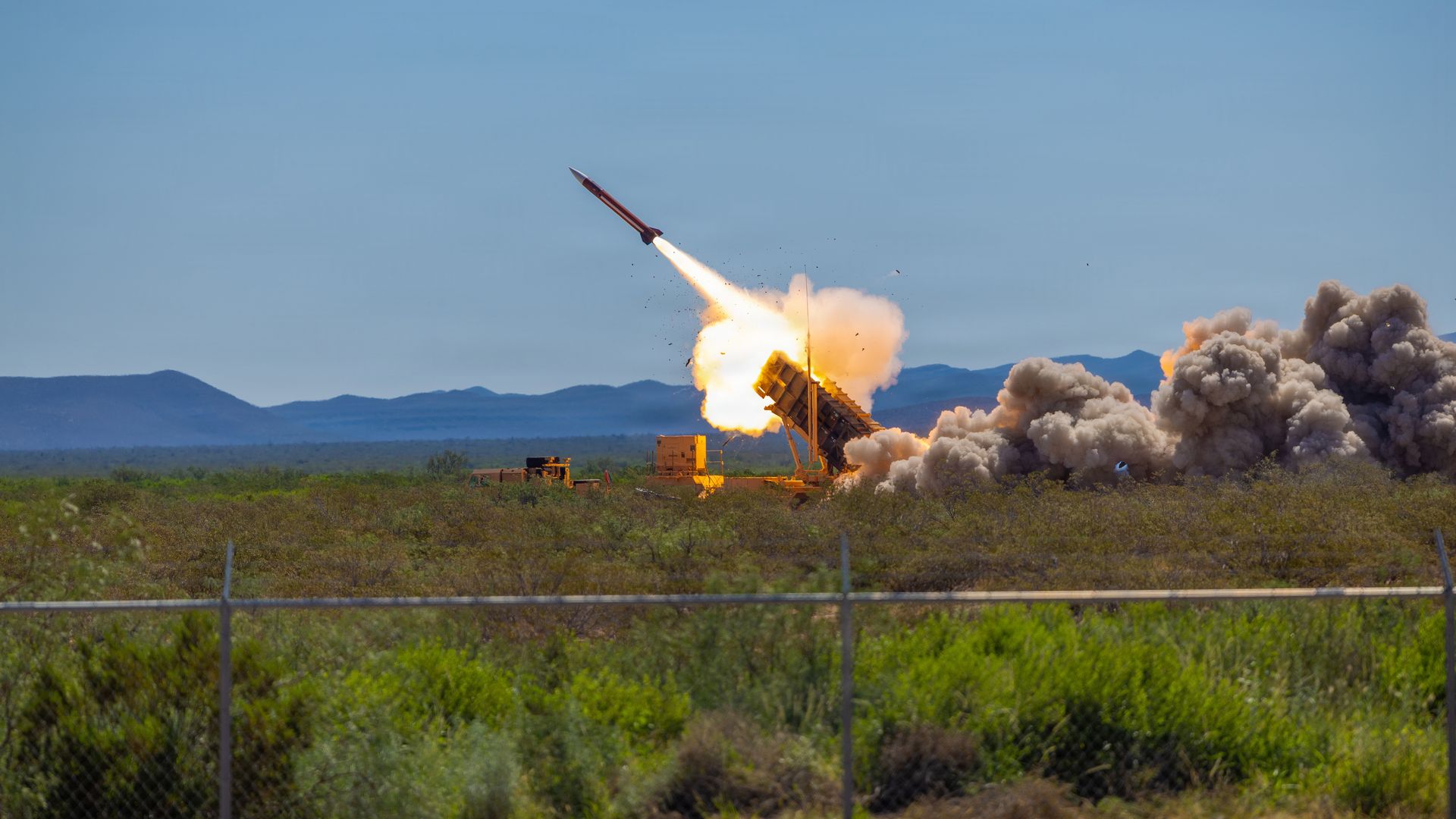
A Patriot missile live-fire drill at MacGregor Range near Fort Bliss, Texas, in 2025. Photo: JaDarius Duncan/DVIDS
GRAND PRAIRIE, Texas — Hadrian is embedding a factory inside a factory not its own.
- And its machinery, capable of running around the clock, is expected to help build some of the world's most complex, in-demand and scrutinized weapons.
Why it matters: This is a major move for the $8 billion startup, and it comes as the U.S. wages war in the Middle East and as the Pentagon strikes deals, in some cases, to triple and quadruple munitions output.
Driving the news: Lockheed Martin on Oct. 14 celebrated an expansion of its missiles and fire-control facility here, just west of Dallas. A key part of that growth — more than 100,000 square feet, all told — is the installation of Hadrian manufacturing capabilities.
- The defense contractors will benefit together from "connected systems, connected workforces, as well as what I would call an overflow to our factory in Arizona," one of a few states where Hadrian operates, CEO Chris Power told reporters.
- "If it gets full," he said, "there's actually a massive buffer."
Zoom in: The Hadrian cells will be overseen by Lockheed employees. They will help build Patriot interceptors, GMLRS rocket artillery and Precision Strike Missiles.
- On display during Wednesday's ceremony were large systems, like the HIMARS launcher, and smaller components, like internal and external fins.
- Also arranged for viewing were Javelin anti-tank kits, a Joint Air-to-Surface Standoff Missile and an Air-Launched Rapid Response Weapon.
What they're saying: "Nineteenth-century tasks, like forging metal, casting metal, machining metal, are being revolutionized" by new technologies, methods and quality control mechanisms, Lockheed CEO Jim Taiclet told reporters.
- "Systemic change has been needed to take advantage of the strengths of the United States," he said. "And that's what's happening."
- The Grand Prairie plant produced hundreds of thousands of parts last year.
Between the lines: The narrative between prime Pentagon supplier and scrappy Silicon Valley startup is changing by the day. What was once an us-versus-them gnashing of teeth has become something far more collegial and collaborative.
- "We have a big tent approach to this whole emerging entrant scenario," Taiclet said.
- Lockheed recently partnered with Saildrone and Fortem Technologies. The former makes drone boats; the latter, radars and drone countermeasures.
Zoom out: "The president says 'peace through strength.' I like to say 'peace through industrial strength,'" Pentagon chief weapons buyer Michael Duffey told reporters.
- "I do think a robust industrial base can form a deterrent in and of itself," he said. "And I think we've seen that over the last year and a half."
Threat level: A report published in March by the Ronald Reagan Institute graded American manufacturing capacity "D+" and defense modernization "D."
- Private-sector innovation received an "A-."
What's next: Hadrian also has plans for a new headquarters and research-and-development hub in California.
Go deeper: CenCore unveiling defense-contractor collaborative in Utah
