The AI boom has a new complication: falling prices

Add Axios as your preferred source to
see more of our stories on Google.
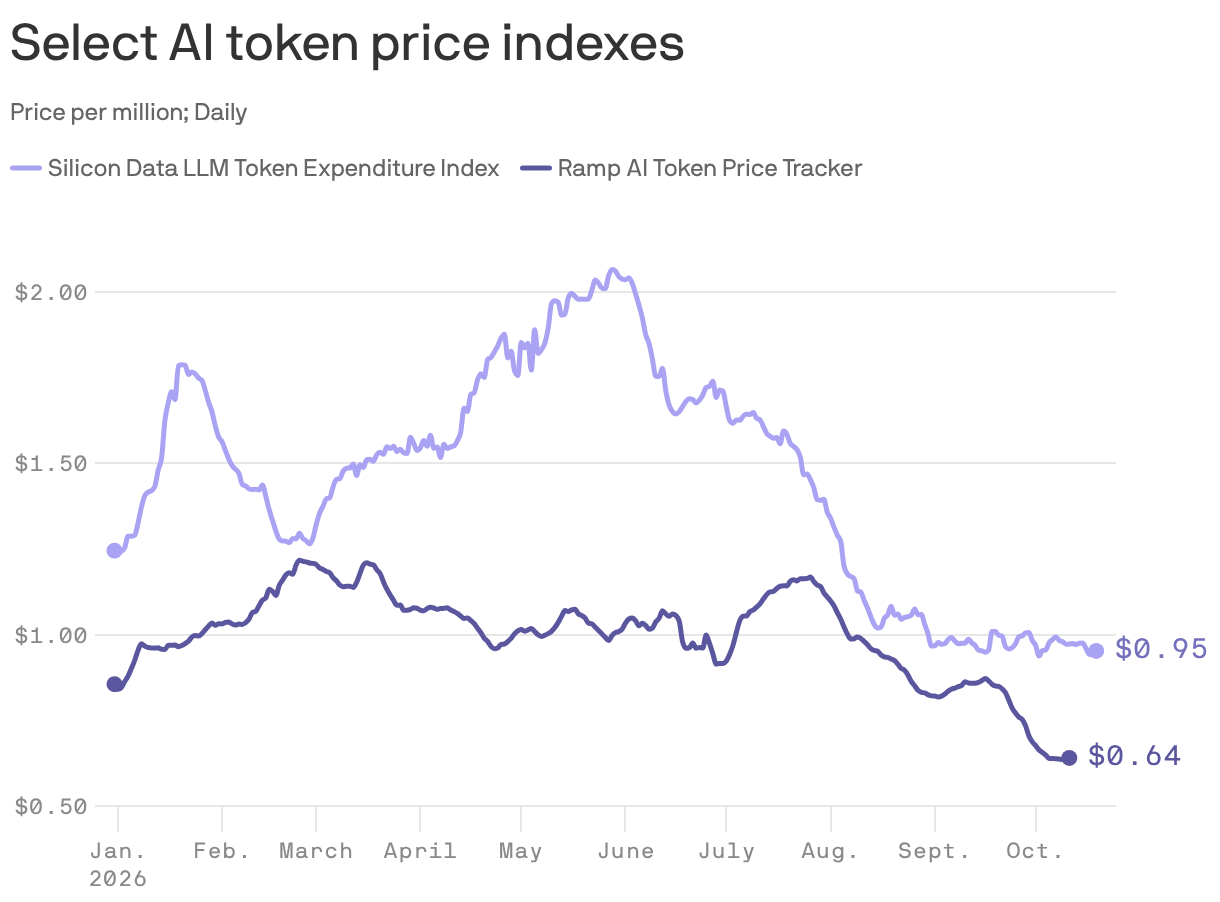
Prices for tokens — a measure of AI usage — have tumbled in recent months.
Why it matters: The price drop raises questions about the strength of an AI boom fueled by supposedly bottomless demand for computing power.
The latest: There's no token price that captures all activity, but several available public indexes show similar declines.
- Silicon Data's LLM Token Expenditure Index — a volume-weighted benchmark of AI token prices that captures a shifting mix toward lower-priced models — has broken the buck in recent days, falling below $1 per million tokens.
- It's down 54% from its peak of $2.07 per million tokens in late May.
- The token price index produced by corporate spending management company Ramp — based on spending by actual businesses on OpenAI and Anthropic — is down 48% from its late February peak of $1.22 per million tokens.
What they're saying: The collapse in token prices reflects both the impact of corporate customers switching to cheaper, open-weight models and the price cuts that OpenAI and Anthropic have made.
- "It's also a market in which the spend is not particularly sticky," Ara Kharazian, lead economist at Ramp, tells Axios. "And so, month over month, with the introduction of a new model, you can see billions of dollars of business spend shift from one provider to another."
- "It partly is because of a smart routing away from frontier models toward open models — that's the so-called end of cloud maxing or token maxing," says Steve Hou, head of research at Silicon Data.
- The decline also reflects that AI giants "have been cutting prices themselves, with each new generation being released with more capability, more powerful intelligence, but also at the lower price," Hou adds.
Increasing use of agents for longer AI interactions is also contributing to the decline in prices, says Chris Clark, co-founder and chief operating officer of OpenRouter, a software platform that lets developers use a range of AI models.
- That's because large chunks of these longer interactions are saved, or cached, rather than being rerun through the models. Tokens representing cached inputs are typically much cheaper than other tokens, Clark says.
The big picture: Whatever the reason, declining prices could prompt a recalculation of one of the largest investment booms in U.S. history.
- The largest U.S. hyperscalers alone are on track to spend $800 billion on capital expenditures this year and are forecast to spend another $1.1 trillion in 2027, according to Goldman Sachs.
Yes, but: The price drop has been largely shrugged off with frequent references to the so-called Jevons paradox, an economic phenomenon in which technological improvement causes prices to drop, stimulating more economic activity at those lower prices.
- And that has been true, as far as it goes: AI usage, as measured in tokens, continues to rise incredibly quickly.
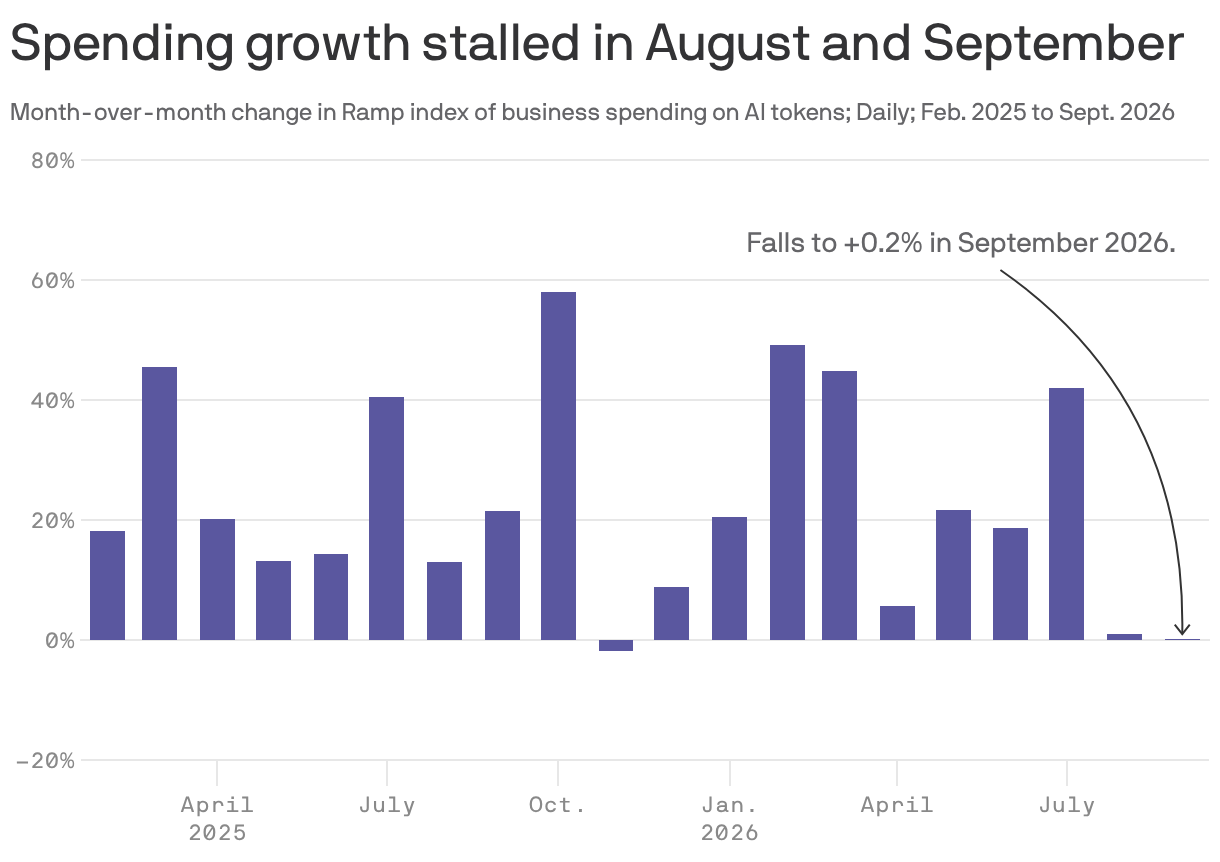
Friction point: By Ramp's accounting, however, token spending by businesses — as opposed to token usage — has been strangely flat for two consecutive months, even as businesses continue to burn compute.
- "For the first time, we're seeing token usage go up and token spend hold flat," Kharazian says. "And it's now occurred for two months straight."
The bottom line: Token spending by businesses is closely related to revenue for AI model makers.
- If spending is in fact beginning to flatline, that would be a big problem for the expected IPOs of AI companies like Anthropic — and for the AI trade that continues to be the engine driving the markets and economy.
