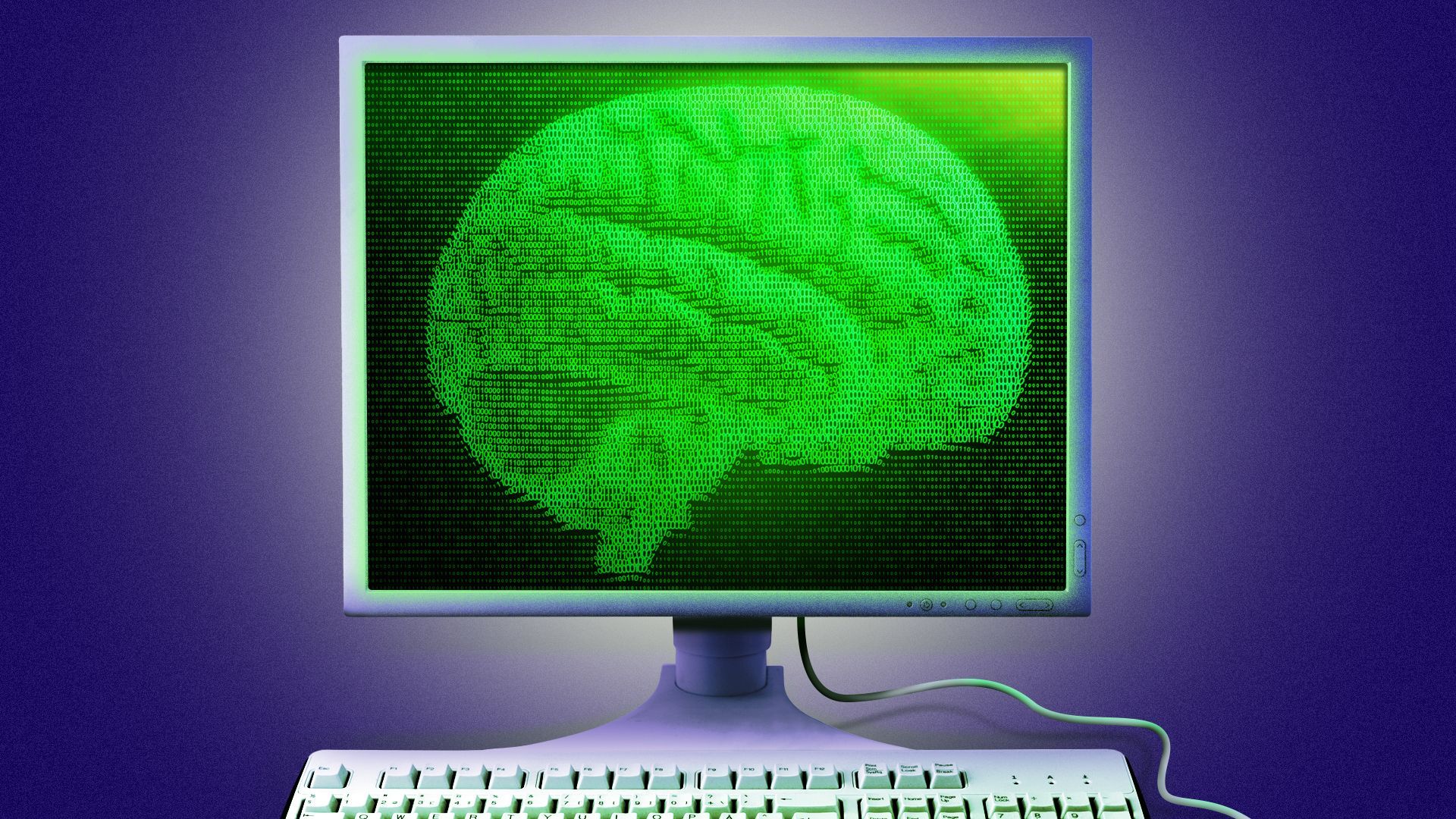
Why it matters: xAI is said to be raising as much as $6 billion to catch up to rivals like OpenAI and Anthropic, and it needs a compelling story for investors.
The Department of Justice and TikTok asked a U.S. appeals court on Friday to expedite its consideration of legal challenges to the new U.S. law requiring parent company ByteDance to sell the app or face a ban, multipleoutlets reported.
The big picture: It's the latest in apotentiallyprotracted legal fight over the popular social media app's fate in the U.S., after President Biden signed a law forcing TikTok's sale or ouster.
OpenAI no longer has a separate "superalignment" team tasked with ensuring that artificial general intelligence (AGI) doesn't turn on humankind.
Why it matters: The non-profit firm — founded to protect the world from the gravest threats AI could pose — is looking more and more like an impatient Silicon Valley startup cranking out new products at warp speed.
The Pentagon is looking at expanding its use of Microsoft software across all components starting next month, according to a draft memo obtained by Axios.
Why it matters: The tech upgrade is spurring concerns among competitor cybersecurity and software vendors interested in coveted defense contracts.
A Chinese-speaking hacking group is targeting individuals tied to a U.S. artificial intelligence company in an ongoing phishing attack, researchers at Proofpoint said Thursday.
Why it matters: AI operators have become prime targets for hackers looking to steal trade secrets as the U.S. and China continue to battle for AI dominance.
Most defense contractors believe they're too small and inconsequential for nation-state hackers to target them, a National Security Agency official told Axios.
Sony Music has sent letters to more than 700 AI companies complaining of "unauthorized use" of its content in training their systems. (TechCrunch)
AI search firm Perplexity has added a number of big-name tech veterans as advisers, including Android co-founder Rich Miner and former Uber business head Emil Michael.
Two bits of softball news for you as the NCAA tournament kicks off this weekend. First, UCLA has added Gabriela Jaquez, a forward on its basketball team, to its softball roster. Second, my alma mater Miami University (the one in Ohio) is leading the country in home runs (and headed to the Knoxville regional).
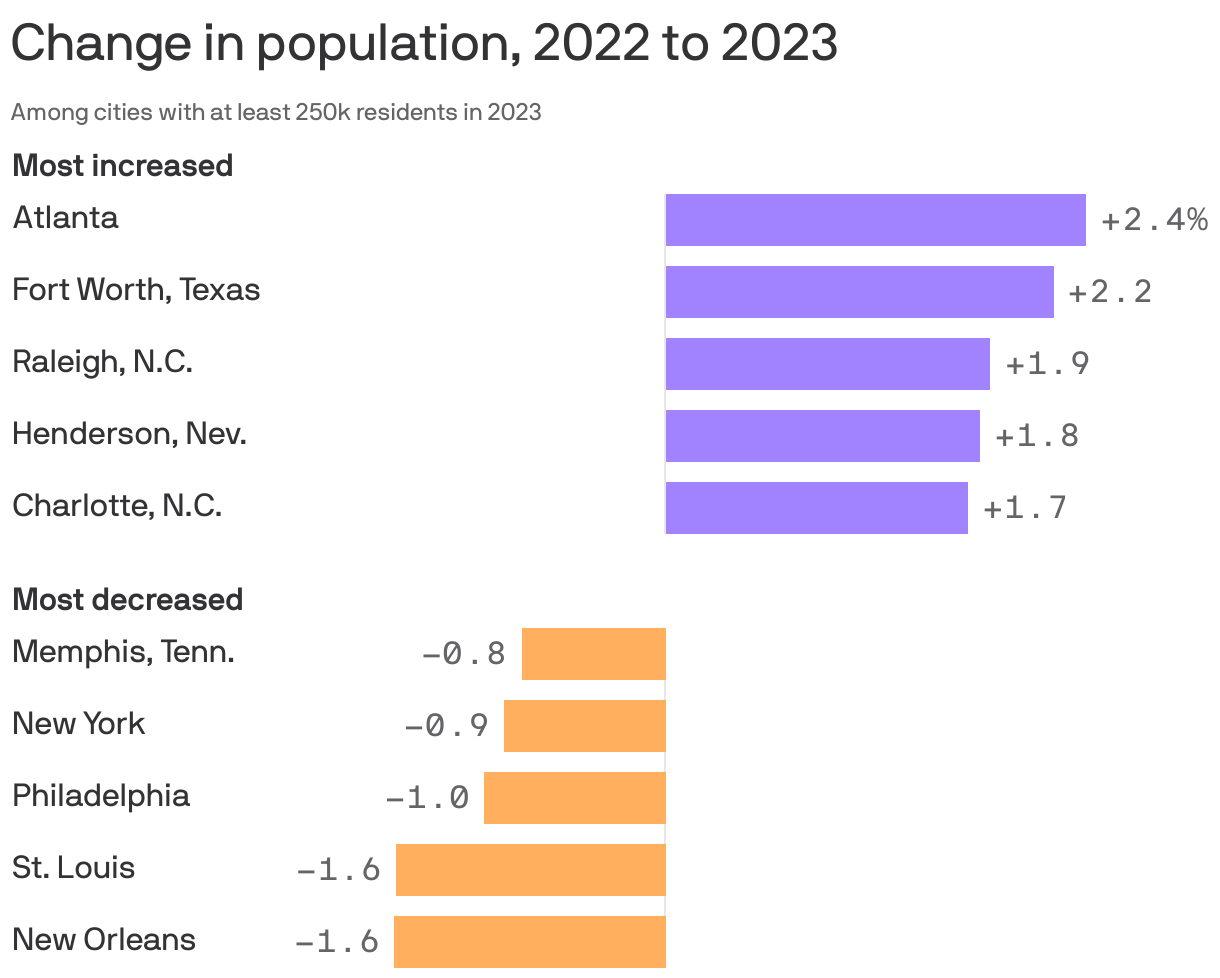
Data: U.S. Census; Chart: Erin Davis/Axios Visuals
Data: U.S. Census; Chart: Erin Davis/Axios Visuals
Atlanta, Fort Worth and Raleigh are America's fastest-growing cities with more than 250,000 residents as of 2023, according to new U.S. Census Bureau data.
Why it matters: Late-pandemic shifts in where Americans live are still shaking out — with big implications for cities seeing massive growth or rapid decline.
The Pentagon's newestquandary: How to cost-effectively intercept cheap but deadly drones wielded by a growing number of enemy forces.
Why it matters: The U.S. and other militaries are sometimes using million-dollar munitions to blow up relatively inexpensive drones. That trade may prove unsustainable.
Dallas Love Field is officially carbon neutral, reaching Level 4 on the Airport Carbon Accreditation 1-5 scale after years of emissions-reduction efforts.
Why it matters: Airports nationwide are trying to cut their emissions, but only five have achieved Level 4 or higher.
Google's shift toward AI-generated search results, displacing the familiar list of links, is rewiring the internet — and could accelerate the decline of the 30+-year-old World Wide Web.
Why it matters: A world where Google answers most questions in a single machine voice makes online life more convenient — and duller.
The biggest names in computing are all pouring resources into building generative AI into their devices, hoping to inject the venerable PC market with a boost of AI excitement.
The big picture: Most of today's AI software runs in the cloud, so any standard PC or Mac should be able to handle generative AI work. Just how much AI work can be done on the device will depend on support from software makers.





/2024/05/17/1715973160111.gif?w=3840)






/2024/05/17/1715909472575.gif?w=3840)