UN Secretary-General António Guterres has endorsed creating a UN agency to deal with AI threats ranging from how AI might be used in weapons of mass destruction to AI's role in spreading conspiracy theories.
Guterres told a U.K.-organized briefing at the UN Security Council — the body's first-ever AI discussion — that the prospect of "malfunctioning AI" in a nuclear or biotech setting is "deeply alarming."
Many smart home devices will soon come adorned with a label that helps consumers decipher how secure these products actually are.
Driving the news: The White House and the Federal Communications Commission this morning kick-started the new U.S. Cyber Trust Mark program, which will place a label on internet-connected devices that meet the U.S. government's cyber standards for Internet of Things products.
Facebook on Tuesday said it is making Llama 2, its large language model for generative AI, available freely for commercial use.
Why it matters: Making the code easily available under a customized partial open source license could help Meta woo developers and offer a ready alternative to OpenAI and others — but Facebook, like the rest of the world, will have to deal with all the content these programs churn out.
The Commerce Department placed spyware vendors Cytrox and Intellexa on a trade blacklist Tuesday after determining that the companies threaten U.S. national security.
Why it matters: The blacklist prevents any U.S. entities from conducting business or transacting with these companies.
OpenAI, the parent company to ChatGPT, on Tuesday said it reached a two-year deal with the American Journalism Project (AJP) to help fund efforts by local outlets to experiment with artificial intelligence technology.
Why it matters: It's part of a larger effort by OpenAI to work with journalism companies on news and tech-sharing agreements.
Citing a need for "humility" by Congress in the face of the rise of artificial intelligence, Senate Majority Leader Chuck Schumer plans a series of nine "AI Insight Forums" with AI experts in the fall.
Why it matters: Instead of debating legislation or holding more traditional hearings, Schumer wants his colleagues to bone up on the complexities of the new technology before regulating it. He's also acknowledging that Congress is still a long way from bipartisan consensus for AI legislation.
The annual E3 video game convention didn’t happen in Southern California last month, but a smaller gathering for the controversial Web3 gaming scene did.
Why it matters: A quick tour of the event, called 3XP, offered a pulse check of crypto/blockchain gaming following a rough year.
Young people are increasingly sharing their locations digitally to track or be tracked by loved ones (and sometimes looser acquaintances) — creating an evolving culture around apps like Find My Friends.
Why it matters: While people who use the apps shared positive experiences, privacy experts have been apprehensive about indefinite location sharing.
Paradigm, the investment firm known for throwing money behind many of the crypto industry's mainstays, hired Alex Grieve as its government relations lead.
Why it matters: The shop appears to be continuing its effort to shape U.S. crypto policy, as Congress considers multiple bills aimed at ironing out rules around stablecoins and market structure.
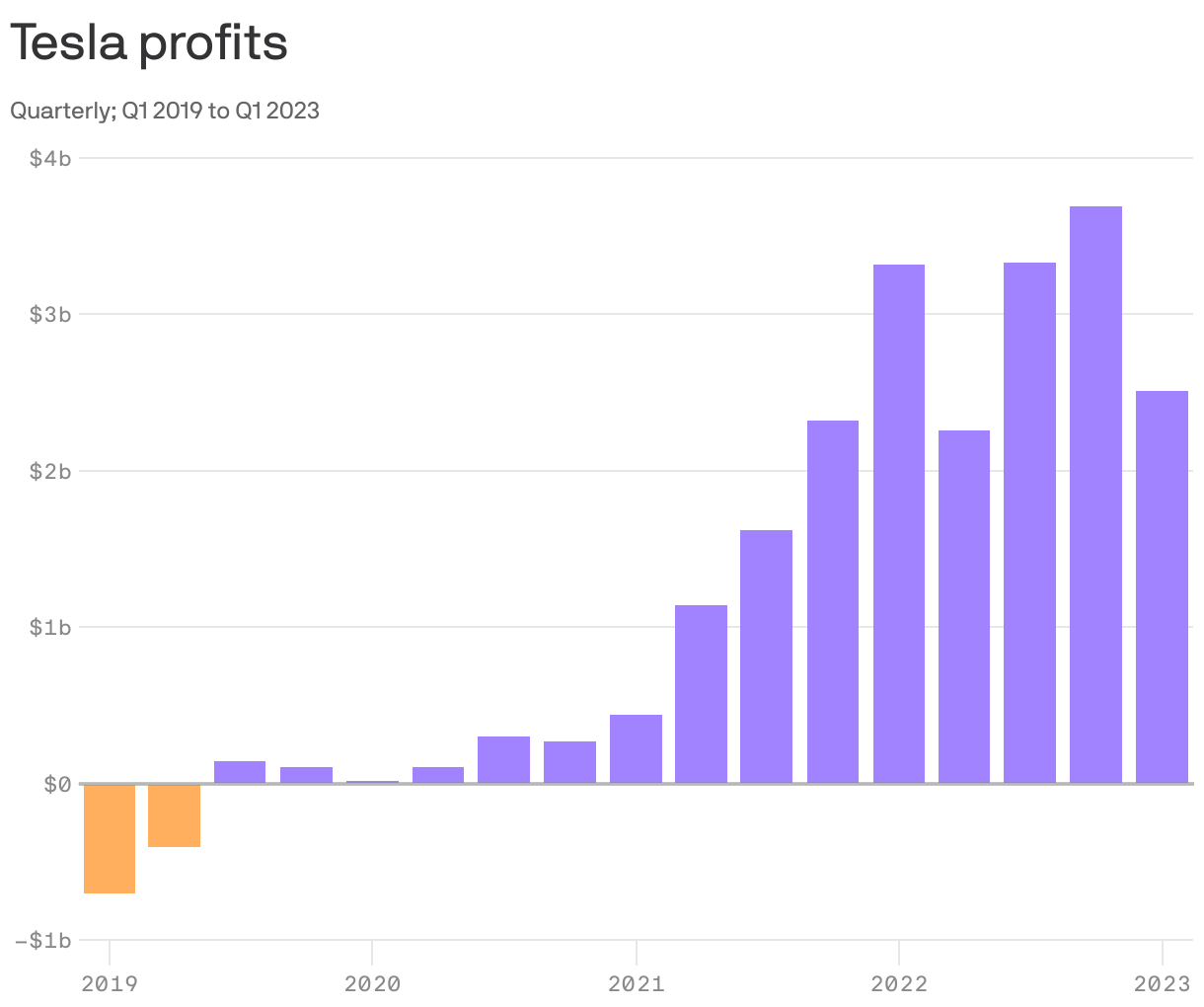
Tesla will report second quarter earnings after markets close on Wednesday.
Why it matters: The market-leading EV maker will provide details on a three-month stretch of record deliveries that beat Wall Street estimates.
The intrigue: It will be the first call with analysts since multiple automakers and charging providers said they will adopt Tesla's North American Charging Standard.
Look for questions on how Tesla executives sees this affecting future revenues and charging expansion plans.
What we're watching: Plans for Tesla's long-delayed and unusual pickup truck, which the company said began production a couple days ago.
And Tesla's ongoing calibration of its pricing will be a focus too, as recent price cuts boost sales but eat into margins.
Also: "On the first-quarter call, management said costs of raw materials would begin to decline, so look for updates here," Morningstar analysts note.
We reached out to a host of tech luminaries, executives, academics, critics and regulators, and asked them the same question: What’s the single most important thing that people should be doing to prepare for AI?
Human decisions will matter more, not less, as the AI age dawns around us.
Why it matters: It's humans who will choose where to allow AI and where to bar it. And humans will pick the values that guide these systems and what data is used to train them.











/2023/06/29/1688059652144.gif?w=3840)


/2023/07/17/1689561095105.gif?w=3840)