Momentum against TikTok is brewing in Congress, where House Republicans are marking up legislation to empower President Biden to ban the app.
Why it matters: The U.S. government's security review of TikTok has dragged on for years, and lawmakers are growing impatient to appear strong against potential Chinese threats.
A top cybersecurity official said in a speech Monday it's long past time for technology companies to build cybersecurity into their product design.
What they're saying: "The risk introduced to all of us by unsafe technology is frankly much more dangerous and pervasive than the spy balloon, yet we've somehow allowed ourselves to accept it," Cybersecurity and Infrastructure Security Agency Director Jen Easterly said in remarks at Carnegie Mellon University.
The lack of visible Black cybersecurity leaders is making it difficult for Black employees to see a future in the industry, according to job recruiters, hiring managers and industry veterans.
Advocates say it’s too soon to tell whether the small rise in the number of Black people working in the video game industry will be sustained or meaningful.
Why it matters: The percentage of Black people making video games professionally has been stubbornly low for decades.
Democrats in Congress are warning the Biden administration that federal agencies could be indirectly aiding state and local law enforcement investigations that could result in the prosecution of abortion providers and patients.
Driving the news: Sens. Ron Wyden (D-Ore.) and Mazie Hirono (D-Hawaii) and Rep. Sara Jacobs (D-Calif.) expressed concern that FBI and Department of Homeland Security resources could be used to help undermine access to reproductive care, according to a letter lawmakers sent Monday evening.
The Department of Justice is investigating a ransomware attack that targeted one of the U.S. Marshals Service's systems earlier this month, the service confirmed Tuesday.
Why it matters: The affected system contains sensitive law enforcement information, including "returns from legal process, administrative information, and personally identifiable information pertaining to subjects of USMS investigations, third parties, and certain USMS employees," according to an agency statement.
The rush is on among tech companies large and small to add the latest hot AI technology into their products.
Why it matters: Generative AI has dominated the tech conversation in recent months with both its impressive capabilities and its noteworthy shortcomings.
Car shopping from the comfort of your home could soon become easier with the help of immersive, interactive digital showrooms powered in part by ChatGPT, the groundbreaking generative AI platform.
Why it matters: With their newly introduced "metaverse" dealerships, Fiat and Kia both hope to revolutionize the car-buying experience.
The White House has mandated that federal agencies remove TikTok from phones and systems in a bid to keep U.S. data safe, the Office of Management and Budget (OMB) announced Monday.
The big picture: The ban follows similar actions from Canada, the EU and Taiwan, notes Reuters, which first reported the news.
Meta is unifying its generative AI work across the company into a new product team tasked with more quickly integrating the latest technologies into its products.
Why it matters: Companies large and small are rushing to bring generative AI to their customers.
Over the past decade, the Philadelphia Police Department has spent more than $20 million on its body camera program, an initiative it launched to offer transparency and accountability to city residents. But an analysis by Axios found that thousands of officers violated bodycam policies, most for not turning on their cameras.
Why it matters: Philadelphia launched body cameras in 2014, during a period when high-profile police killings led many departments across the country to outfit their officers with recording devices.
The generative AI revolution will be monetized, but nobody can yet say exactly how.
The big picture: It seems logical that if AI can conduct conversations and produce images, companies will figure out how to use it to build revenue and profits — but there's no guarantee, and the technology could also become a money sink for early adopters.
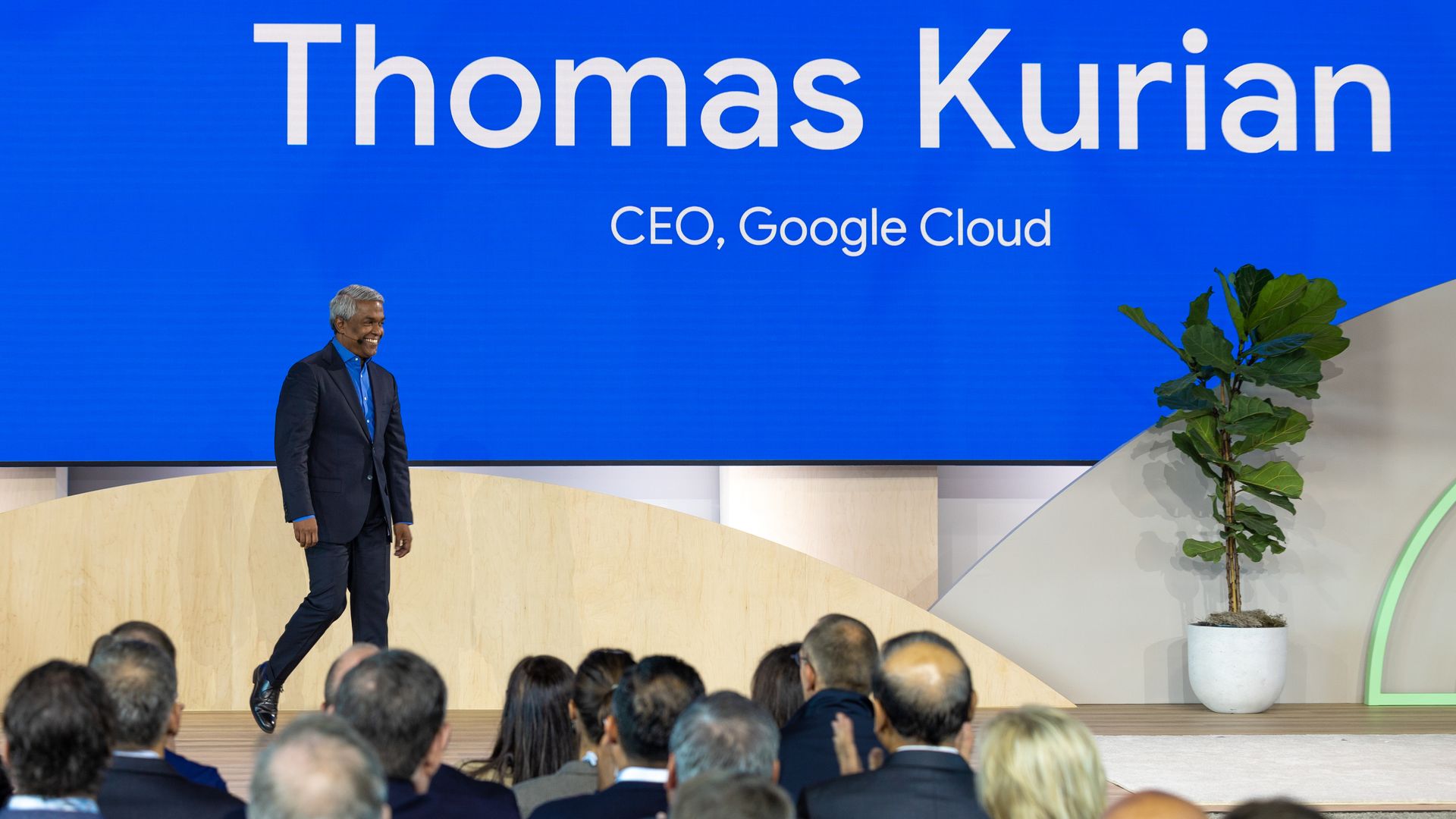
Google Cloud may still trail Amazon Web Services and Microsoft's Azure, but unit CEO Thomas Kurian tells Axios that he has a plan to continue to gain share and — eventually — turn a profit.
The big picture: Google's cloud business has been growing fast, but it trails market leaders Amazon and Microsoft.












/2023/02/27/1677535249325.gif?w=3840)