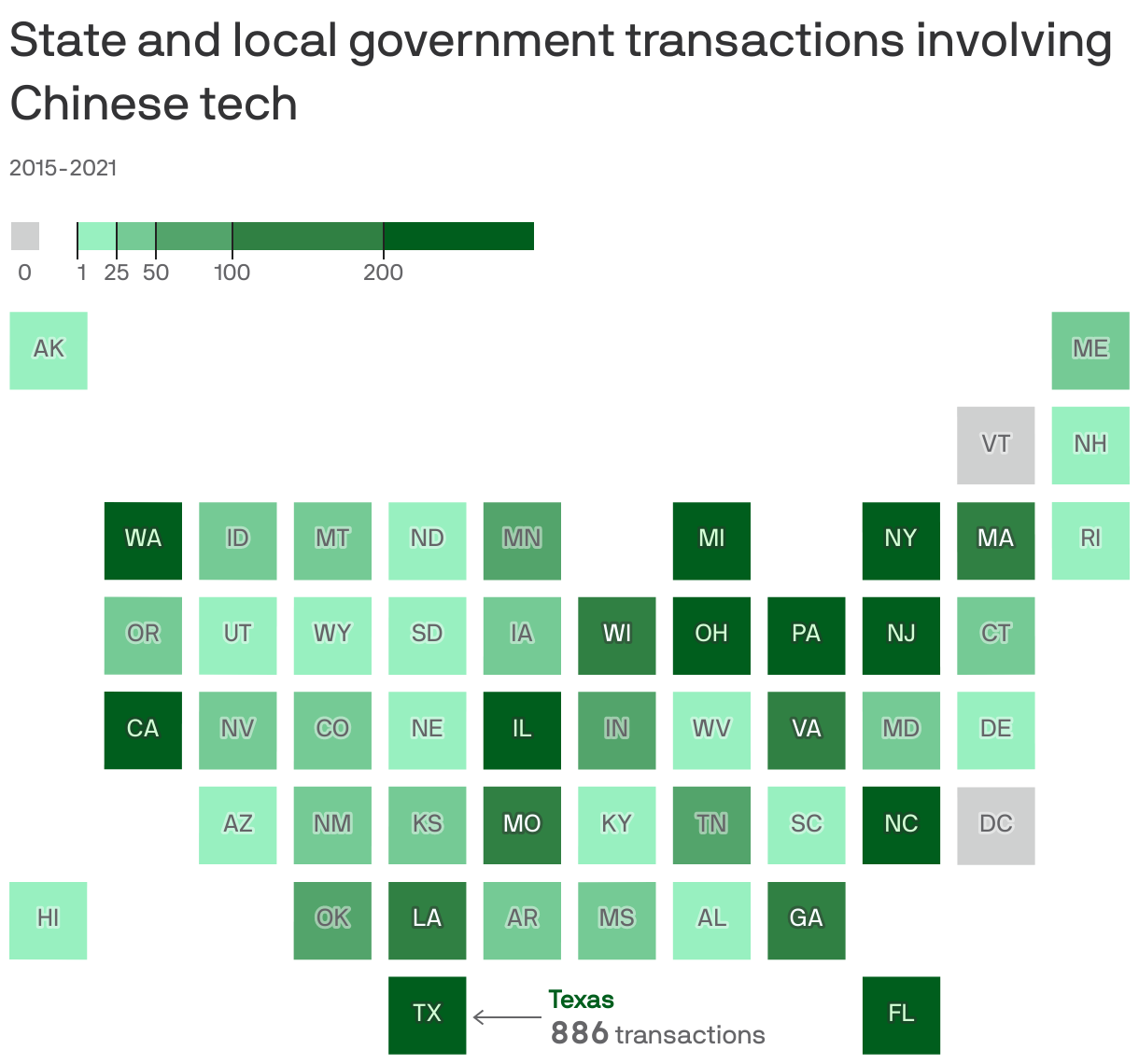
Data: Center for Security and Emerging Technology; Note: Tech transactions refer to information and communications technologies and services from foreign companies that U.S. entities and federal agencies are prohibited from buying; Chart: Simran Parwani/Axios Visuals
Despite federal efforts to block Chinese telecom equipment from U.S. supply chains, state and local governments across the country continued tobuy products designated a threat to national security, a new report finds.
Why it matters: U.S. officials warnChinese telecom equipment could make the U.S. vulnerable to economic espionage or digital sabotage.
Meta shares fell more than 10% Wednesday after the tech giant reported third quarter results that missed investor expectations on earnings, but beat them marginally on revenue and user growth.
Why it matters: After decades of unprecedented revenue and profit growth, Meta's ad business is beginning to slow, thanks to increased competition from TikTok and Apple and overall uncertainty around the economy.
ElonMusk on Wednesday shared a video of himself carrying a bathroom sink into Twitter's headquarters in San Francisco, ahead of the expected close of his deal on Friday.
The big picture: The visit is the latest development in Musk's attempt to buy the social media company for an estimated $44 billion. Here is a timeline of remarks, discussions and dealings in Musk's quest to buy the company.
Researchers at Google-owned Mandiant said in a report Wednesday that they've detected a group attempting to sow division in the U.S. and "operating in support of the political interests of the People’s Republic of China."
Why it matters: Election officials have been on high alert for foreign disinformation campaigns aimed at further dividing the country and casting doubt on the U.S. political system in the weeks before the midterms.
The Biden administration will announce a new 100-day sprint later today aimed at better protecting chemical facilities and manufacturers from cyberattacks, a senior administration official tells Axios.
Why it matters: The chemical sector has been running on cybersecurity regulations that haven't been updated in more than a decade. Those are no longer enough to fend off the sprawling threat facilities face, the official said.
There's a growing fear that political misinformation is spiraling out of control on social media two weeks before the U.S. midterm elections.
Driving the news: Activist groups are sounding the alarm on election-related dis- and misinformation, putting pressure on tech platforms to be more vigilant, per a letter to the CEOs of Meta, TikTok, Twitter and YouTube signed by more than 60 groups and shared exclusively with Axios.
Microsoft on Tuesday reported earnings that narrowly topped analysts' expectations, even as results were hurt by a strong dollar amid strong cloud sales, However, it warned it saw a slowdown in PC sales and ad spending in September that it expects to persist through the current quarter.
Why it matters: Microsoft offers a look into a wide swath of the economy, with its Xbox unit tied to consumer spending, Azure cloud and Office linked to business spending and its Bing business providing insight into online ad spending.
Google's parent Alphabet reported earnings that missed expectations in its quarterly report Tuesday, though touted growth in its search and cloud businesses.
While many people in California felt a moderate earthquake Tuesday, some smartphone users actually got a heads-up before it happened thanks to technology developed at the University of California, Berkeley.
Why it matters: Android warned users just a few seconds before the quake, but experts hope the technology will eventually give people enough time to find shelter or to duck and cover.
Two weeks out from Election Day, U.S. officials are staring down a complex map of election security concerns that go beyond the now-expected foreign hack-and-leak operations.
The big picture: Heading into this year's election, a web of domestic and foreign disinformation campaigns, physical threats to poll workers, and 2020 election deniers running for political office are complicating election security officials' jobs.
Poynter's digital literacy project MediaWise is broadening its training to battle online misinformation in Spanish.
Why it matters: Per a Nielsen report last year, Latinos spend more time than other groups on most social media apps and messaging, where poorly sourced information can go viral and Spanish-language misinformation often sits unchallenged.
Pressure is growing for the U.S. to develop a plan to quickly build internet lifelines for people living in conflict zones or under repressive regimes.
Why it matters: The absence of a strategy has led to a reliance on the ad hoc goodwill of private companies, such as Elon Musk's donation of Starlink satellite internet service in Ukraine.
A majority of people surveyed by creator economy company Patreon say they feel "screwed" by large tech platforms and their algorithms, per a new survey shared exclusively with Axios.
Driving the news: In Patreon's survey of more than 1,500 creators (some of whom do not use Patreon), 70% say they feel social media platforms put them at a disadvantage, but 60% say they are reliant on those platforms to showcase their work.
Two right-wing activists each pleaded guilty in a Cleveland court Monday to single felony counts of telecommunications fraud over false robocalls in Ohio ahead of the 2020 election, prosecutors announced.
Driving the news: Jacob Wohl, 24, and Jack Burkman, 56, were indicted in October 2020 in connection with a scheme that Cuyahoga County prosecutors said targeted thousands of minority voters with pre-recorded messages that falsely claimed they could face mandatory vaccines or be tracked by law enforcement if they voted by mail.