Samsung said Friday it suffered a data breach in late July that exposed some customers' personal information.
Why it matters: This is the second data breach Samsung has confirmed this year following an announcement in March about an attack from the Lapsus$ data extortion group.
A new ransomware gang is starting to ramp up its operations — and its exploits focus on a programming language that makes it harder for researchers to crack.
The big picture: Ransomware hackers have had to get creative to avoid detection as companies have become increasingly aware of the threat and cost these file-encrypting cyberattacks pose.
Cyber defense training for businesses is evolving to create immersive scenarios putting board members and C-level executives in the crosshairs of simulated attacks.
The big picture: As ransomware attacks and nation-state cyber espionage campaigns ramp up, more executives and board members find themselves making key decisions about how their companies respond to cybersecurity incidents.
A year and a half after it was removed from Google’s Play Store, Parler, a Twitter alternative that attracts conservatives, has returned to the showcase for Android apps.
Why it matters:Google removed Parler following the Jan. 6 Capitol attack, which was incited by misinformation and violent speech online.
The word "competition" has a different meaning in Washington and other centers of regulation around the globe than it does in Silicon Valley.
How it works: The same actions that industry leaders see as part of the natural process of business competition — acquiring startups, keeping customers inside their existing ecosystems and trying to dominate new platforms — sound alarm bells to regulators and legislators.
Apple has quietly beefed up the malware-fighting capabilities of the Mac by tweaking the system software to scan for malicious apps more proactively, as noted by Ars Technica and others.
Why it matters: Like all elements of computer security, fighting malware is a cat-and-mouse battle. While the Mac has traditionally had fewer problems than Windows on this front, the Mac also gets less attention from commercial anti-spyware software, putting more pressure on Apple to keep its systems clean.
If automakers want their electric cars to qualify for newly revised federal tax credits, they must be able to certify the provenance of their batteries — potentially through the use of a "battery passport."
Why it matters: Strict supply chain requirements attached to the Inflation Reduction Act's restructured electric vehicle (EV) tax credits were meant to catalyze domestic manufacturing and bolster U.S. energy independence.
A rising percentage of critical minerals must be mined or processed in the U.S. or a trading partner, for example, for a vehicle to qualify. None of the materials can come from "foreign entities of concern," like China or Russia.
House Speaker Nancy Pelosi (D-Calif.) does not support the most recent federal data privacy bill in its current form, she announced Thursday.
Why it matters: The proposal has won bipartisan support and is farther along than any other recent privacy legislation, but without Pelosi's backing, lawmakers working to pass such a law face a much more uphill battle.
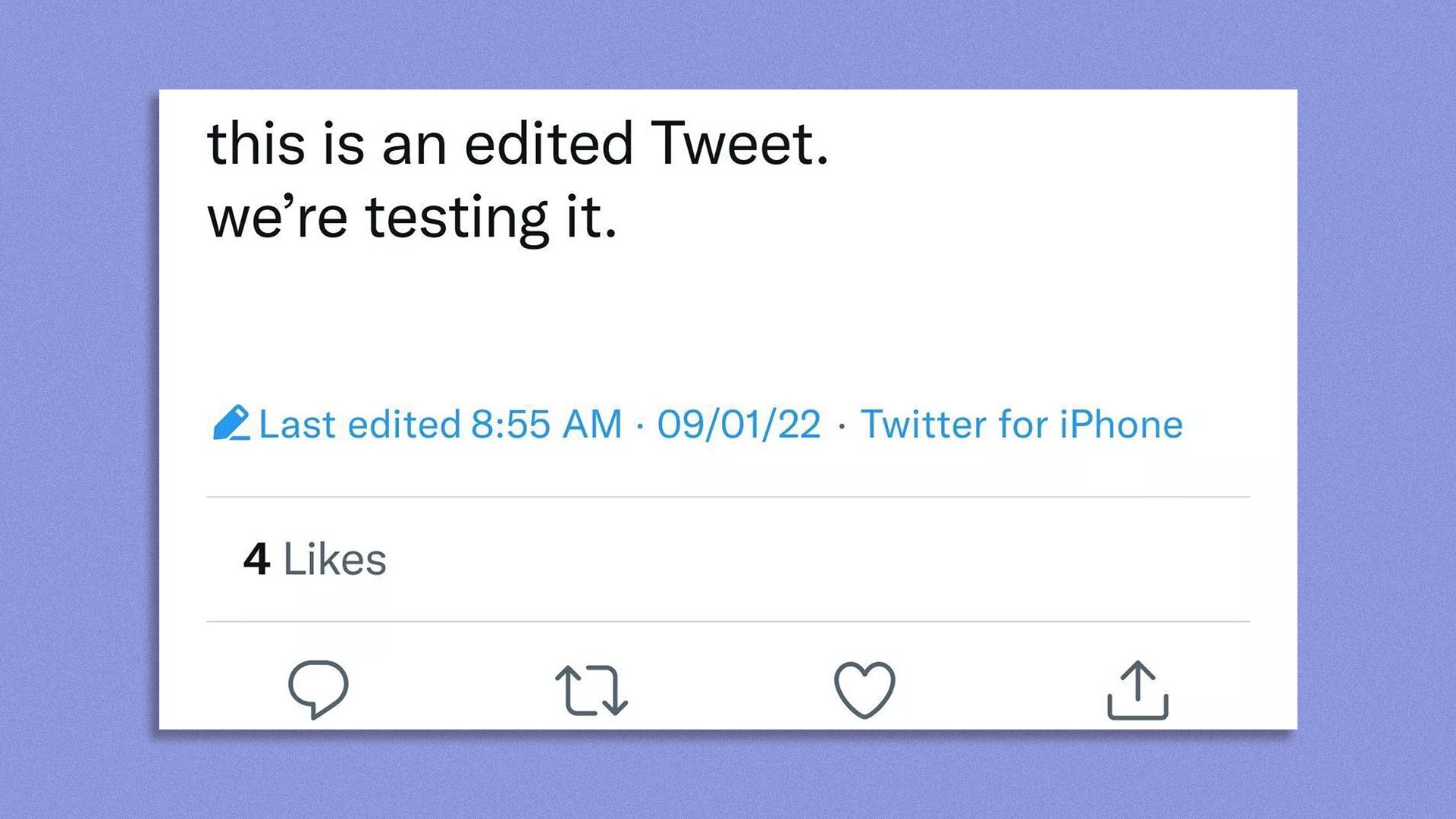
Twitter announced Thursday it has started internal testing of a long-requested feature that will allow people to edit tweets after they are sent.
Be smart: Such a feature has topped customer requests for years, but the tricky part is allowing edits without opening the door to spam and misinformation.
The phenomenal and speedy rise of TikTok has made the short-video-sharing platform the latest and most-likely-to-succeed front-runner in the race to join tech's inner corporate circle.
Why it matters: TikTok's vast pool of users, fine-tuned content algorithm and accelerating cash machine have made it the upstart that most spooks Facebook, which started copycatting TikTok's format in 2020.