Eager to show progress on the pledge to make its platform and business anti-racist, Uber on Friday announced new anti-racism driver and rider campaigns, as well as fresh internal hiring practices, Axios was first to report.
Why it matters: Uber is one of the biggest ride hailing companies in the world. Its decisions impact the millions that use the platform, where drivers and riders alike say they have experienced racism.
Housemarque, a 26-year-old video game development studio in Finland with a reputation for pushing the limits of PlayStation hardware, is making a comeback with its recent PS5 release “Returnal.”
“I think we're now finally understanding what we can do,” Housemarque marketing director Mikael Haveri told Axios.
The iconic spacefaring adventure "Mass Effect" is back today with "Mass Effect: Legendary Edition," a single, remastered version of all three games.
Why it matters: There is no series like "Mass Effect" — even when it comes to BioWare's other choice-driven RPGs like "Dragon Age." "Mass Effect" is a big ol' space adventure first and foremost, but it’s also about loyalty, love, and tough calls.
Why it matters: In a message from a cybercrime forum, the group said it had lost access to the infrastructure needed to carry out its extortion operations and that a cryptocurrency account it uses to pay its affiliates had been drained.
Facebook lost on Friday in its attempt to block a European Union privacy decision related to how it sends data about EU users back to the U.S.
Driving the news: Ireland's High Court dismissed procedural complaints from Facebook about a decision it had made about the data transfer last August, rejecting the platform's argument that the EU's judgment was made too hastily.
Apple is swatting down criticisms about how it runs its App Store, arguing its policies are just like those of its peers, in a new letter to senators today.
Between the lines: Apple is making similar arguments to Congress to the ones in its defense in the Epic Games lawsuit — namely, that it has the right to run its marketplace as it sees fit, and that companies and consumers that don't like it have alternatives.
Big Tech companies, led by Google, filed an amicus brief in federal court Fridaymorning in support of the spouses of certain H-1B high-skilled visa holders, whose ability to work in the U.S is being threatened in court.
What they're saying: In the brief, tech giants like Microsoft, Apple, Adobe and Amazon argue that removing the ability of more than 90,000 H-4 visa holders to work, "would result in these talented individuals being barred from the workplace" and "would be utterly destructive for the families impacted."
The nonprofit world is pouring money into efforts to get qualified science and technology experts into posts in federal and local government.
Driving the news: The Day One Project, an initiative backed by the Federation of American Scientists, has raised $650,000 with an ultimate goal of raising $4 million to send people on "tours of duty" in the federal government.
Those people will be working on projects including technology modernization, climate change and pandemic response, according to an announcement exclusively shared with Axios.
The Knight Foundation also announced this week a $1 million investment in Code for America to fund training for "Tech Brigades" working for local government in Miami, Charlotte, Detroit, Philadelphia, San Jose, St. Paul and Boulder.
The big picture: These are the latest in a long series of efforts to get tech experts into the federal government.
The Day One Project's program, called the Day One Talent Hub, aims to be a resource for getting qualified experts into public service. Such efforts are often too time-intensive and complicated for federal agencies to take on themselves.
The Biden administration has shown an appetite for modernizing the federal government and investing in research and development, said Matt Cutts, who left his post as administrator of the U.S. Digital Service in April. "It seems like this administration is receptive to ways to use technology and design to improve delivery to the American public."
What they're saying: "Frankly, we need a full court press with all different kinds of initiatives because it's unclear what the best or right way is to bring people in. But the the more exposure we can get between the worlds of technology and government, the better it is for everybody," Cutts said.
The Day One Project, which has published policy proposals and memos for the Biden administration, will place experts in temporary government jobs through the Intergovernmental Personnel Act Mobility Program, which helps place people in temporary government jobs.
"For many talented people, a period of public service can be the most impactful and satisfying part of their career,” said Arati Prabhakar, former director of the Defense Advanced Research Projects Agency and Day One Project council member.
Ireland's public health care service preemptively deactivated its IT services on Friday after it was targeted by a ransomware attack, according to the AP.
Why it matters: The attack on Ireland's Health Service Executive, and other recent high-profile cyber extortion attempts, demonstrates how vulnerable critical infrastructure is to criminal hacking groups.
President Biden's promise to cut the price of Americans' internet bills has provoked a fierce lobbying campaign by cable and telecom companies to prove that the cost of broadband has already dropped.
Why it matters: Internet providers are desperate to fend off any move to regulate the prices they charge, while the government is increasingly viewing connectivity as an essential service.
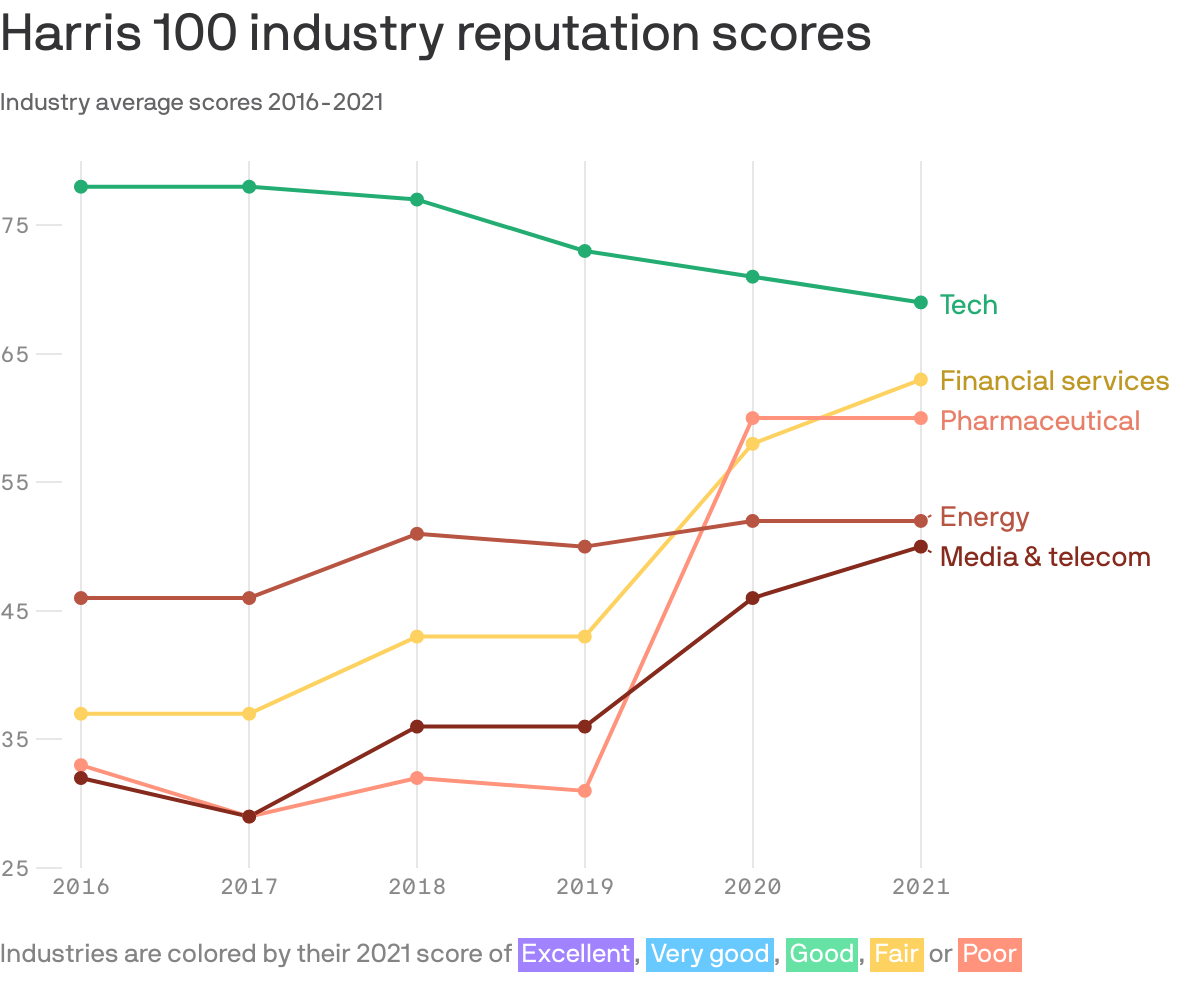
Most industries' reputations are improving, according to the latest Axios/Harris 100 poll — but Big Tech is the big exception.
Driving the news: The financial services, telecom and pharmaceutical sectors all gained ground with the public this year, while the biggest tech companies saw their reputations erode.