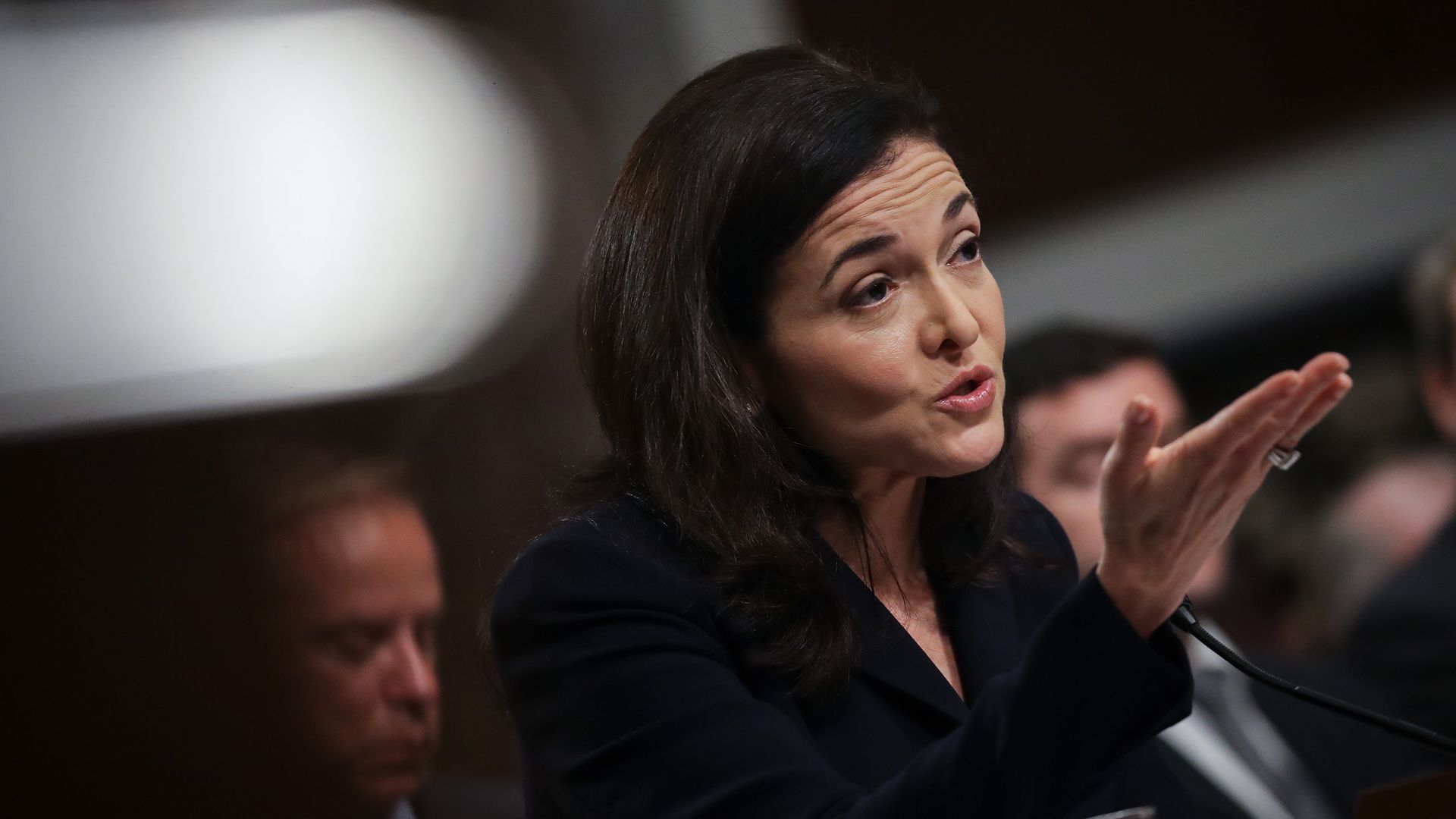
Facebook stayed in the news this week as COO Sheryl Sandberg met with a civil rights group and her story continued to shift on her involvement with a political consulting firm's work. Here are five other stories in tech news this week that may have gotten lost in the Facebook drama.
The internet has become a fundamental requirement of modern life. For those with comfortable incomes, living in cities or suburbs, connectivity and information can seem ubiquitous.
Reality check: According to a 2017 report from the Brookings Institution, less than one-fifth of Americans live in a neighborhood where at least 80% of the residents have broadband.
Although the choice between iOS and Android may sometimes seem like a question of aesthetics, the reality is that the different business models of Apple and Google lead to fundamental differences for your privacy.
Why it matters: Because of the way Google monetizes user data, Android phones can cost hundreds of dollars less than iOS devices. The more you spend, the more likely you are to use a device with more privacy protection and less data collection.
The federal government's efforts to provide ubiquitous internet access have had varying levels of success.
Why it matters: Congress mandates that the FCC take "immediate action" if advanced telecom capability is not being deployed to "all Americans in a reasonable and timely fashion." Chairman Ajit Pai says closing the digital divide is his top priority, but the FCC can't compel ISPs to expand networks; it can only offer incentives to do so.
Google Hangouts will shut down sometime in 2020, according to a scoop from 9to5Google.
Why it matters: Hangouts had lost some of its footing on the instant messaging medium since its rename and redesign from GChat that started in 2013, and has overall slowed its app development. A handful of other chat mediums that have launched since then, and workplace behemoth Slack surpassed 8 million daily paid users in May, per TechCrunch.
As of market close on Friday, Microsoft is the most valuable U.S. public company with a market valuation of $851.2 billion, per CNBC.
The backdrop: Microsoft had been closing in on Apple throughout the week during intraday trading, but as of Friday's close, Apple's market valuation lagged behind at $847.4 billion. This year alone, Microsoft surged past Amazon and Google parent Alphabet.
Marriott announced Friday that up to 500 million people might be affected by a data breach of the Starwood properties guest reservation system. But it's harder than ever today to interpret a first estimate —"up to 500 million" could mean 500 million, nearly five hundred million, or substantially less.
The big picture: The new privacy law in the European Union, the General Data Protection Regulation (GDPR), requires companies to notify government agencies about breaches almost immediately. Gone are the days where a company can do a full investigation before announcing a breach, and that means most are likely to overestimate until better facts come in.
There were fewer cars and more tech on display at this week's preview of the Los Angeles auto show — a sign that automakers are shifting their strategy to shared but personalized autonomous transportation.
Why it matters: The auto industry is moving away from gasoline, steering wheels and personal ownership as cities get more crowded and polluted and people look to avoid the hassles of owning a car. The transition is going to be rocky for many traditional auto manufacturers, as we've seen at GM this week, but the consensus in L.A. is that personal mobility is approaching a tipping point.
The AV industry has largely focused on the best technology for the cars themselves, not the roadblocks that current infrastructure will present to their deployment.
Why it matters: We may soon find ourselves with functional AV technology, but infrastructure so poor that in many places AVs cannot be safely deployed. The U.S. needs both basic improvements to its roads — to the tune of as much as $1 trillion — and also investment in a new generation of infrastructure that is smarter, more responsive and more sustainable.
Up to 500 million guests who made reservations at Starwood properties around the world since 2014 may have had their personal information compromised after a data breach by "an unauthorized party" targeted its guest reservation system, Marriott announced on Friday, per the Wall Street Journal.
Details: The compromised information includes "names, addresses, phone numbers, email addresses, passport numbers, and travel details" for two-thirds of those affected, according to the WSJ. And Marriott couldn't definitively state that card payment information hadn't been stolen as well, though it noted that information is usually encrypted.
Despite rising concern in both Silicon Valley and beyond about screen time overload, a new Pew Research Center report shows a large majority of teenagers believe using social media is good for them.
Why it matters: A lot of research into the relationship between young people and social media has drawn negative conclusions: social media is anxiety-inducing, creates unrealistic body images, and promotes cyberbullying and ideological bubbles, BuzzFeed reports. But teens themselves apparently disagree.
Facebook COO Sheryl Sandberg keeps adjusting the story she tells about controversies involving the company and billionaire George Soros, a frequent recipient of anti-Semitic attacks. Specifically at issue is her role in the company's reaction to criticism from Soros and in the company's relationship with a consulting firm that linked the social network's critics to him.
Why it matters: Sandberg’s boss, CEO Mark Zuckerberg, has stood by her thus far. But the flow of new revelations about what she knew, and what she did, are further fraying the company's reputation.
Facebook will release an early report on an audit of civil rights on its platform by the end of the year, according to an advocacy organization that demanded the move in a meeting with COO Sheryl Sandberg Thursday.
The bigger picture: The social network hasn’t yet fulfilled any of the other requests made by the group, called Color Of Change, which has asked Facebook to:
fire its top policy executive, a former Republican staffer
release data on voter suppression attempts on Facebook products
release opposition research that a right-leaning consulting firm produced trying to link the civil rights group to liberal billionaire George Soros
Google made headlines for walking away from a contract to provide intelligent software for the Pentagon — but its hesitation, a response to a staff uprising, may be an anomaly rather than an omen.
Increasingly, big tech companies and startups are flocking to show military and security officials their wares for everything from surveillance and detecting fake content to disaster relief.
In two decades, Amazon has erupted into one of the most successful juggernauts in history, pushing forward absent any apparent limits to its horizons, including this week into high-end computer chips. But its pathway has become decidedly more bruising, straddled by a groundswell of public recriminations in both the U.S. and Europe.
Why it matters: While it marches from industry to industry, Amazon has become a larger target with more dangerous enemies. "Any regulator that doesn't have one eye on Amazon is not doing their job," says Timothy Wu, author of "The Curse of Bigness."