Thursday's technology stories

House Democrats blast Google memo on diversity
Democratic lawmakers are joining the vocal critics of an internal memo at Google that claimed women aren't naturally suited to tech jobs:
- The memo written by engineer James Damore "highlights how far the tech community needs to go to address gender and racial stereotypes," said Rep. Ro Khanna, who represents part of Silicon Valley.
- Four other Democratic House members wrote a letter to Google CEO Sundar Pichai praising the decision to fire Damore. "We ask that Google remain committed to aggressively promoting a culture of diversity and inclusion in its workforce, and address our concerns in an expeditious manner," they wrote.
The bigger picture: What started as an internal memo has become a political debate. Democrats are pushing Silicon Valley to double down on its efforts to increase diversity in its workforce. Meanwhile conservatives are upset that Google decided to fire Damore — something they see as more evidence of Silicon Valley's left-leaning bias. Google declined to comment.

Uber's first employee and original CEO resigns

Ryan Graves, Uber's first employee and original CEO, has resigned from his current post as VP of operations, according to an email sent to employees on Thursday and obtained by Axios.
- Despite stepping down from an operational role, Graves will remain on Uber's board of directors, which has been searching for a new CEO since the June resignation of Travis Kalanick.
- Graves wrote in reference to the company's current search for a CEO: "My hope is that ensuring my transition is known and planned for well before our board's decision on CEO it will help to make it clear to our team and to our new leader that I will be there to support however I can."
- This is a bit surprising given that Uber sources had recently referred to Graves as re-engaged in Uber operations, after having been viewed as largely absent in the months leading up to Kalanick's resignation.
Lyft tries to boost growth while Uber is distracted
Taking advantage of rival Uber's ongoing challenges (it's currently rushing to hire a new CEO and a slew of other execs), ride-hailing company Lyft has acquired two companies, YesGraph and DataScore, to boost its market growth.
What's in it for Lyft: Despite its claims of rapid growth, Lyft is still a distant No. 2 to rival Uber as far as market size. But with a recent injection of funds and a competitor currently distracted by internal matters, this may be its opportunity to use a heavy dose of tech to get ahead.
The companies: Founded in 2012 and with more than $2.30 million in total funding, YesGraph has built tools for app referrals best on a user's phone contacts. Lyft says that YesGraph's technology will help it improve its driver referral program—meaning helping it get better at recruiting new drivers. Then there's DataScore, which was founded in 2013, and provides consulting services and tools for customer growth to startups. Lyft declined to disclose the acquisition prices.

How The Mooch brought Monica Lewinsky into his drama
Anthony Scaramucci seemingly alleged on Twitter last night that The New Yorker's Ryan Lizza had recorded him without his permission, calling him "the Linda Tripp of 2017. People know. And he is up at night not being able to live with himself." In this analogy, The Mooch inadvertently compared himself to Monica Lewinsky, who then responded to his tweet this morning:
Think back: Linda Tripp was a civil servant who befriended Monica Lewinsky in the early 1990s when they worked together at the Pentagon, eventually secretly recording phone conversations with Lewinsky where she described a sexual relationship with President Bill Clinton.
The startup behind Facebook's strategy to thwart competitors
One of Facebook's most underrated acquisitions is Onavo, which it bought in 2013. The company was highlighted in a recent Wall Street Journal report on how Facebook, to maintain its influence over the years, has been vigilantly acquiring or copying potential threats to its own products.
Why it matters: Facebook is notorious for building copycat apps and features in an attempt to stifle up-and-coming social media services, though its standalone apps have largely flopped. A year ago, it made headlines when Instagram, which it owns, released a copy of "Stories," one of ephemeral messaging app Snapchat's signature features. Since there, some have speculated that Instagram has successfully stolen some of Snapchat's users—a problem for newly-public parent company Snap.

Facebook is launching a TV-like video feature
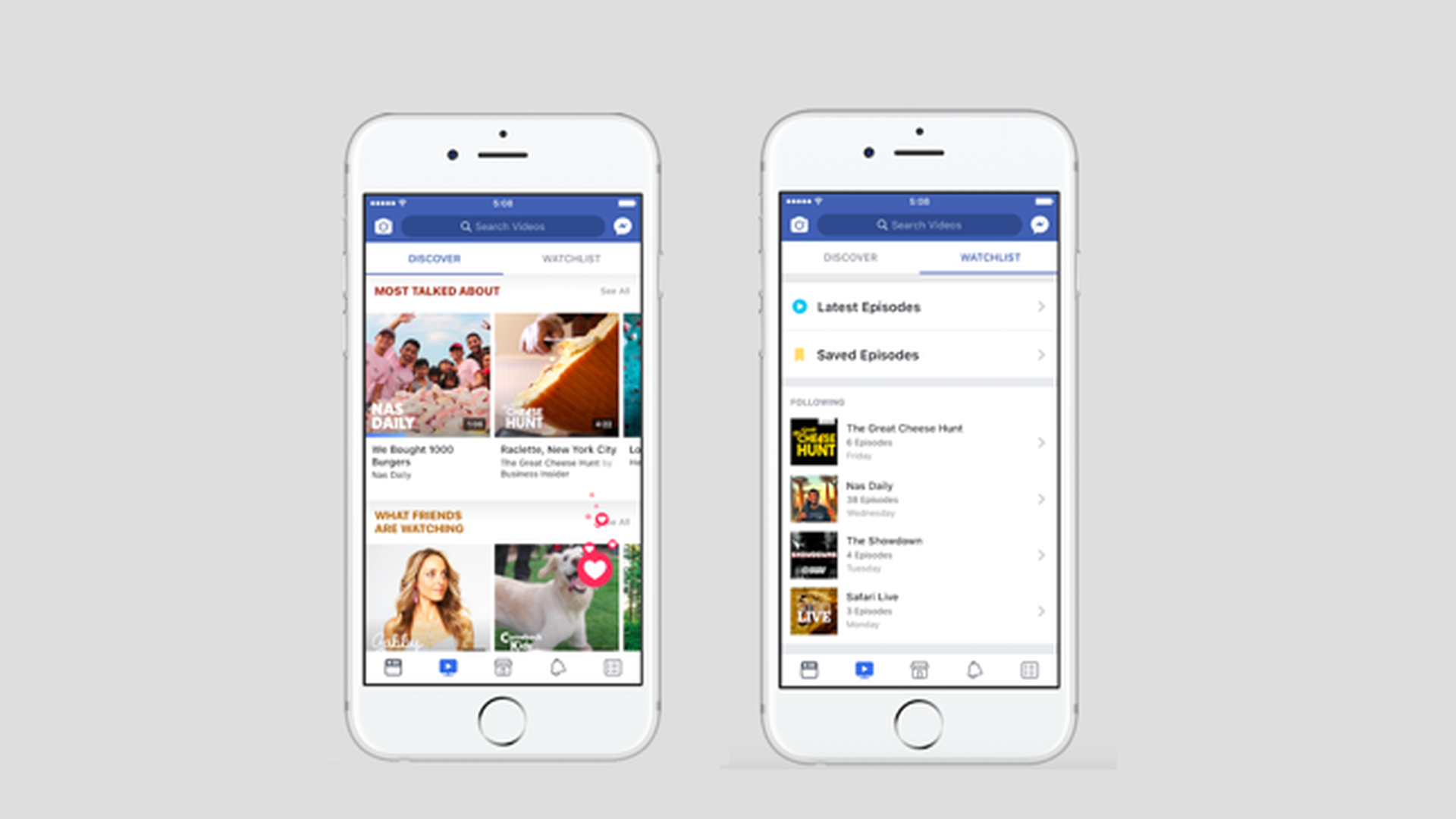
Facebook is rolling out "Watch," a new platform for original and licensed TV-like programming on Facebook — available on mobile, desktop and in TV apps. Facebook will partner with digital websites, sports leagues and personalities to deliver live and scripted programming. (See what shows they're announcing below.)
The aesthetic of the new feature undoubtedly riffs off of rival Snapchat's successful mobile video platform, Discover, but here's how it's different:
- More personalized: Facebook's platform will be organized by themes and personalized the same way the News Feed is personalized — around family, friends and interests, to help users discover new content.
- More social engagement: It will allow for comments and reactions so users can engage with each other, and it will show you what your friends are watching
- Accessible on TV: It will be accessible via a TV app and multi-device as opposed to Snapchat which is mobile-only.
Our thought bubble: From the TV/multi-device perspective, "Watch" seems like it could be more of a competitor to YouTube than perhaps anything else. It will include both long and short-form content and will feature a range of highly-produced to low-cost content.
Why it matters: Facebook is officially going after the TV market. It will offer users access to TV-like shows that they can watch on any screen, and it will allow Facebook to win over ad dollars typically spent on cable and broadcast. It's also another copycat feature that will likely slow Snapchat's user growth and audience engagement.
Shows:
- Nas Daily will be a daily show where Nas makes videos together with his fans from around the world.
- Gabby Bernstein, a New York Times bestselling author, and motivational speaker will use a combination of recorded and live episodes to connect with fans and answer questions in real time.
- Tastemade's Kitchen Little that will feature a new child, a new chef, and a new recipe each episode.
- League Baseball is broadcasting a live game weekly on Facebook.
A number of digital sites, like Quartz, Cheddar, Buzzfeed and The Atlantic, have also announced that they are going to be running video content on the platform. Here's what we know about their shows:
- Quartz will be presenting several shows that follow compelling characters and groundbreaking science shaping the future of the global economy.
- The Atlantic is creating two new video series for Facebook's Watch platform that will release this fall. They also expect to make other Atlantic Studios content -- like their regular series like You Are Here and Unpresidented, or longer documentaries -- available on Watch.
- Cheddar announced that it will have a Show Page on Facebook's new Watch platform that will be rolled out to users in the coming weeks.

Tech's tolerance problem
The "think different" tech crowd is developing a habit of blowing up people who actually do think differently.
- The latest example is the internal memo from (now former) Google engineer, James Damore, questioning the company's diversity efforts and women's affinity for engineering. Damore's memo — and Google's decision to fire him — triggered outrage.
- Those offended by the memo branded it as sexist, misogynistic, and counter to the equality goals that tech companies like Google strive for. Those who supported his views, or at least his ability to express them, called his firing a form of censorship and harshly criticized Google's ouster of someone who strayed from the corporate correctness.
- Why it matters: Tech's well-documented diversity problems appear to have revealed a deeper cultural crisis. Companies have worked hard — and spent hundreds of millions of dollars — to project an aura of diversity and inclusion, but those efforts have sparked a backlash.
Google memo outcry is about something bigger
Google has spent the past week embroiled in controversy, following the leak of an internal memo that included arguments about how the company's lack of gender parity can be partially explained by biological differences between the sexes. The memo's author was quickly fired for "advancing harmful gender stereotypes in [Google's] workplace."
Story behind the story: The loudest outcries invoked the memo's specific contents and the employment fate of its author. But I suspect that the weightier undercurrent from women who work in Silicon Valley — especially from those with Google on their resumes — is that the incident is a reminder of all the other wrongs and inequities at Google that predate the memo, and of those that they fear will persist.

The chatbots in our future

Led by China, tech companies are pushing into a voice-and-chat future in which we will rarely get a human on the phone for our banking or shopping question. And when we do, our egos will be massaged by emotionally intelligent bots that will advise call center reps how to handle our complaints.
WeChat, a wildly popular mobile app made by Tencent, is part of the daily lives of an estimated hundreds of millions Chinese. By comparison, talking apps, many built on machine-learning platforms, are only beginning to penetrate working and playing lives in the West.
Why it matters: Robotic chat is coming, and it may be fast — we will increasingly buy our stuff, and conduct our personal and work lives, through voice-command apps and artificial intelligence-trained chatbots. What we may not have expected is the degree to which non-human, intelligent bots will look over our shoulder and offer up helpful suggestions while we are at work.