The Senate unanimously passed a resolution Thursday to provide backpay to federal workers affected by the partial government shutdown.
"I had an opportunity to talk to President Trump a moment ago and wanted to indicate to our colleagues that he will sign the bill that we've been discussing here to guarantee that government workers displaced as a result of the shut down will ultimately be compensated"
— Senate Majority Leader Mitch McConnell
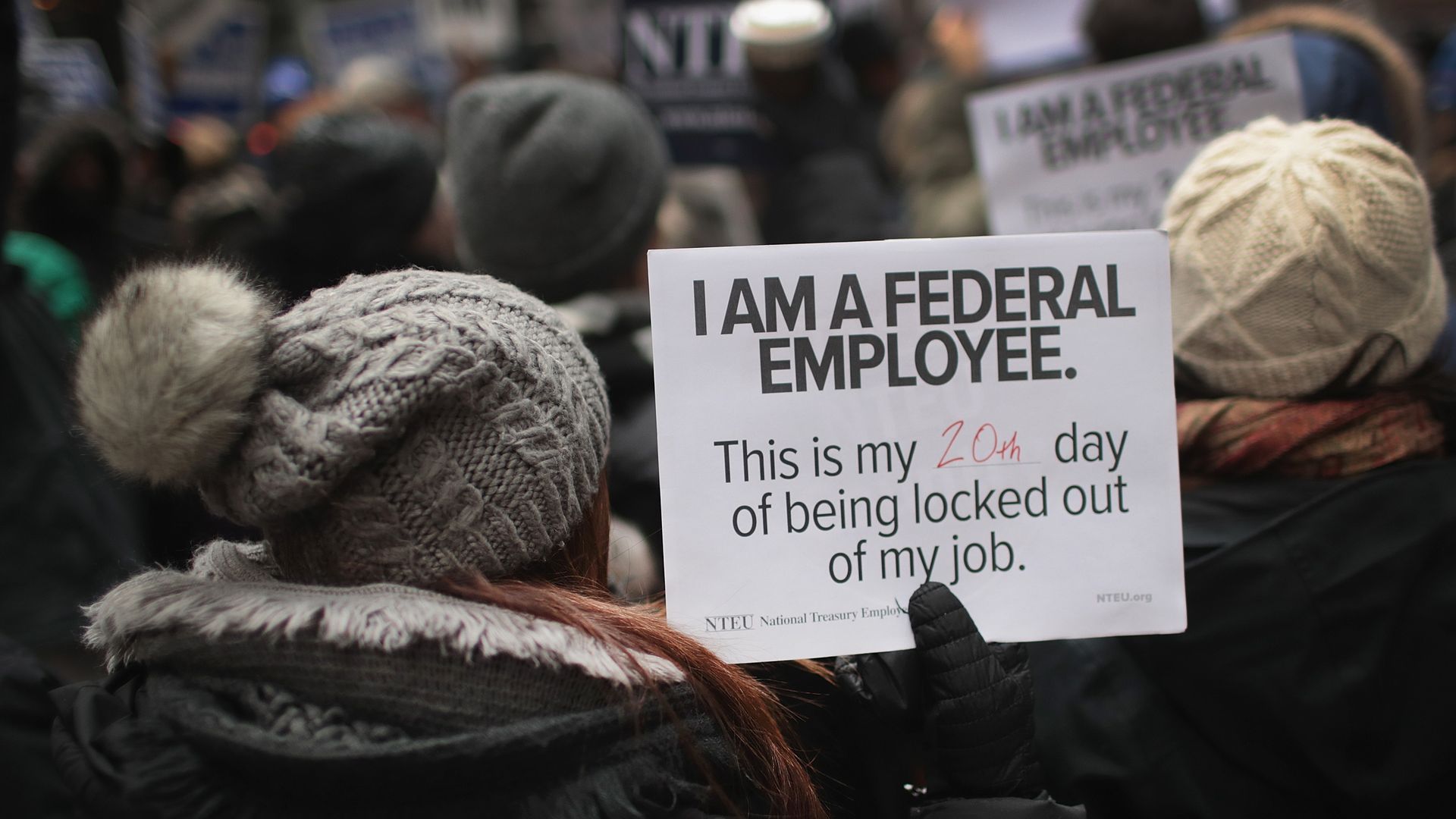
Why it matters: This will provide some level of assurance to federal employees who are working during the shutdown that they will eventually be paid, but it doesn't erase the difficulties they may face paying off bills or loans. And on the 20th day of the shutdown, there is still no end in sight.
Shutdown negotiations don't seem to be improving during President Trump's visit to the southern border.
The big picture: Federal workers miss a paycheck tomorrow, three weeks into a shutdown that's raging over a $6 billion funding request that Trump threw into the process in the final days of unified Republican control in D.C. The federal discretionary budget is just under $1.4 trillion in 2019. Republicans had complete control of Congress and the White House for two years.
The House approved two appropriations bill Thursday to reopen the Departments of Transportation, Housing and Urban Development, Agriculture and other agencies.
Why it matters: 12 Republicans broke with GOP leadership and President Trump to fund HUD and the Department of Transportation, while 10 voted to approve the agriculture appropriations bill. On Wednesday, only eight House Republicans voted to reopen the government, suggesting that pressure is mounting on the GOP to do something to end the 20-day stalemate.
House Republican conference chair Liz Cheney condemned remarks made by her GOP colleague Steve King Thursday as "abhorrent" and "racist," and said they "should have no place in our national discourse."
The backdrop: In a New York Times article about his hard-line views on immigration, King was quoted as saying, "White nationalist, white supremacist, Western civilization — how did that language become offensive?” After the article was published, King issued a statement rejecting the notion that he's a racist, claiming that he considers himself "simply a nationalist" and an advocate for Western values.
The Taliban canceled its scheduled peace talks with U.S. officials this week in Qatar, following an encouraging meeting between senior U.S. and Taliban representatives in the UAE several weeks ago. The Taliban objected to Washington’s desire to include Afghan officials in this round, who were not present at the last meeting.
The big picture: The cancellation underscores the daunting challenge of launching peace talks in Afghanistan. The Taliban refuses to talk to Kabul until Washington reaches a deal with the insurgents on the departure of U.S. forces. Washington has expressed a willingness to discuss the troop issue with the Taliban, but it also wants Kabul to talk to the Taliban as soon as possible to ensure that the Afghan government isn’t written out of the script of its own reconciliation process.
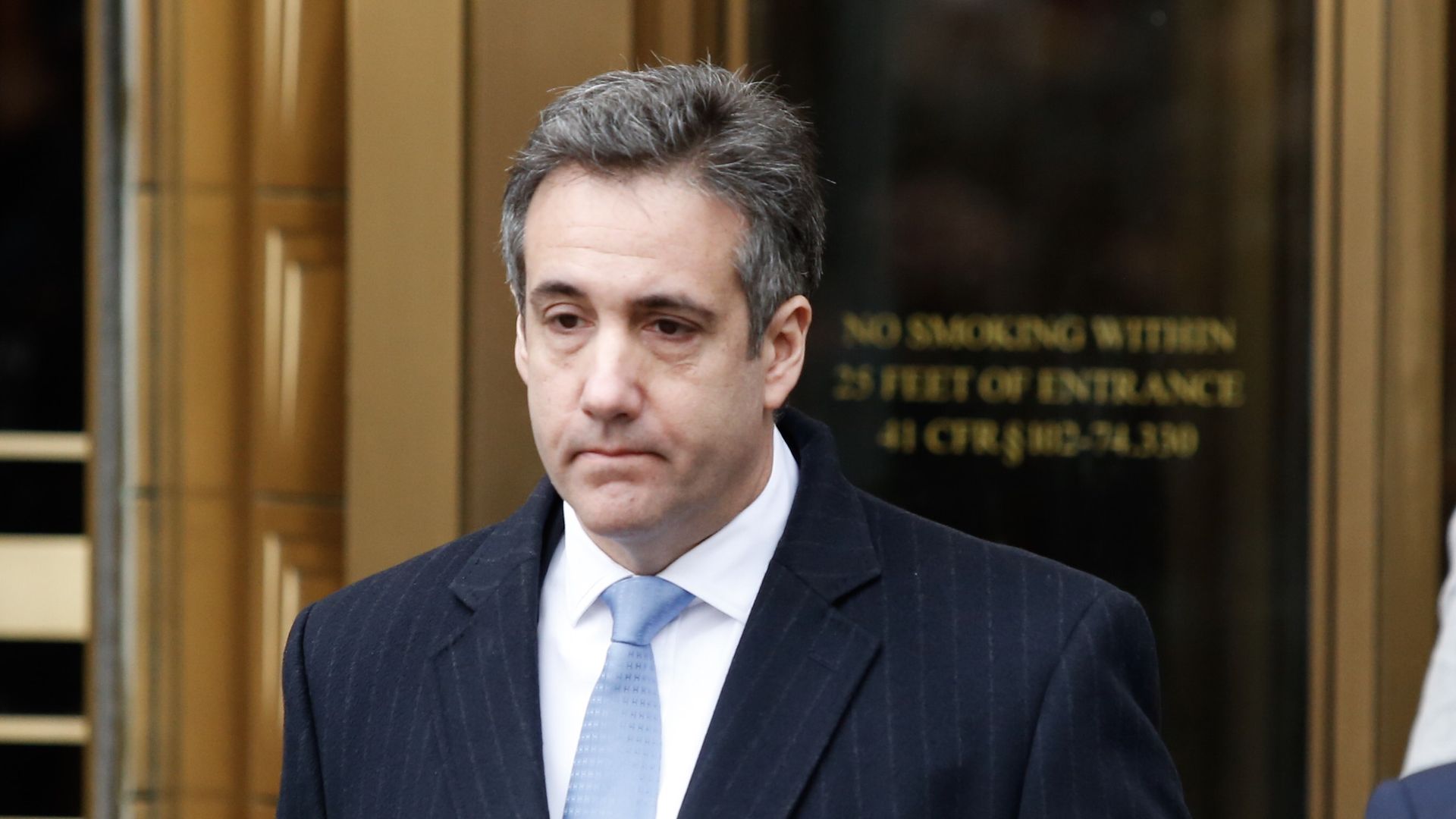
President Trump's former personal attorney Michael Cohen will testify voluntarily before the House Oversight Committee on Feb. 7.
Why it matters: Cohen was sentenced to three years in prison last month after pleading guilty in the Mueller investigation, including on charges that he lied to Congress about the extent of his work on plans to build a Trump Tower in Moscow. Cohen is also expected to face questions about his campaign finance violations and whether President Trump directed him to pay off women with the express purpose of influencing the 2016 presidential election. Cohen said Thursday that he would like “to give a full and credible account of the events that have transpired.”
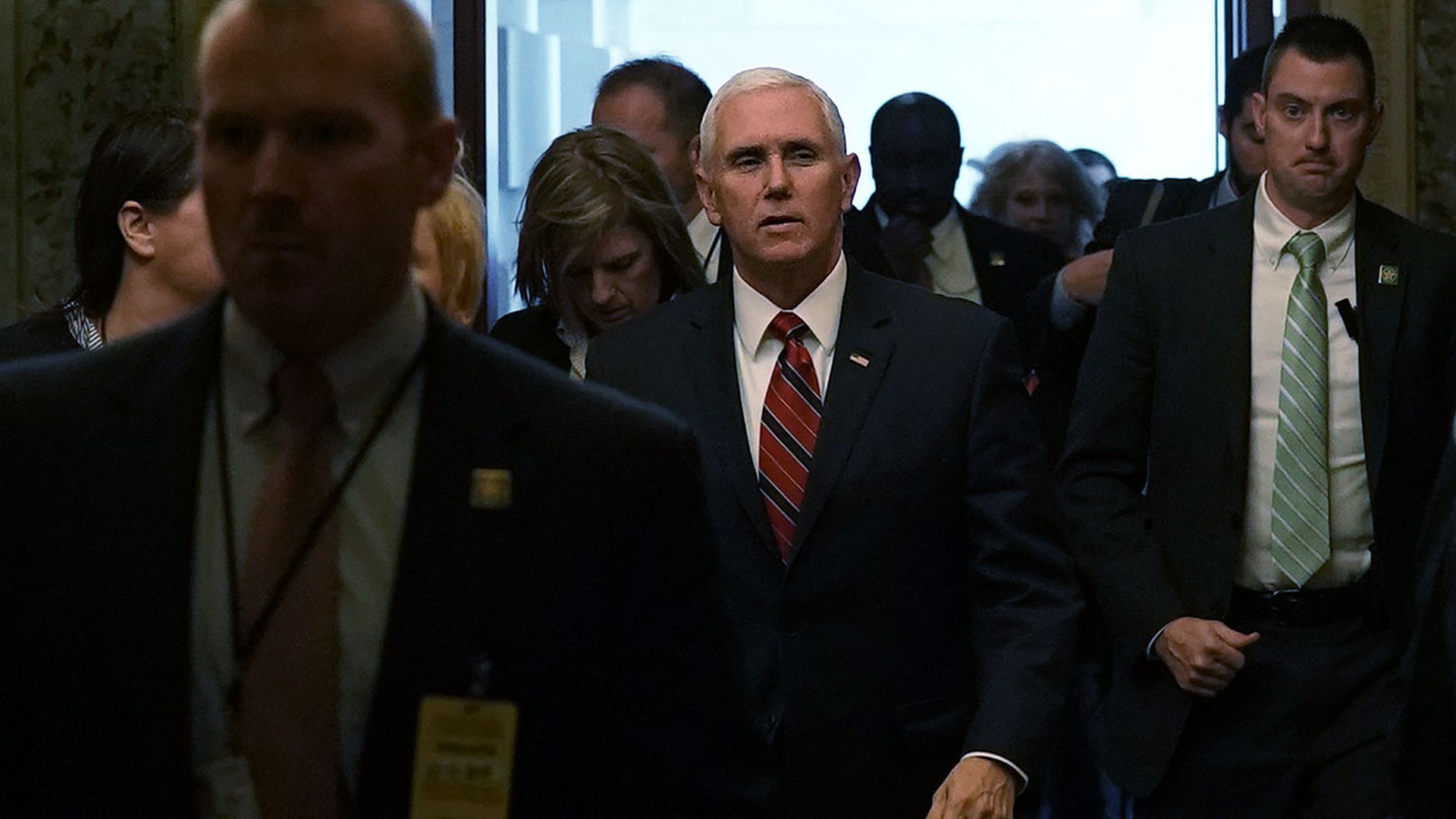
In a briefing with Capitol Hill reporters Thursday afternoon, Vice President Mike Pence made it clear that the Trump administration won't give in on wall funding, but said that Trump “has made no decision” as to whether he’ll declare a national emergency. He also suggested that the administration does not want to trade DACA protections for wall funding.
“It’s time for the Democrats to start negotiating ... if there’s no wall, there’s no deal.”
Between the lines: This doesn’t leave much room for negotiation, as protecting Dreamers is Democrats' most urgent immigration priority. Instead, Pence's comments reinforced that the administration's strategy is to say Democrats aren't negotiating, placing blame for the prolonged shutdown with them.
President Trump announced in a Thursday tweet that he is canceling his planned trip to the World Economic Forum in Davos, Switzerland later this month as a result of the ongoing partial government shutdown.
"Because of the Democrats intransigence on Border Security and the great importance of Safety for our Nation, I am respectfully cancelling my very important trip to Davos, Switzerland for the World Economic Forum. My warmest regards and apologies to the @WEF!"
The big picture: Axios' Alayna Treene and Jonathan Swan reported Wednesday that a big Trump administration contingent — 8 Cabinet members, along with Trump himself — was set to head to Davos, but noted that the optics of attending during the shutdown could cause that number to shrink.
Treasury Secretary Steven Mnuchin will appear before the chairs of seven House committees in a classified briefing Thursday afternoon on the administration’s decision to lift sanctions against Russian aluminum giant Rusal. The decision along with its accompanying deal would reduce oligarch Oleg Deripaska’s ownership stake and control of the company (Deripaska has been linked to Paul Manafort).
Why it matters: If Congress demands answers to the right questions, it could improve Russia sanctions policy, but Rusal makes for a poor target. The Treasury Department has repeatedly delayed implementing the sanctions in order to avoid a catastrophic break with European allies, whose high-end manufacturers depend on Rusal for aluminum and cannot easily find new suppliers.
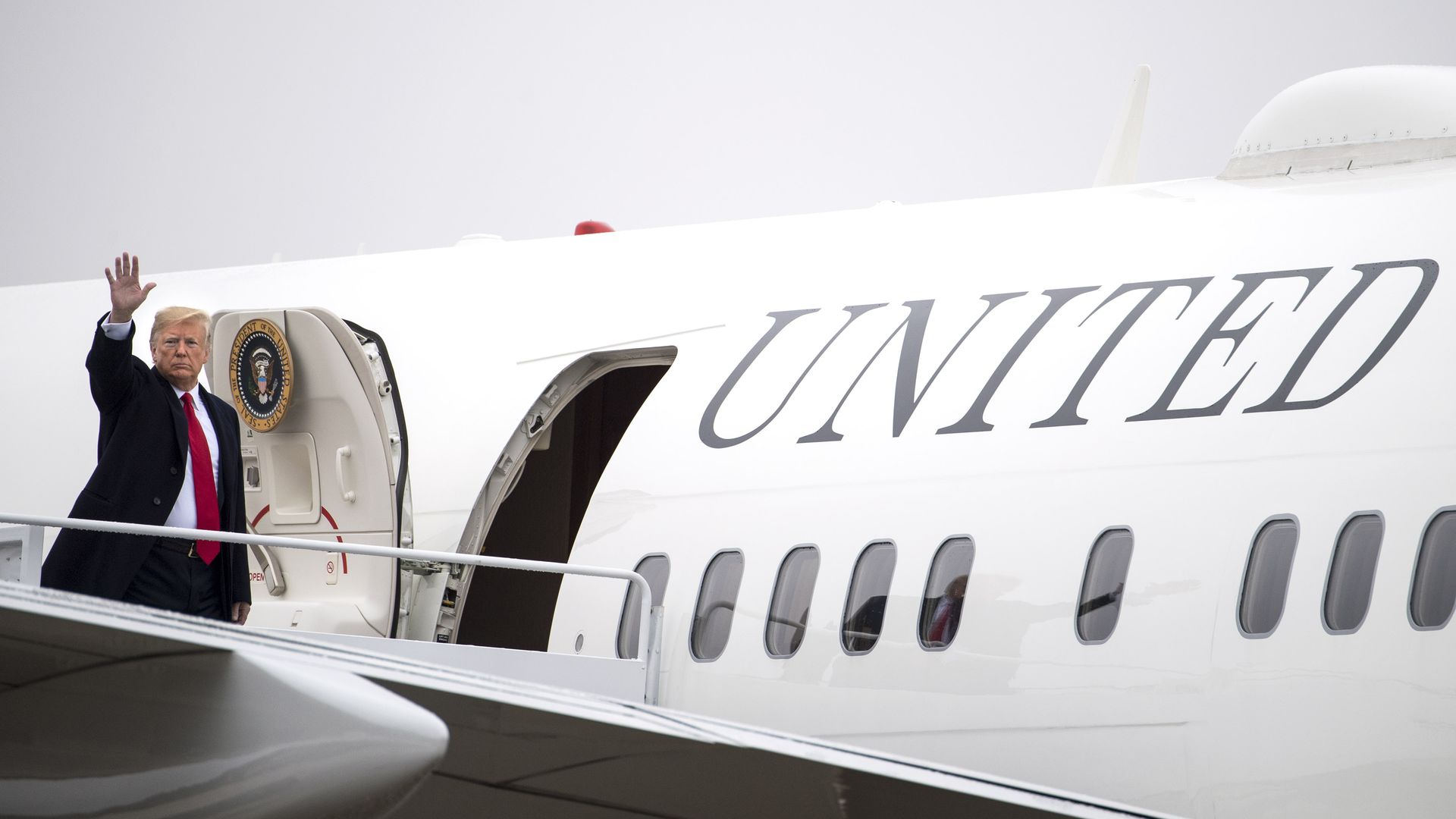
Before boarding Marine One to visit the U.S.-Mexico border in Texas Thursday, President Trump said he is leaning toward declaring a national emergency after it was clear in Wednesday's meeting with the congressional Democrats they were not going to fund the $5 billion for the border wall.
One big quote: "I have the absolute right to declare a national emergency. I haven't done it yet. I may do it. If this doesn't work out, probably I will do it. I would almost say definitely."
The partial government shutdown is being fought over a wall to keep people out of the U.S. But based on a stat from a recent poll, we might want to worry more about people wanting to leave.
Why it matters: Moving isn't typically a political decision, but the share of Americans wanting to emigrate remained at 10% through the Bush and Obama years, then jumped to 16% under Trump, according to a Gallup poll. Close to a quarter of Americans who disapprove of Trump said they want to move, compared to 7% of those who approve. A startling 40% of women under the age of 30 want to leave.
Here's President Trump's response to Senate Minority Leader Chuck Schumer, who said yesterday that Trump "sort of slammed the table" and exited the room after being told by House Speaker Nancy Pelosi that Democrats wouldn't agree to funding his border wall.
"Cryin Chuck told his favorite lie when he used his standard sound bite that I 'slammed the table & walked out of the room. He had a temper tantrum.' Because I knew he would say that, and after Nancy said no to proper Border Security, I politely said bye-bye and left, no slamming!"
President Trump, and vast parts of the federal government, have been consumed with caravans, walls and a border “crisis” since at least Oct. 16. While the definition of a crisis is highly debatable, the extent of other problems with wider reach and much higher death tolls is not.
Why it matters: The border is a big deal, and the problems are real, but often lost in the shutdown madness is whether the crisis is bigger than other wrongs and injustices impacting American lives.
Almost a week after taking control of the House, Democrats on Wednesday voted on a resolution to allow them to intervene in a lawsuit challenging a Texas federal judge's ruling that the Affordable Care Act is unconstitutional.
The big picture: Democrats campaigned on health care as a major priority during the midterm elections, which helped them flip 40 seats and take control of the lower chamber. The vote puts Democrats on record seeking to protecting Americans with pre-existing conditions, while putting vulnerable Republican incumbents in an awkward position on health care. Three GOP congressmen — Reps. Tom Reed (N.Y.), John Katko (N.Y.) and Brian Fitzpatrick (Pa.) — voted in favor of the resolution.
The National Treasury Employees Union, which represents hundreds of thousands of federal workers at 33 agencies, sued the Trump administration Wednesday for forcing tens of thousands of employees to work without pay during the government shutdown.
Details: The lawsuit, which names two Customs and Border Protection officers as the plaintiffs, comes a week after the American Federation of Government Employees filed a similar suit, calling the shutdown a "blatant violation" of the Fair Labor Standards Act. NTEU President Tony Reardon said in a statement: “If employees are working, they must be paid — and if there is not money to pay them, then they should not be working."