The Senate has passed a bill reauthorizing farm programs and aid for the next five years with an 87-13 vote, pushing the bill on to the House where it can be authorized as late as this week. The total package will cost $867 billion.
Details: The bill renews food stamp regulations for the next five years despite House Republicans' efforts to add stricter work requirements for recipients. The bill also legalizes industrial hemp. The passage is seen as a victory for farmers in President Trump's base, who have been bogged down by the U.S. trade war with China.
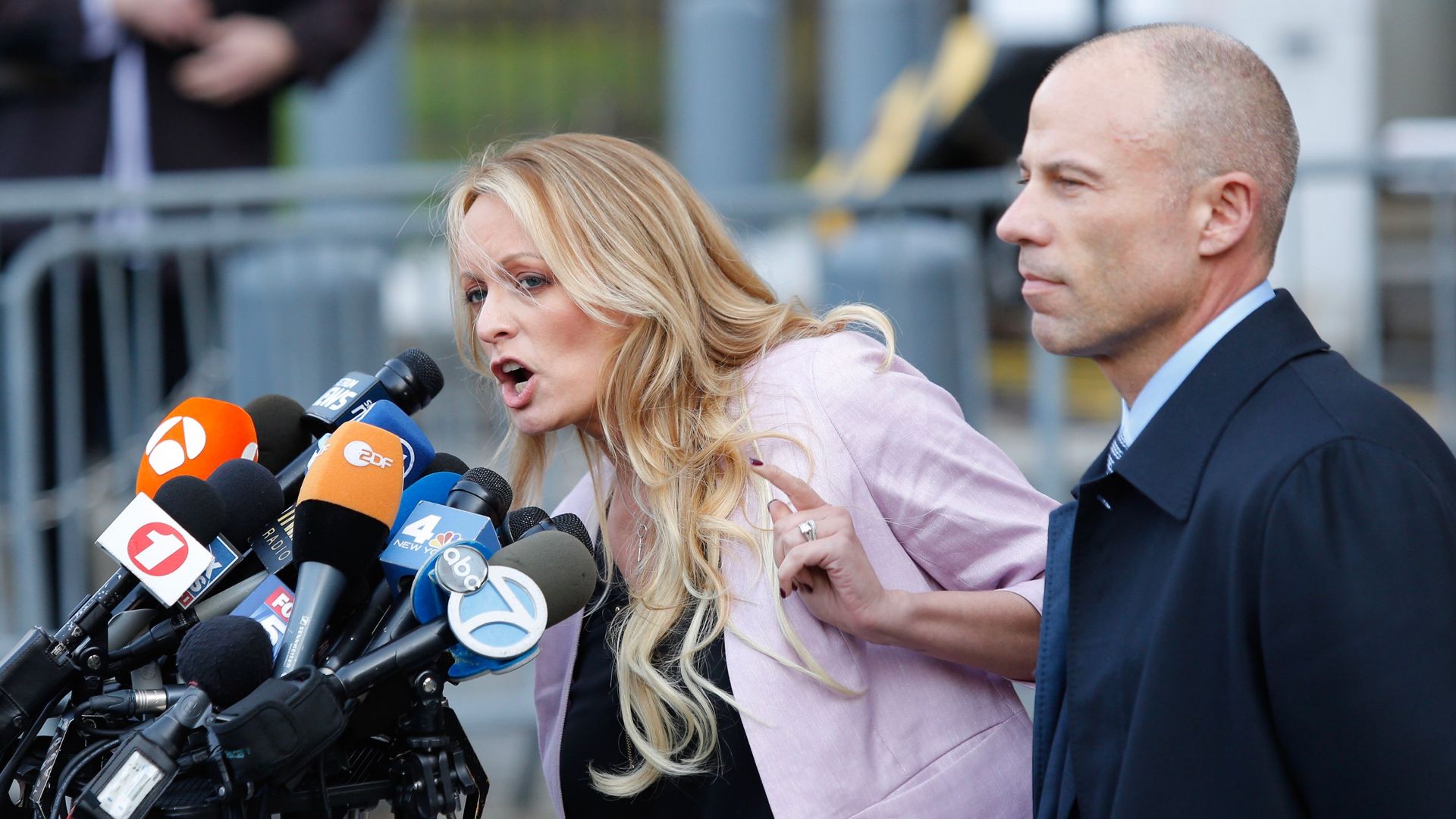
A federal judge in California on Tuesday ordered adult film star Stormy Daniels to pay Donald Trump $293,052.33 in attorneys' fees for her defamation case against the president, which the judge dismissed in October, and another $1,000 in sanctions for filing a "meritless" legal challenge.
Background: Daniels sued the president for what her legal team described as "irresponsible and defamatory statements" he made about her on Twitter. But U.S. District Judge James Otero ruled that it was non-defamatory on its face, instead characterizing it as "rhetorical hyperbole."
Welcome to the next season of the Trump Show, featuring televised Oval Office debates, cheap shots behind closed doors and the next generation nipping at Democrats' heels.
Driving the news: The president hosted Chuck Schumer and Nancy Pelosi at the Oval Office today, with VP Mike Pence sitting silently by Trump's side.
Prior to his meeting with Rep. Nancy Pelosi and Sen. Chuck Schumer, President Trump brought reporters into the Oval Office and — in an extended, heated exchange before the cameras — clashed with the two Democratic leaders over congressional support for funding for his border wall, declaring that he is "proud to shut down the government for border security."
Why it matters: The president taking ownership of any potential government shutdown hinders Republicans' ability to pin the blame on Democrats, while also giving a glimpse into what Trump's negotiating style with a Democrat-controlled House may look like over the next two years.
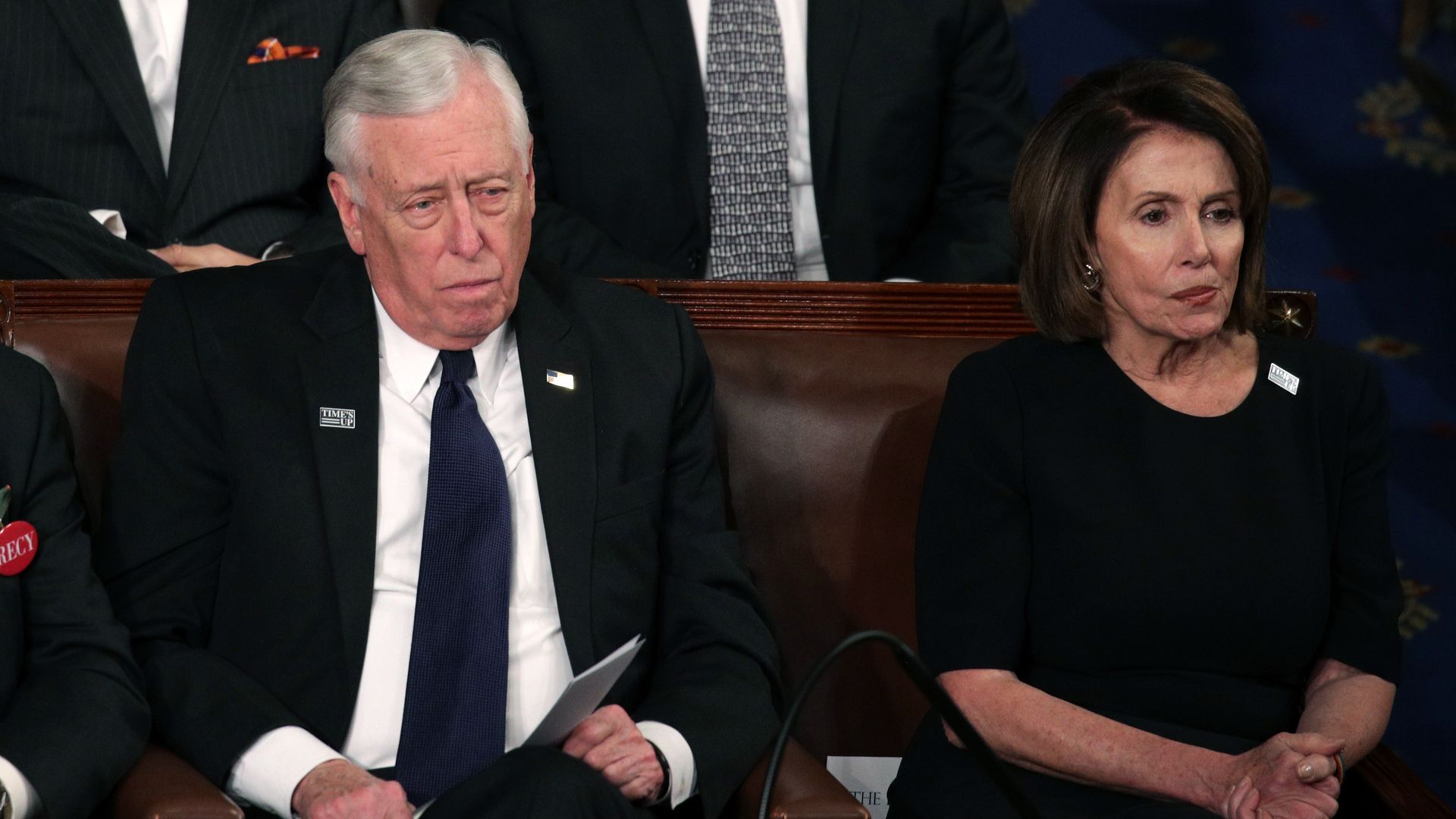
Incoming House Majority Whip Steny Hoyer is not on board with Nancy Pelosi's reported negotiations over potential leadership term limits for House Democratic leaders, saying, "She's not negotiating for me. I. Am. Not. For. Term. Limits," reports CBS News' Rebecca Kaplan.
Why it matters: Democratic political leadership is old, with most of the party's energy dominated by younger voters. This fight is merely the first of many to come.
In the days after prosecutors revealed that Michael Cohen paid off two women "in coordination with and at the direction of" then-candidate Donald Trump, top Democrats have said the president's alleged actions during the 2016 campaign could leave him open to impeachment — or possibly even indictment when he leaves office.
The other side: Top congressional Republicans, meanwhile, have largely dismissed Trump's place in the allegations, arguing that Cohen is not credible, that the investigation is tainted by Democratic bias, and that campaign finance violations are a minor offense. Or, as Sen. John Kennedy (R-La.) argued, Cohen's plea is "a long way from collusion with a foreign agent to influence the election in 2016."
Senate Majority Leader Mitch McConnell (R-Ky.) said Tuesday that the Senate will vote this month on a bipartisan criminal justice reform bill, which has been publicly endorsed by President Trump but opposed by some hardline conservatives.
Why it matters: McConnell has said he would only bring the bill to the floor if it had the votes to pass. The bill has continued to gather support among both parties over the past few weeks and is almost certain to pass the Senate, but will have to go back through the House before reaching the president's desk. McConnell said members should "be prepared to work between Christmas and New Year's if necessary in order to complete our work."
Dan talks with Axios' Alayna Treene about the results of the "year of the woman," and how newly elected women in Congress are filling into leadership roles.
"To have powerful female voices leading the conversation, driving the conversation ahead of 2020, if you're seeing a lot of that only from the Democratic side and not the Republican side, that could only further exacerbate the gender gap that we see between both parties."
In a letteron the op-ed page of today's Washington Post, 44 bipartisan former U.S. senators —though mostly Democrats — warn of "an inflection point in which the foundational principles of our democracy and our national security interests are at stake."
What they're saying: "[I]t is our shared view that we are entering a dangerous period,and we feel an obligation to speak up about serious challenges to the rule of law. ... We are on the eveof the conclusion of special counsel Robert S. Mueller III’s investigation and the House’s commencement of investigations of the president and his administration. The likely convergence of these two events will occur at a time when simmering regional conflicts and global power confrontations continue to threaten our security, economy and geopolitical stability."
Last week's stunning court filings detonated what one official calls a "reality tremor" that has White House officials and key allies increasingly aware of President Trump’s rising legal and political vulnerability.
What's happening: Some top officials are suddenly much more attuned to the political fallout from the Mueller investigation and are growing more anxious about Trump's re-election prospects, according to people close to the president. And on the outside, some hardcore Trump allies — who have mostly accepted his denials about Robert Mueller — were rattled by the specificity of the Friday night revelations by the special counsel and by federal prosecutors.
Far more people around the world would like to see immigration decrease than increase, at least in 27 countries polled by Pew.
By the numbers: Support for increasing immigration ranges from just 2% in Greece and Hungary to 28% in Spain. In the U.S., 29% want immigration reduced, 24% want it increased and 44% want it to stay the same.