On Thursday Sen. Ed Markey (D-Mass.) and Rep. Pramila Jayapal (D-Wash.) introduced an updated version of the Health Over Wealth Act, legislation that would take aim at private equity firms and for-profit companies that own health care businesses.
Why it matters: Private equity ownership of health care companies is under the spotlight, especially the firms' practices around worker treatment and cost-cutting.
Attacking consolidation and related anti-competitive business practices in health care has emerged as something of a bipartisan cause over the last few years. There's just one big problem: Health care already is heavily consolidated, and most of the solutions can't change that.
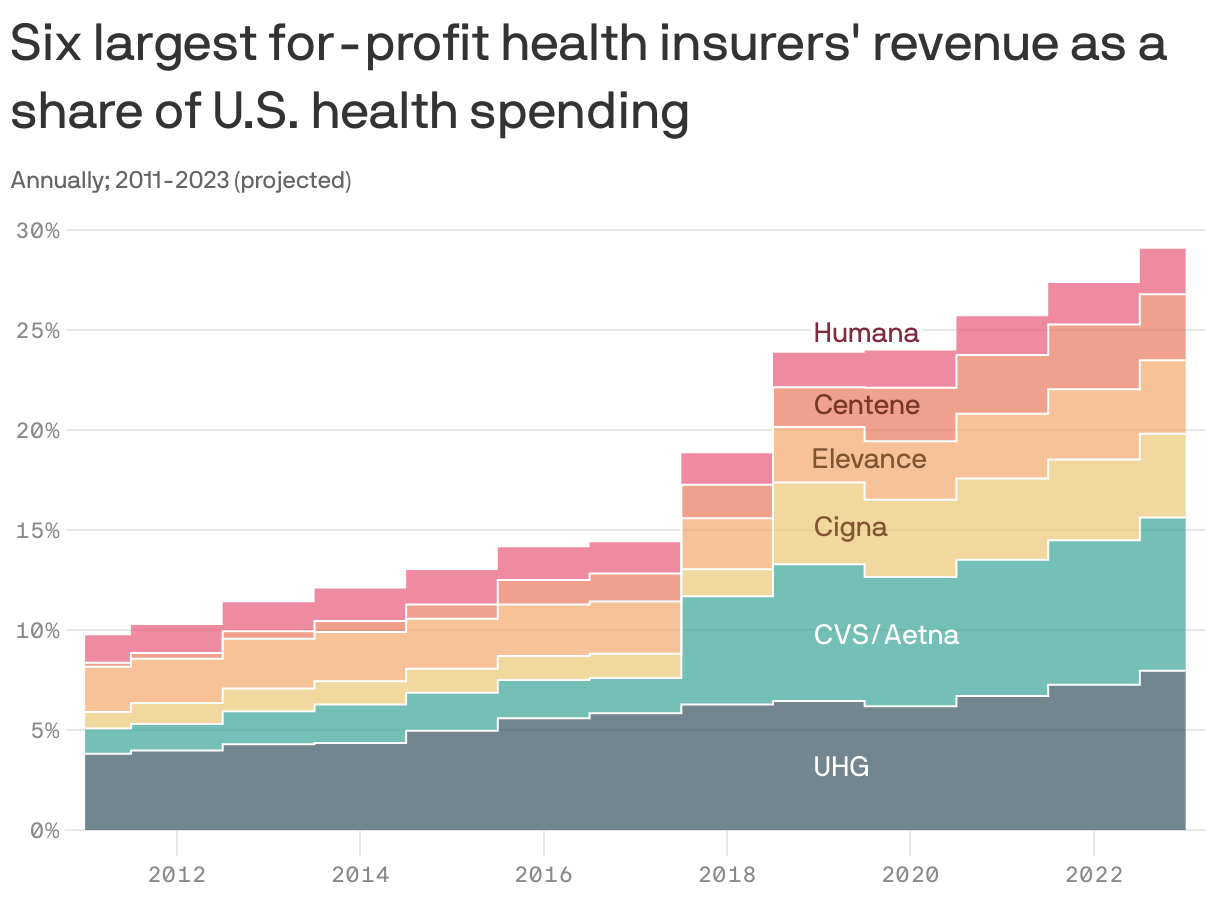
Why it matters: Whether it's insurers, pharmacy benefit managers, hospitals or providers, today's health care landscape is increasingly dominated by large players wielding outsize market power, which experts say contributes to high and rising costs.
Most policymakers worried about health costs are still generally united around approaches that use market forces to lower or at least stabilize prices. Many measures that would ultimately help prevent future consolidation and preserve competition have widespread appeal.
Let's start by talking about the bucket of policies that Congress or the Biden administration are pursuing.
Particularly in the House, there's been bipartisan interest in measures promoting hospital price transparency and aligning payment rates for different settings of care, known as site-neutral payments. There's also been chatter (mostly among Democrats) about increasing resources and authorities for the FTC to pursue antitrust cases.
The FTC has been aggressive in challenging health care mergers under President Biden, and the administration this year put out a request for information about consolidation in health care markets.
I want to go deeper on one think tank plan in particular, partially because it's been turned into actual legislation on the Hill — and also because both versions are coming from the political right.
How it works: The plan, originally developed by the Foundation for Research on Equal Opportunity, would cap payment rates for commercial payers at Medicare Advantage rates in "extremely concentrated hospital markets," with exemptions for rural hospitals.
If hospitals in those markets didn't want to get paid MA rates — which generally are much lower than commercial rates — they could opt to break up instead.
Why it matters: Booming sales of Novo Nordisk's Ozempic and Wegovy and Eli Lilly's Mounjaro and Zepbound have led to widespread shortages of GLP-1 treatments.
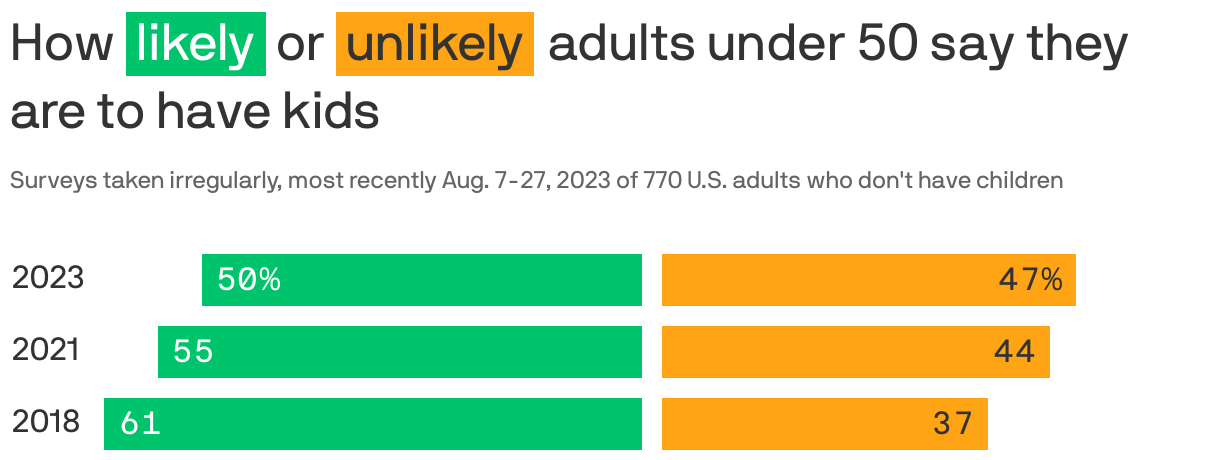
An increasing share of adults under 50 say they're unlikely to have kids — and the major reason is, well, they just don't want them, according to a report from Pew Research Center out Thursday morning.
Why it matters: The U.S. fertility rate is at a historic low, posing problems for future economic growth, and the survey takes a crack at figuring out what's going on.
🌎 The U.S. Treasury has committed $667 million for a global pandemic fund hosted by the World Bank, but a divided Congress still has to sign off. (Endpoints News)
🧬 An ultrarare disease that speeds up aging in children is getting closer to a cure via a gene editing technique. (NYT)
🥼 A neurological drug that Biogen gained rights to in a $1 billion research deal failed a key human trial and likely will be scrapped. (Reuters)
👩🍼 Why six months of paid parental leave is optimal but not realistic in the United States. (Axios)
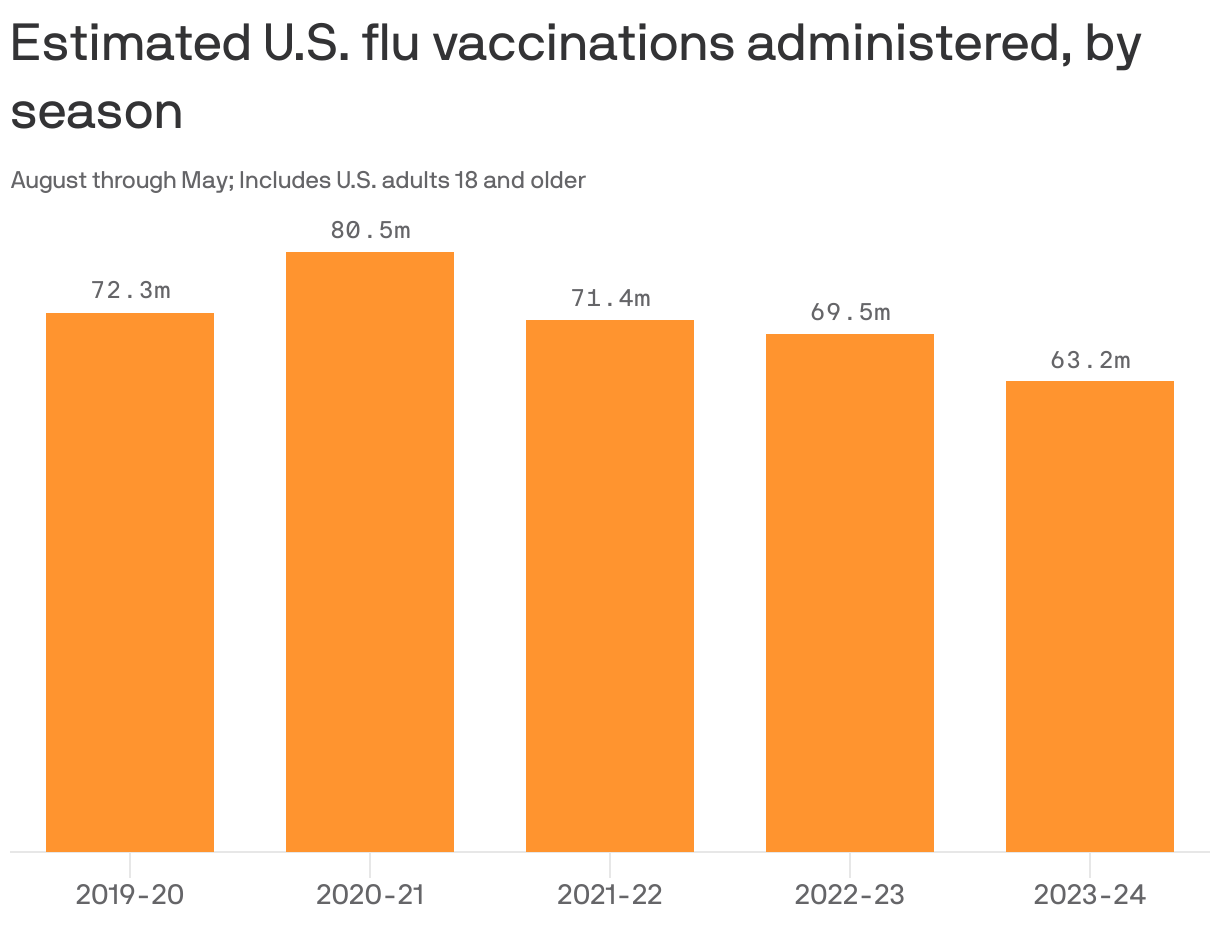
Demand for flu shots is declining, particularly among some of the most medically vulnerable groups, raising concerns that the vaccines may be falling out of favor in a post-pandemic world.
Why it matters: While uptake for flu shots has never been stellar, experts say vaccine fatigue, shifting attitudes and lowered public trust may be eroding demand.
Vials used for blood culture samples are in critically low supply.
Why it matters: The shortage of blood culture bottles made by Becton Dickinson (BD) could delay patients' diagnoses or lead to misdiagnoses or other challenges if not properly managed, the Centers for Disease Control and Prevention warned in a Tuesday alert.
Context: Health providers take blood cultures to diagnose patients with bloodstream infections or related conditions, like sepsis and endocarditis.
Sepsis is a leading cause of death in hospitals, affecting at least 1.7 million people in the U.S. annually.
About half of all laboratories in the country use a blood culture monitoring system that's only compatible with the BD bottles, the CDC said.
The shortage isthe result of supply chain disruptions, and more vials should be available in September, a BD vice president told clinicians during a Tuesday call.
In the meantime, the CDC advised health facilities to improve their blood culture collection practices to avoid unnecessary cultures that strain bottle supply.
Congress' boldest effort to date to crack down on social media platforms and protect kids' mental health is stoking a debate over whether the remedy could end up making youths less safe.
Why it matters: Curbing sources of anxiety, depression and other harms raises privacy and free speech concerns, and can turn into a subjective exercise that could sweep up content some people find empowering.
Massive wildfires burning across the unusually hot and dry western U.S. and Canada have led thousands to evacuate, with reports of at least one fire in California and another in Oregon creating their own weather.
The big picture: 78 large fires are burning in the West, per the National Interagency Fire Center (NIFC). This includes 31 blazes in Oregon and 12 in California, as dangerously hot temperatures continued to roast the West.