Wildfires erupt in West, Canada amid major heat wave

Add Axios as your preferred source to
see more of our stories on Google.
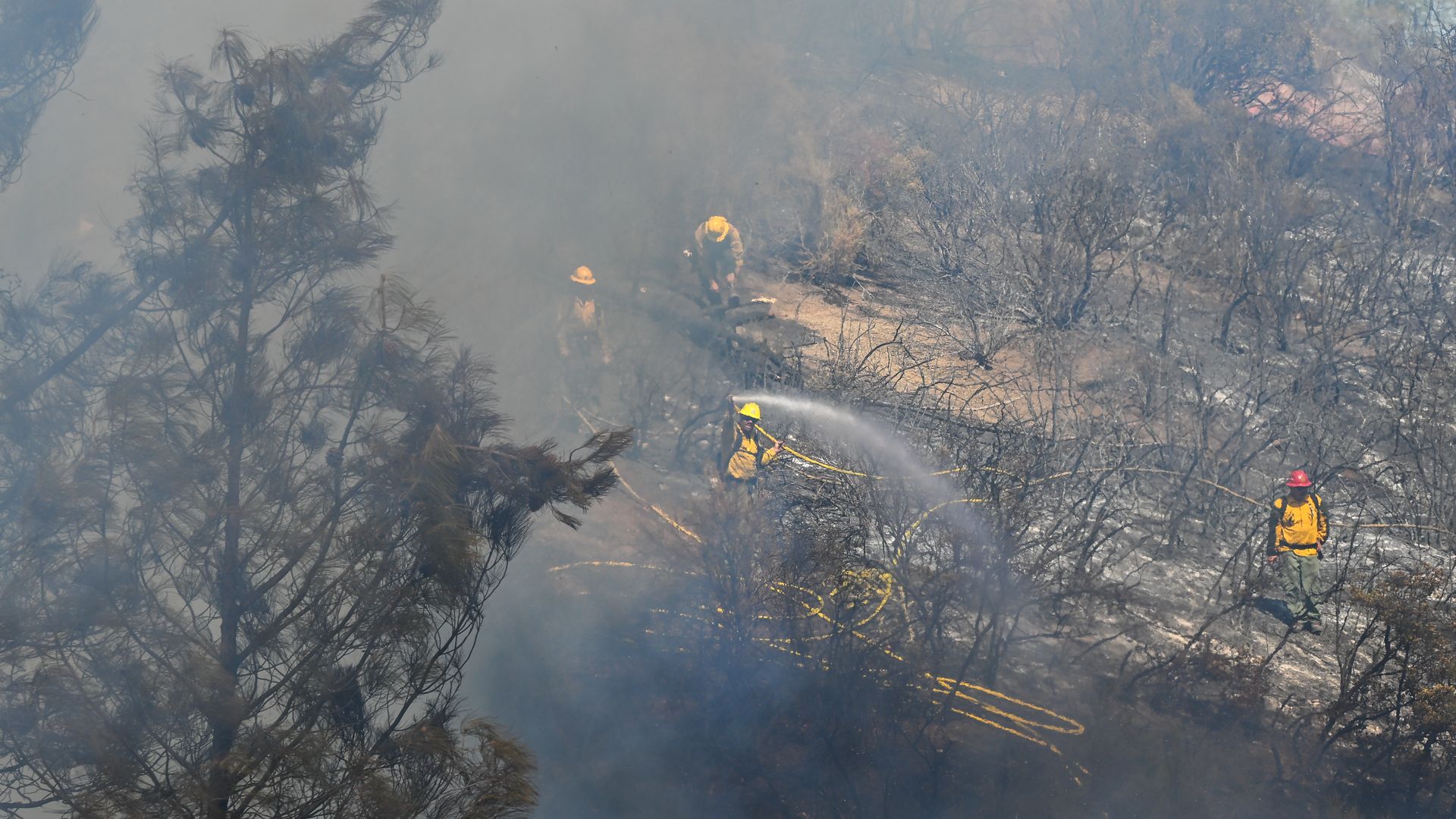
Crews battle the Ridge Fire in California on July 21. Photo: Tayfun Coskun/Anadolu via Getty Images
A dangerous heat wave will continue into midweek in much of the West as large wildfires burn out of control in several states, particularly California, Oregon and Washington.
Why it matters: The combination of heat and wildfire smoke is bringing a significant threat to public health, and smoke from fires burning in Canada may soon move into the U.S. as well.
Zoom in: The heat wave has triggered warnings for millions in California, Nevada, Oregon, Washington and Idaho. In addition, red flag warnings are in effect in many areas for dangerous fire weather conditions.
- The National Interagency Fire Center was tracking 60 uncontained large wildfires as of Sunday afternoon, most of them in the Northwest and Southwest.
- Several have exhibited extreme fire behavior, which makes them more difficult for firefighters to control. The Durkee Fire in eastern Oregon burned nearly 60,000 acres on Saturday alone, according to the National Interagency Fire Center, bringing its total to more than 100,000 acres.
- In California, the Hawarden Fire burned homes in Riverside, about 55 miles east of Los Angeles, prompting evacuations.
Threat level: The heat wave will continue to bring temperatures above 100°F across much of the West, with highs in the 110s°F in the Southwest.
- Many locations in the East, Southeast and West are having their hottest summers on record, and this prolonged heat wave is likely to continue that trajectory.
- Redding, California, has gone further and broken every temperature record that existed during a three-week period.
- "Redding not only saw its hottest single day on record, but also its hottest 2-day period, 3-day period, hottest week on record, and hottest 3-week period on record," UCLA climate scientist Daniel Swain said on X.
The heat is forecast to reach "major" to "extreme" levels on NWS' experimental Heat Risk scale through Thursday in the vicinity of Las Vegas, the Central Valley of California, Boise, Idaho, near Spokane, Washington, and across most of Montana.
- "The prolonged nature of the heat in the West will keep the Heat Risk at major to locally extreme levels across portions of the Central Valley of California, and the Great Basin today where another afternoon of triple digit high temperatures is expected," the NWS stated Monday morning in a forecast discussion.
- The heat is expected to moderate across the Pacific Northwest by midweek as a cold front moves in from the Pacific. However, California's Central Valley may stay unusually hot for much of the week, the NWS said.
Context: Human-caused climate change, caused largely by burning fossil fuels such as coal and natural gas, has greatly increased the odds of heat waves and made them more intense and longer lasting, research shows.
- According to the Climate Shift Index from the research organization Climate Central, human-caused climate change is making daytime highs on Monday at least five times as likely in Spokane compared to the pre-industrial era.
- This is compared to a pre-industrial atmosphere without added amounts of planet-warming greenhouse gases.
- This index also shows highs in Salt Lake City on Monday are being made at least three times as likely due to human-caused climate change.
Zoom out: The large, slow-moving high pressure area or heat dome across the West is also affecting Canada, with record heat in British Columbia along with numerous large wildfires.
- All-time temperature records have been set or tied in the Northwest Territories, with other milestones falling in British Columbia as well.
- In what's becoming a typical feature of the summer season now, smoke from these wildfires plus the ones burning in the U.S. may combine to bring hazardous air quality even in areas far from the blazes.
- Satellite imagery of British Columbia and Alberta in particular shows a milky, smoke-filled sky across a broad expanse.
Between the lines: Studies show human-caused climate change is increasing wildfire risks, particularly in the West.
- Extreme wildfire events during the past two decades more than doubled in frequency and magnitude globally, with the six worst seasons occurring during the past seven years, a study published last month found.
What's next: The heat in the Pacific Northwest is expected to eventually migrate into the northern Plains during the middle-to-late part of this week.
- Excessive heat watches and heat advisories are already in effect for Montana as the heat builds there.
Rebecca Falconer contributed reporting.
