Extreme wildfires doubled in frequency, magnitude since 2003

Add Axios as your preferred source to
see more of our stories on Google.
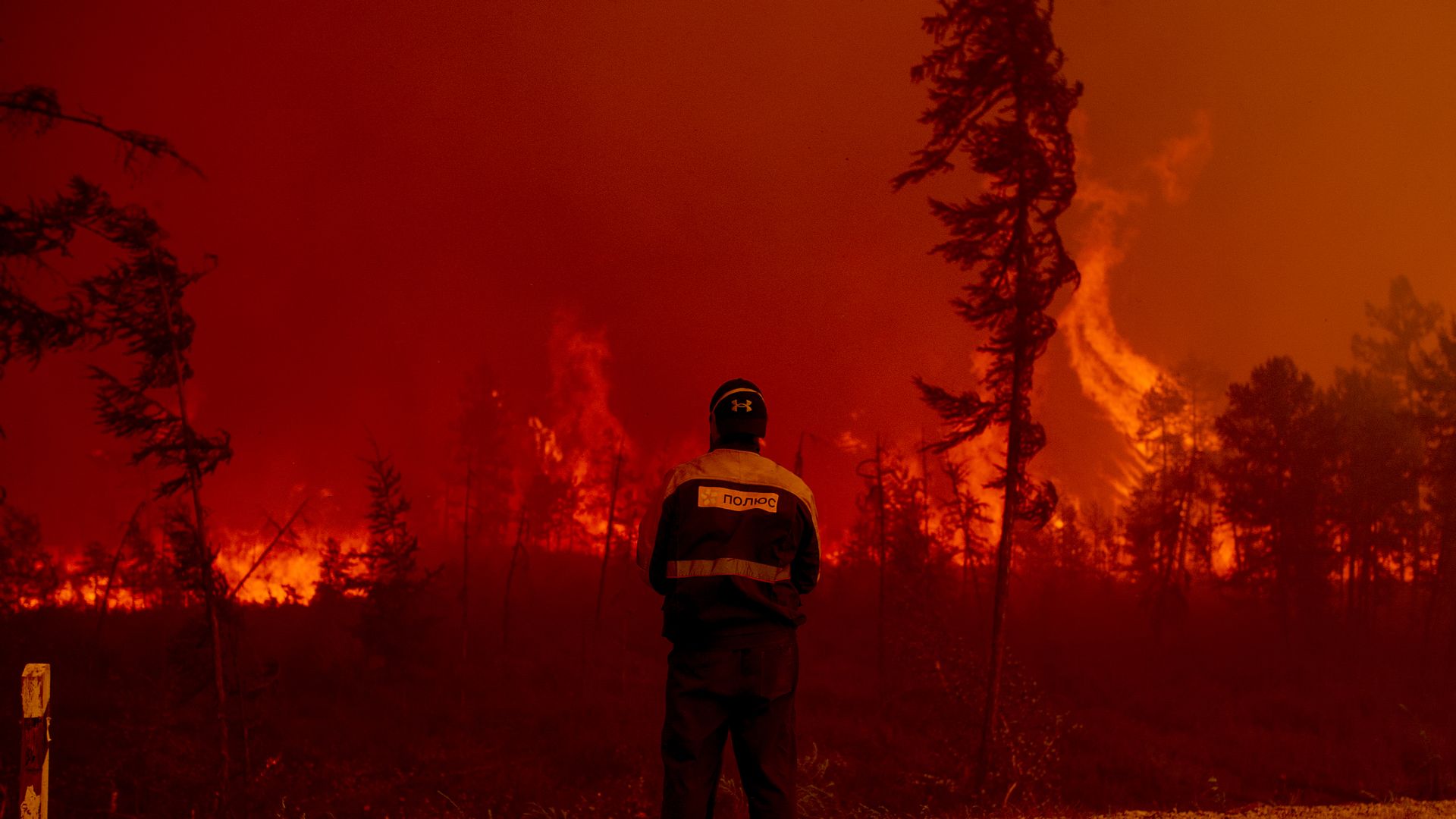
A wildfire in the village of Kuel in Yakutia, Sakha, Russia on August 8, 2021. Photo: Ivan Nikiforov/Anadolu Agency via Getty Images
Extreme wildfire events during the past two decades more than doubled in frequency and magnitude globally, with the six worst seasons occurring during the past seven years, a new study found.
Why it matters: Intense wildfires — as measured by satellites — are more difficult to fight, emit vast quantities of greenhouse gases and noxious smoke, and can cause disastrous consequences for communities.
Zoom in: The new study, published Monday in the journal Nature Ecology and Evolution, found that the biggest upward trends in extreme wildfires are in temperate conifer biomes, such as in the western U.S., along with the boreal forests that ring the Arctic region.
- The researchers, from the University of Tasmania in Hobart, note that previous studies focused on burned area and hadn't investigated trends in extreme wildfires.
- These latter wildfires are characterized by high amounts of outgoing heat energy.
What they did: The researchers used 21 years of satellite observations of wildfire-released radiative power to evaluate shifts in the frequency and/or magnitude of extreme wildfires.
- They devised an approach to measure the integrated daily fire radiative power from active fires detected by satellites for each day between January 1, 2003 and Nov. 30, 2023.
- This way, they could incorporate measurements of a wildfire event rather than just measuring a particular hotspot.
- They then examined trends over time and associations with particular ecosystems in the most extreme, or 99.99th percentile, of events.
What they found: They found a 2.2-fold increase in extreme wildfire events over the study period. The scientists also noted a greater uptick in such fire behavior at night compared to the day.
- This, the study states, "is in line with the observation that temperatures are warming faster at night than during the day, and such warming is consequently reducing the night-time barrier to wildfire."
- It isn't just the frequency of extreme wildfire events that's going up, however. It's also the magnitude, which registered a 2.3-fold increase and accelerating.
The big picture: Extreme fires are becoming more prevalent in forests close to the Arctic and in Australia/Oceania, the study found. The temperate conifer forest and the boreal forest were responsible for much of the increase in extreme wildfire events when viewed by biome.
- Big jumps in the yearly number of extreme wildfire event occurred in these areas, with an 11.1-fold increase over 21 years in temperate conifer biomes, which includes the forests of the Western U.S.
The intrigue: Previous studies have linked wildfire increases in the West to climate change, as hotter temperatures dry out the soils and vegetation faster and earlier in the fire season.
How it works: Climate change is causing an increase in days with extreme wildfire weather conditions, as temperatures warm and vegetation dries out faster.
- "Climate change has already caused fire weather to depart from its historical variability across ~20% of burnable land area globally," the study states.
- The new study notes the destructive wildfire seasons seen in recent years in the Amazon, Australia, Canada, Chile, Portugal, Indonesia, Siberia and the Western U.S., citing them as examples of the trend toward more extreme fires.
Go deeper:
Dangerous fire weather conditions becoming more common across U.S.
