Dozens of wildfires in Pacific Northwest and Canada hit U.S. air quality


Add Axios as your preferred source to
see more of our stories on Google.
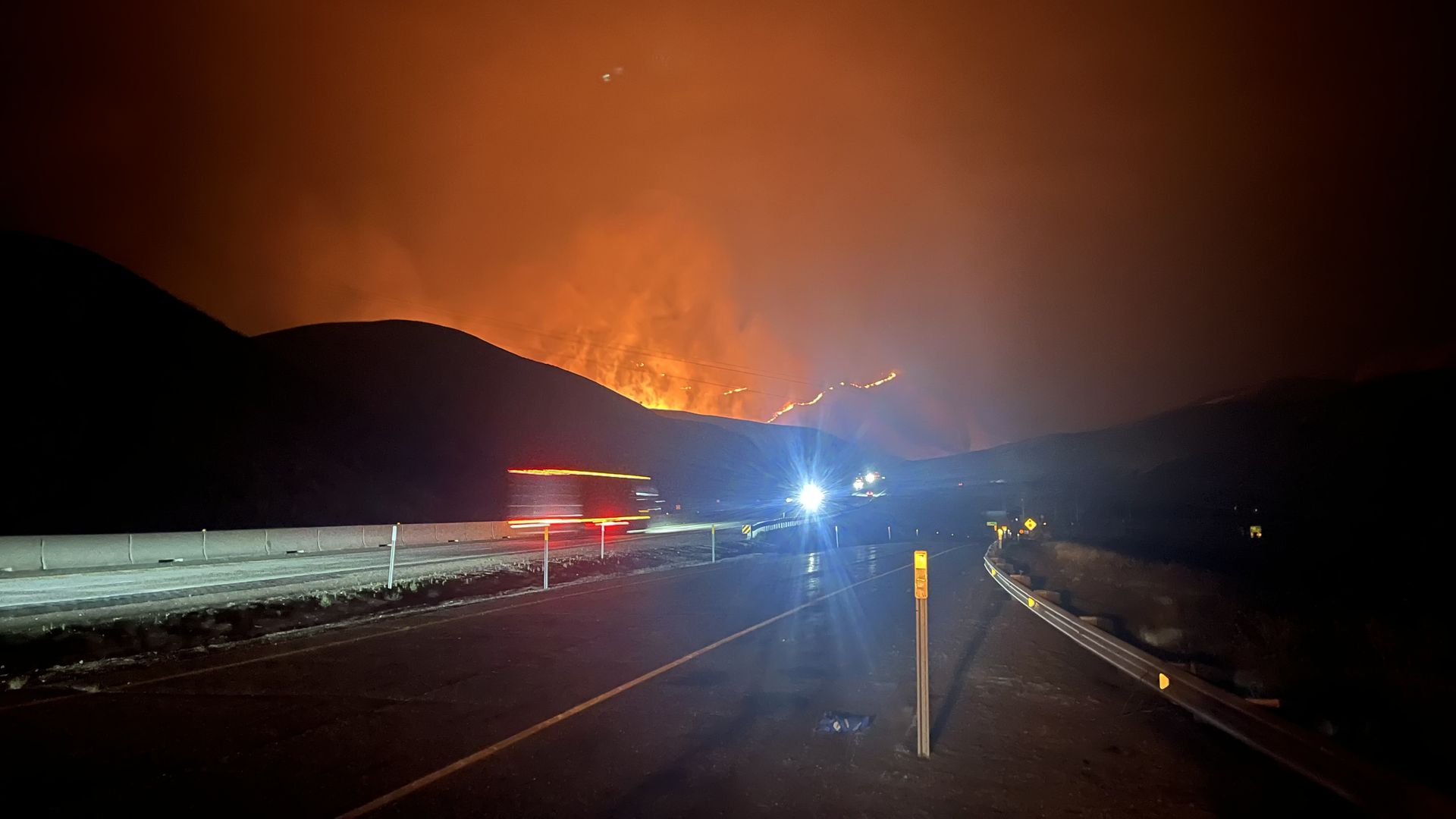
A fire burns behind hills near I-84 in eastern Oregon, where parts of the road from Pendleton to Ontario remained closed from Tuesday through Friday morning "due to unpredictable fire activity in the area," per the state's Department of Transportation. Photo: Oregon DOT/X
Massive wildfires burning across the unusually hot and dry western U.S. and Canada have led thousands to evacuate, with reports of at least one fire in California and another in Oregon creating their own weather.
The big picture: 78 large fires are burning in the West, per the National Interagency Fire Center (NIFC). This includes 31 blazes in Oregon and 12 in California, as dangerously hot temperatures continued to roast the West.
Threat level: On Wednesday, eastern Oregon as well as parts of Idaho and Montana faced "critical" wildfire risk, according to the National Weather Service.
- This is the second-highest risk level, and indicates the expectation of extremely dry conditions, hot temperatures and strong winds.
- Lightning associated with dry thunderstorms triggered by the passage of a cold front "will result in critical fire danger over the interior northwestern U.S.," per an NWS forecast discussion.
- Wildfire smoke has spread from Canada and the Pacific Northwest into the Plains and impacted air quality across the region.
- The Federal Emergency Management Agency authorized the use of federal funds to help with firefighting costs for the Durkee Fire, the biggest active blaze in the U.S., which has razed over 240,000 acres in Baker and Malheur counties of Oregon since being sparked by lightning on July 17.
Zoom in: The fire that's threatened homes in and around Durkee and other communities near the border with Idaho and shut sections of I-84 has sent massive pyrocumulus clouds into the sky over the past couple of days.
- "That can happen when a fire becomes plume-dominated," said Stephen Parker, a meteorologist with the National Weather Service in Boise, Idaho, per AP. "It's like a thunderstorm on top of the fire, generated by the heat of the fire."
In California, evacuation orders were issued for Butte and Tehama counties in the Sacramento Valley foothills Wednesday over the fast-moving Park Fire.
- Evacuation orders and warnings remained in effect for communities near the Gold Complex fires in the Plumas National Forest, where a pyrocumulus cloud was detected after lightning ignited four fires following thunderstorms in the area.
- Evacuation orders were also in place over the Hawarden Fire in Riverside County, Southern California, which authorities said Tuesday caused over $10 million in damage as it tore through homes after being ignited by illegal fireworks on Sunday.
In Canada, hundreds of wildfires are burning across the country and firefighting crews from Australia and New Zealand have deployed to tackle blazes in British Columbia and Alberta.
- Canada's Prime Minister said on X early Thursday he'd approved Alberta's request for federal assistance. He said he'd deploy Canadian Armed Forces resources, "evacuations support, and more emergency wildfire resources to the province immediately — and we're coordinating firefighting and airlift assistance."
- Evacuation orders were in effect for some 25,000 people in communities near Alberta's popular Jasper National Park, which was closed due to an approaching wildfire.
- Strong winds propelled the blaze to the resort town of Jasper Wednesday evening. Air quality deteriorated later in the evening "to the point that wildland firefighters and others without self contained breathing apparatuses needed to evacuate to Hinton," the park said on Facebook.
- The park said in an overnight Facebook post that "significant loss" had occurred in the town and its "focus continues to be on saving as many structures as possible," but it wasn't immediately able to report on the extent of the damage.
- A pyrocumulus cloud was also reported in this fire, one of many burning across the country.
Context: Human-caused climate change, driven largely by burning fossil fuels like coal and natural gas, has greatly increased the odds of heat waves and made them more intense and longer lasting, multiple studies show.
- Climate change has also increased the occurrence of days with extreme wildfire weather conditions, when blazes can behave erratically and be tougher to impossible to battle.
What we're watching: The ongoing heat wave over the western U.S. was expected to gradually become less intense with the arrival of a Pacific cold front. The relief may prove fleeting, however, as temperature outlooks for early August show renewed heat risks.
- Temperatures were already cooling in Washington behind a dry cold front, where NIFC data shows seven large fires are burning.
Flashback: Canada's historic wildfire season abates after 45.7 million acres razed
Editor's note: This article has been updated with new details throughout.
