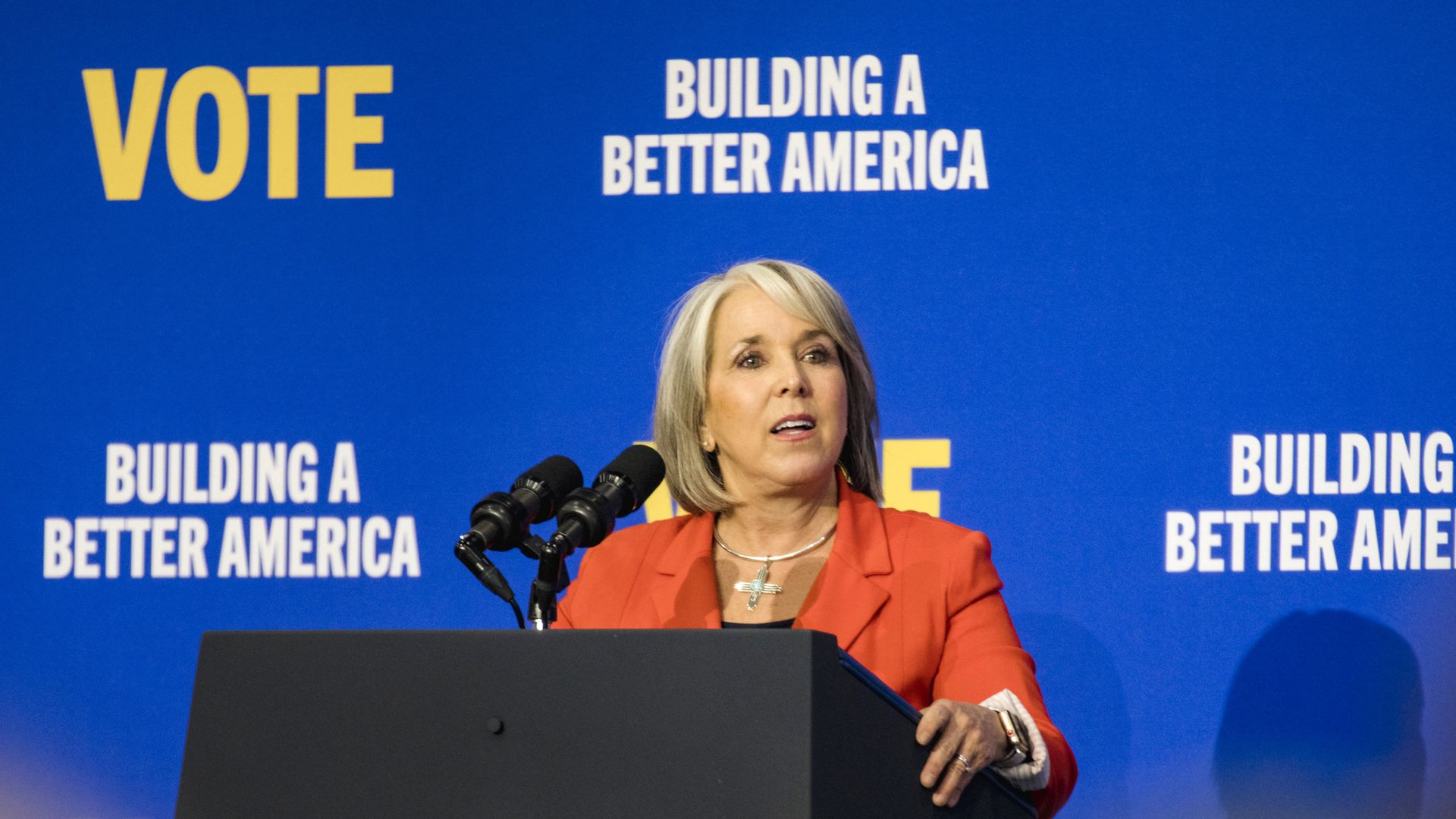
Parts of New Mexico Gov. Michelle Lujan Grisham's emergency health order suspending the right to carry guns in public in the state's largest metro area was temporarily blocked by a federal judge in Albuquerque on Wednesday.
Driving the news: U.S. District Court Judge David Urias said in his decision that the 30-day suspension in Albuquerque and the surrounding Bernalillo County contravened a U.S. Supreme Court ruling that said it's a constitutional right to carry a weapon in public for self-defense purposes.
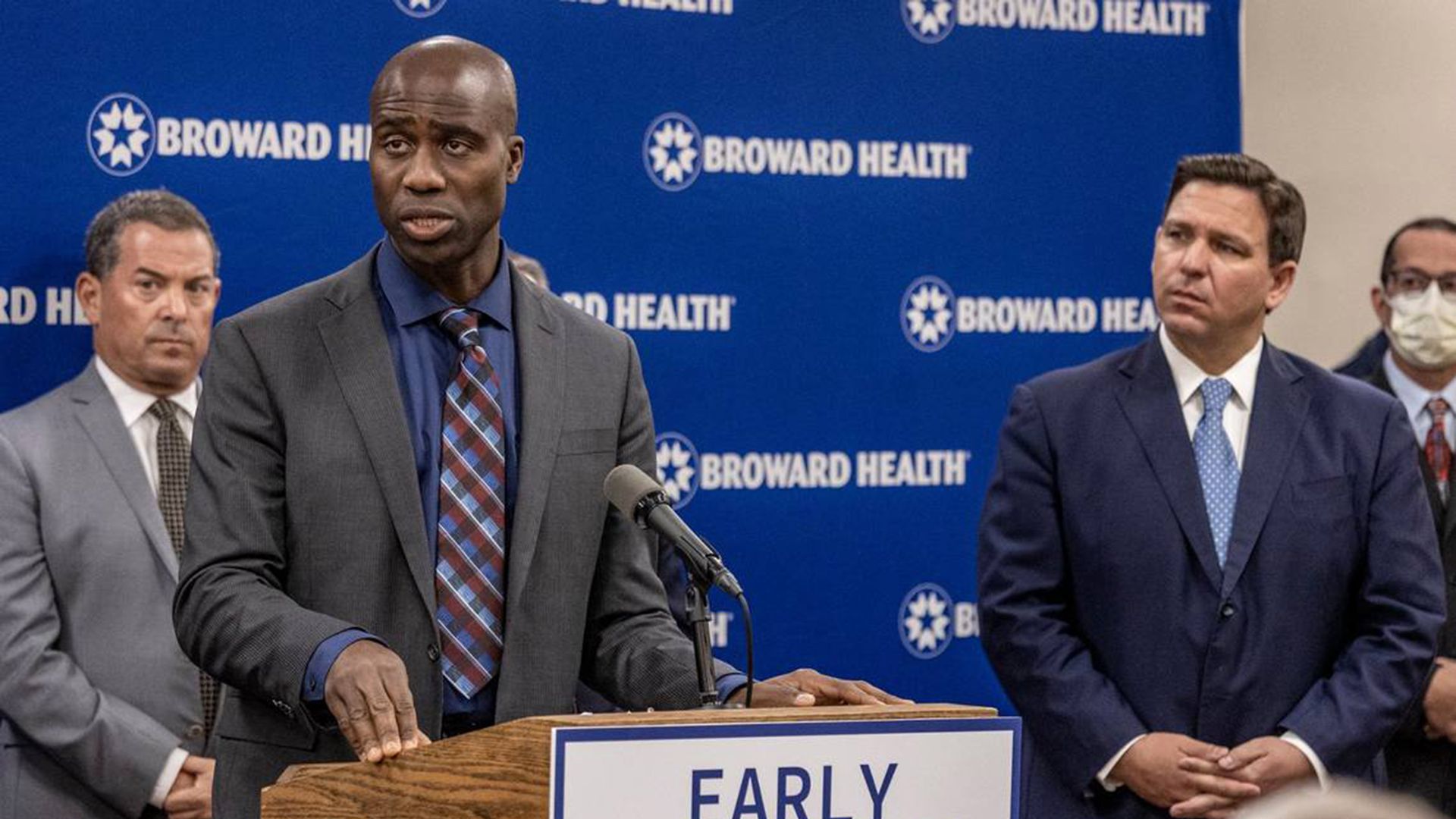
Florida's Surgeon General Joseph Ladapo cautioned against COVID boosters for people younger than 65 Wednesday.
Why it matters: The DeSantis administration said Florida is the first state in the country to recommend against boosters for under-65s. The recommendation contradicts CDC guidance that calls for "everyone 6 months and older" to receive the new boosters ahead of the winter virus season.
Nearly 60% of ground ambulance rides were out of network in 2022, according to an analysis provided first to Axios by FAIR Health.
Why it matters: Patients can't really shop around for an ambulance ride, but they're getting smacked with major medical bills because their emergency transportation is outside of their insurers' network.
Plenty of legal precedent already allows Medicare to determine what it will pay for health care goods and services, the Department of Justice argued this week in defense of new Medicare drug price negotiations.
Why it matters: The filing, in response to Merck's lawsuit, indicates how the government will defend the program's constitutionality against a wave of similar challenges.
The effort to get Americans updated COVID-19 shots this fall will be the first major vaccination campaign without the federal government guaranteeing their availability at no cost.
Why it matters: A new federal program and other community efforts will continue providing free vaccines for uninsured people, but experts say it won't be as easy for them to access the shots.
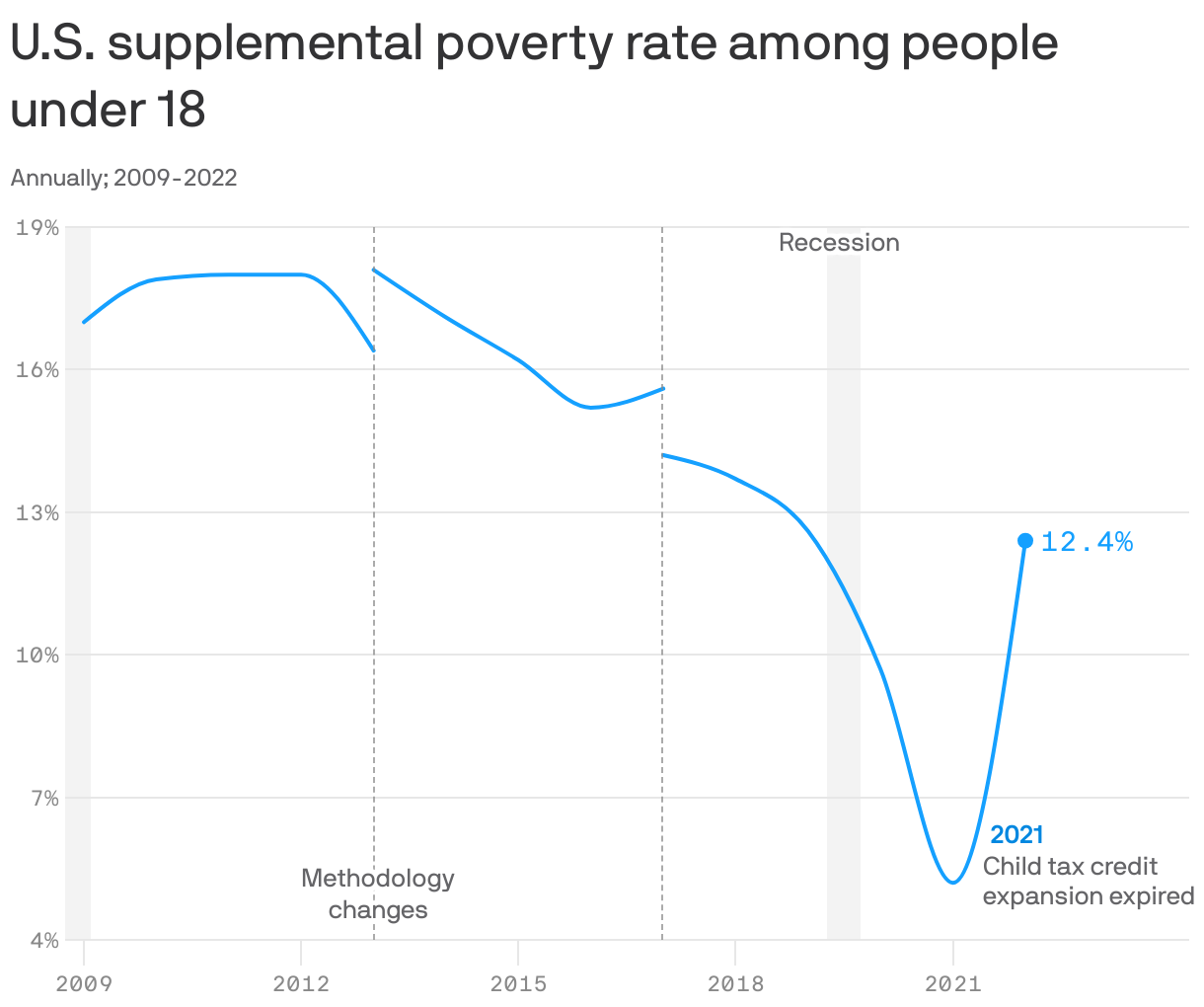
Data: U.S. Census; Chart: Tory Lysik/Axios Visuals
The expected spike in poverty — particularly child poverty — between 2021 and 2022 shows the impact of letting major pandemic-era safety net program expansions expire, a policy experiment with no precedent in the U.S.
Why it matters: The pandemic programs were enacted as temporary measures. But their expiration still stings for the Americans who experienced an economic boost only to lose it — and there's more to come.
The Centers for Disease Control today recommended that updated COVID-19 vaccines from Pfizer and Moderna be given to anyone ages 6 months and older, clearing the way for reformulated shots to be available later this week.
Why it matters: Amid a months-long uptick in cases, the Biden administration is facing pressure to make the updated vaccines available to help head off a repeat of last year's "tripledemic" of respiratory disease.
The new shots are expected to take aim at circulating strains, including the EG.5, or Eris, strain, which the CDC said accounted for 21.5% of cases as of Sept. 2, as well as a newer variant, FL.1.5.1, dubbed Fornax, which accounted for 14.5% of U.S. infections.
The FDA approved mRNA shots from Pfizer and Moderna on Monday, and it's still reviewing a shot from Novavax that uses more traditional protein-based technology.
CDC advisers earlier today recommended the updated Pfizer and Moderna vaccines in a 13-1 vote.
What they're saying: "Today's announcement ... means we now have immunizations for all three major seasonal respiratory viruses COVID-19, flu and RSV," President Biden said in a statement. "As we head into fall and winter, we are in our strongest position yet with more tools and systems available than ever before."
CDC Director Mandy Cohen said: "We have more tools than ever to prevent the worst outcomes from COVID-19."
Details: The vaccine advisers recommended everyone ages 5 years and over receive one dose of an updated vaccine.
Children 6 months to 4 years should complete a two-dose initial series with at least one dose of the updated vaccine.
Moderately or severely immunocompromised people should complete a three-dose initial series that includes at least one dose of the updated vaccine.
Some advisers questioned whether there was enough data to make a universal recommendation for the updated shots, or whether the recommendation should only apply to higher-risk individuals. But only one member, Ohio State University pediatrician Pablo Sanchez, voted against the recommendation on those grounds.
Go deeper: The bivalent vaccine that's been available for the past yeartargets the original coronavirus strain and earlier Omicron subvariants that are largely out of circulation. Those shots will no longer be recommended.
The unwinding of the COVID-19 public health emergency means the federal government is no longer covering the shots, but most people with private insurance and those enrolled in Medicare and Medicaid should be able to get them at no cost.
A temporary Bridge Access Program that runs through 2024 is supposed to provide COVID-19 vaccines at no cost for adults who can't access them through their insurance.
The list prices for the updated Pfizer and Moderna shots will be $120 and $129 per dose, respectively. Novavax would be $130 per dose.
Officials expect boosters to be updated annually to account for circulating variants, much like flu shots.
Uptake of boosters has lagged, with just 17% of the population receiving it, according to the CDC.
A Food and Drug Administration advisory panel unanimously agreed Tuesday that an ingredient in commonly used decongestants is ineffective and should be reclassified.
The big picture: Theagency will now consider whether to revoke the safety designation of oral formulations of phenylephrine, which is in drugs like Sudafed PE and some versions of NyQuil.
A prominent abortion rights group filed legal challenges on behalf of women in three states — Idaho, Oklahoma and Tennessee — who say they were denied abortions despite having severe medical complications.
Why it matters: It's the second major round of complaints arguing that pregnant patients in dire situations are being denied emergency care because doctors are worried about running afoul of at times unclear or narrow exceptions in some strict state abortion bans.
Walgreens is expanding its value-based care footprint in its first major health care move since the sudden departure of CEO Rosalind Brewer earlier this month.
Why it matters: The national pharmacy giant, which also recently saw its CFO leave, has signaled its desireto bolster a health care delivery business that has fallen short of investors' expectations as retailers angle for primacy in the sector.
Most Americans say they wouldn't want to live in a nursing home — or for a relative to live in one — over concerns about care quality and cost, according a new Gallup survey.
Why it matters: Nursing homes already had an image problem before they were hit hard by COVID-19, and the poll suggests they have more work to do to regain public trust.







/2023/09/12/1694554535484.gif?w=3840)