Health insurers' margins in Medicare Advantage were more than double those seen in other markets in 2021, reinforcing the way the program can produce strong financial returns for plans, a new Kaiser Family Foundation analysis shows.
Why it matters: Private Medicare plans are expected to draw more than half of eligible beneficiaries this year. But government payments to insurers for administering the plans could get ensnared in a politically charged fight over the program's finances.
By the numbers: Gross margins in the Medicare Advantage market in 2021 averaged $1,730 per enrollee, similar to levels seen in 2018 and 2019 before the pandemic began, per KFF.
That was substantially higher than margins seen in the individual ($745 per enrollee), fully insured group ($689 per enrollee) and Medicaid managed care ($768 per enrollee) markets.
The individual and group markets had not recovered to pre-pandemic margins by the end of 2021.
Gross margins are a common way to assess insurer profitability and reflect the amount total premium income exceeds total claims costs per enrollee.
Go deeper: Medicare Advantage is a lucrative and fast-growing business for insurers. UnitedHealth Group posted profits of $14.4 billion, up 20% over the prior year, buoyed in large part by increases in enrollment in MA plans.
UnitedHealth had more than 7.1 million Medicare Advantage members in 2022, up about 9% from members 6.5 million the year prior. It’s projected to add 900,000 more members in 2023.
Humana, recently announced plans to exit the commercial market to focus, in part, on its MA plans. It’s expecting at least 625,000 signups in 2023, a 14% year-over-year increase.
More people are being diagnosed at younger ages and with more advanced cases of colorectal cancer, according to new research published Wednesday.
Why it matters: Colorectal cancer is the third most commonly diagnosed cancer and the third most common cause of cancer‐related death in both men and women in the U.S.
The FDA is launching a search for the newly created deputy commissioner for human foods, promising that person will have "a clear line of authority" over the proposed human foods program, the agency announced Tuesday.
Why it matters: It's the latest attempt to detail a plan to reorganize its oversight of food products after the agency faced significant scrutiny in recent years, culminating with last year's baby formula crisis.
Eli Lilly is slashing prices on its most-prescribed insulins and capping out-of-pocket costs for patients amid pressure from consumers and the Biden administration.
Driving the news: After years of price hikes on insulin, Lilly on Wednesday said people with diabetes would see 70% reductions on its most common versions.
The Food and Drug Administration on Tuesday said it will restrict imports of an animal sedative infiltrating the opioid supply and making the effects of fentanyl even deadlier.
Why it matters: Xylazine, known as "tranq" or "zombie drug," is causing blackouts, dangerously low blood pressure levels and heart rates, and severe skin-rotting wounds in users that can lead to amputation if untreated. Since it's not an opioid, the sedative resists common overdose reversal treatments such as naloxone.
Black Americans are nearly twice as likely as white Americans to go to hospital emergency departments for mental health care, the Centers for Disease Control and Prevention said in a new report based largely on pre-pandemic data.
Why it matters: Demand for behavioral health services is swamping the health care system, but those turning to an ER indicate which groups might be facing extra barriers to care.
The increasing criminalization of abortion in the U.S. is exposing major gaps in the legal protection of health information, as more health data ends up in the hands of patients rather than doctors.
Why it matters: Health privacy in the post-Roe digital age is fraught as prosecutors seeking to enforce anti-abortion laws are free to go after reproductive health data in mobile apps, where it is unprotected by federal law.
FBI Director Christopher Wray said Tuesday that the COVID-19 pandemic "most likely" resulted from a potential lab leak in Wuhan, China, as the debate continues over the coronavirus' origins.
The big picture: The new lab leak assessment could have broader implications for U.S.-China relations at a particularly sensitive time.
Mississippi became the third state to ban gender-affirming care for transgender youth in 2023 after Gov. Tate Reeves (R) signed the GOP-led bill into law on Tuesday.
The big picture: The move comes amid a mounting attack on trans rights that has escalated in recent weeks as high-profile Republicans, including former President Trump, are jockeying to establish increasingly extreme positions on gender-affirming care.
Democrats in Congress are warning the Biden administration that federal agencies could be indirectly aiding state and local law enforcement investigations that could result in the prosecution of abortion providers and patients.
Driving the news: Sens. Ron Wyden (D-Ore.) and Mazie Hirono (D-Hawaii) and Rep. Sara Jacobs (D-Calif.) expressed concern that FBI and Department of Homeland Security resources could be used to help undermine access to reproductive care, according to a letter lawmakers sent Monday evening.
Data: Kaiser Family Foundation analysis of Merative MarketScan data; Note: Includes enrollees with private insurance coverage from large employers; Chart: Simran Parwani/Axios
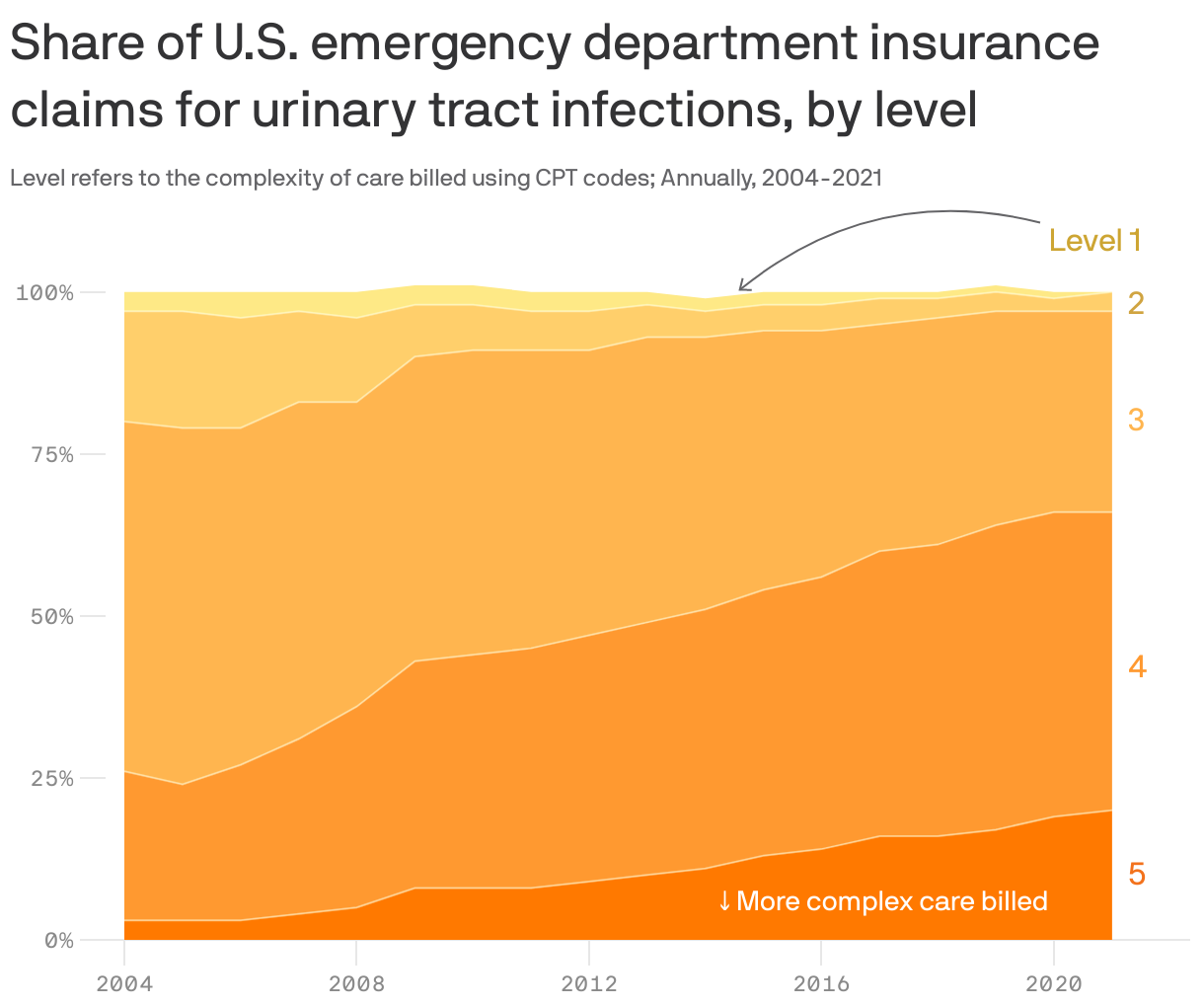
Visits to emergency departments and physicians' offices have grown more complex and costly over time — at least based on the way providers are billing, per a Peterson-KFF Health System Tracker report released Monday.
What they're saying: "There is a trend towards visits being billed at higher levels over time," the authors wrote. "For consumers who bear the marginal costs of more expensive services — those with co-insurance or deductibles — this trend impacts out-of-pocket costs in addition to overall health system costs."
China's Foreign Ministry claimed on Tuesday that the country has been "open and transparent” about its efforts to trace the origins of COVID-19 and accused the U.S. of politicizing the issue.
Driving the news: News reports emerged over the weekend that U.S. Department of Energy concluded in a "low confidence" assessment that the pandemic most likely started from a laboratory leak.
The Biden administration's decision last week to continue restricting Medicare coverage for a class of Alzheimer's drugs has angered some Republicans and renewed a thorny debate over when seniors should have access to new treatments — and under what conditions.
Why it matters: The issue raises fundamental questions about governmentdiscretion and how much datais needed before making a drug available to the public. But it's an especially fraught debate with Alzheimer's — a degenerative disease with no cure that that slowly destroys memory and thinking skills.