This year's global coronavirus death toll has already surpassed that of 2020's, with poor and developing countries accounting for a significant rise in coronavirus deaths in 2021, according to a Wall Street analysis of Johns Hopkins data.
Why it matters: While Americans are returning to activities they haven't done since before the pandemic, the reality is very different in many other parts of the world.
UnitedHealthcare is delaying a new policy, at least until the "end of the national public health emergency period," that would have declined or limited coverage of an emergency room visit if the visit was found to be non-emergent after the fact.
The big picture: Patients, doctors and hospitals slammed the policy, arguing it violated federal law that requires all emergency care to be covered as long as a "prudent layperson" believes it was an emergency.
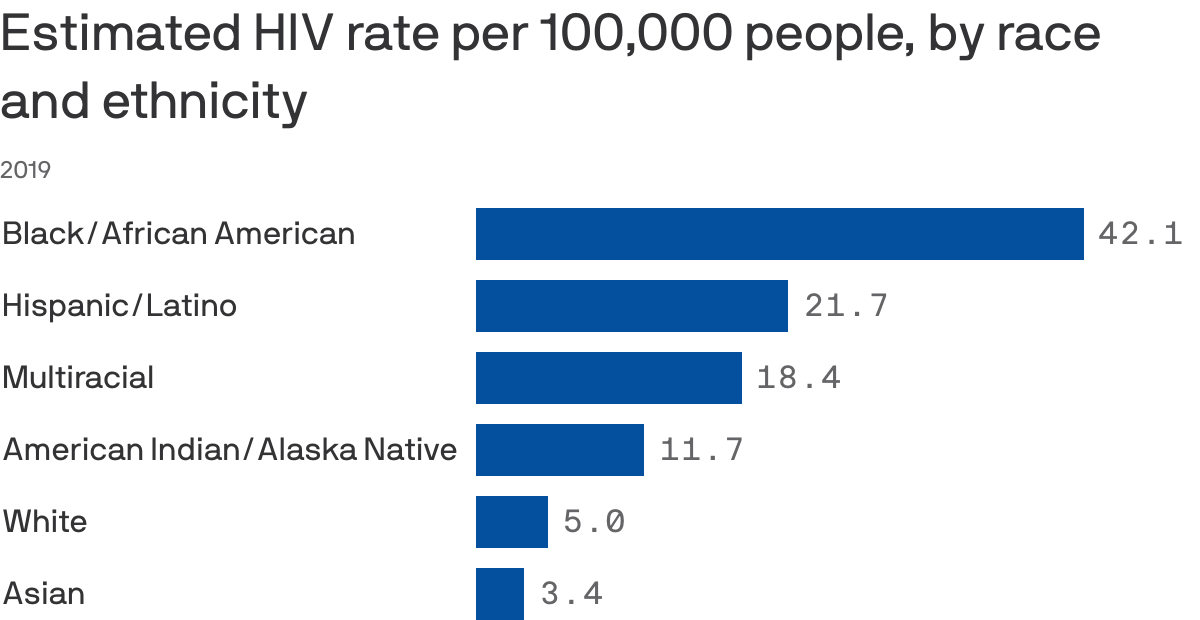
The incidence of HIV across the U.S. has gone down 73% since the first cases were reported in the country four decades ago, but the virus continues to ravage Latino and Black populations.
By the numbers: The Latino communities face four times the rates of HIV infection than white non-Hispanics in the U.S., per the CDC.
Johnson & Johnson announced Thursday that the FDA has authorized an extension of its COVID vaccine's shelf life from three months to 4.5 months.
Why it matters: Amid a slowdown in vaccine uptake, a number of state health officials had been sounding the alarm that hundreds of thousands of single-shot J&J doses could expire this month.
Goldman Sachs is mandating its U.S. employees to report whether or not they've received a COVID-19 vaccine by noon Thursday, reports the New York Times.
Why it matters: The federal government has said it is legal for companies to require workers to get vaccinated against the coronavirus. Yet vaccine "passports" are a point of controversy, with several Republican-led states forbidding some private businesses from using them.
BioNTech announced this week that it plans to establish mRNA vaccine production facilities in Africa, according to the Financial Times.
Why it matters: The blockbuster success of mRNA vaccines for the COVID-19 pandemic could give a boost to efforts to use the adaptable technology to tackle cancers, malaria and other intractable illnesses, as Axios has previously reported.
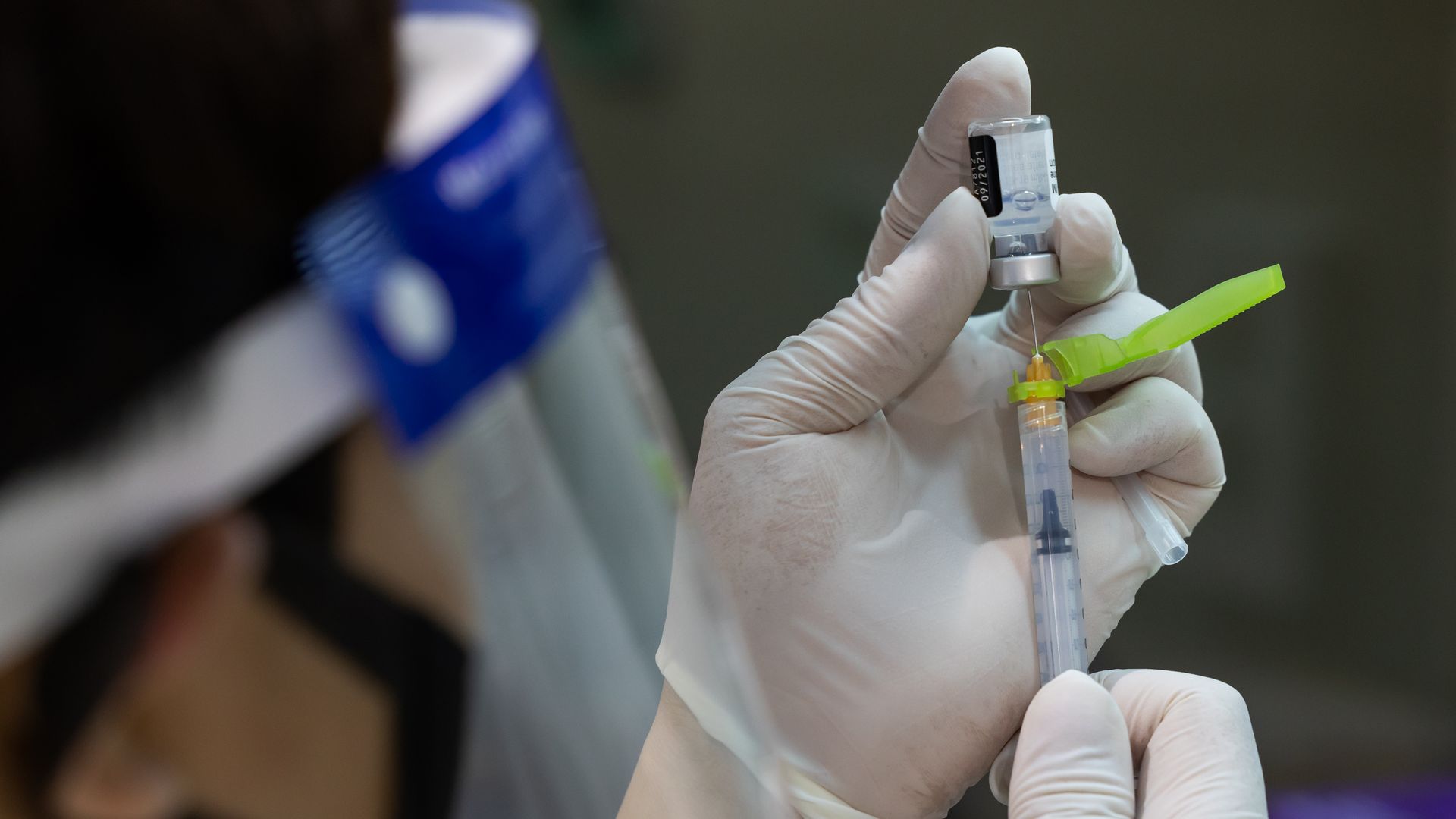
Moderna announced Thursday it has requested an emergency use authorization from the U.S. Food and Drug Administration for its coronavirus vaccine for use in 12- to 17-year-olds.
Why it matters: The emergency use authorization would allow for the use of the vaccine in adolescents before Moderna receives full FDA approval, a key step in speeding up the country's race to herd immunity and reopening schools safely this fall.
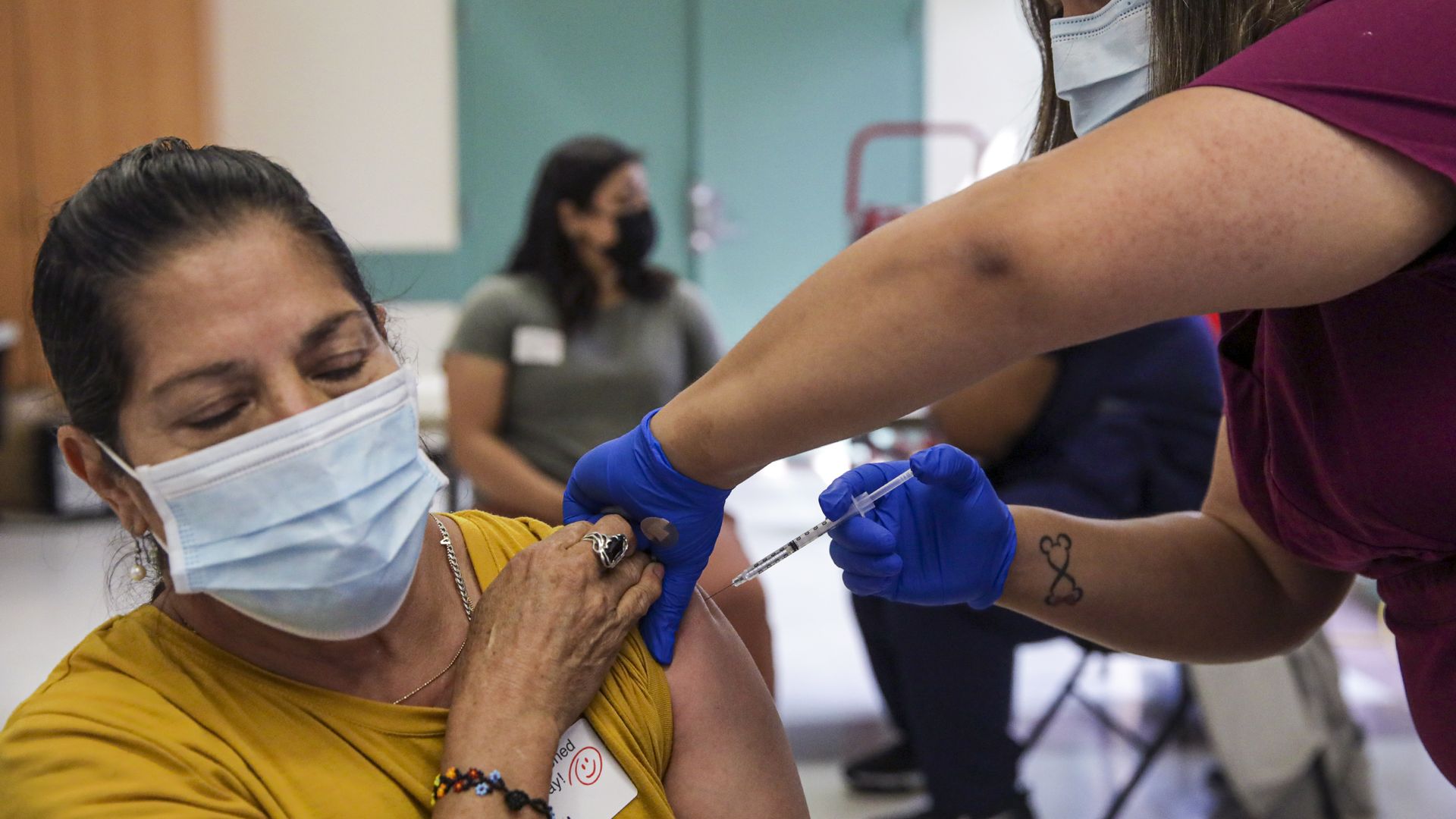
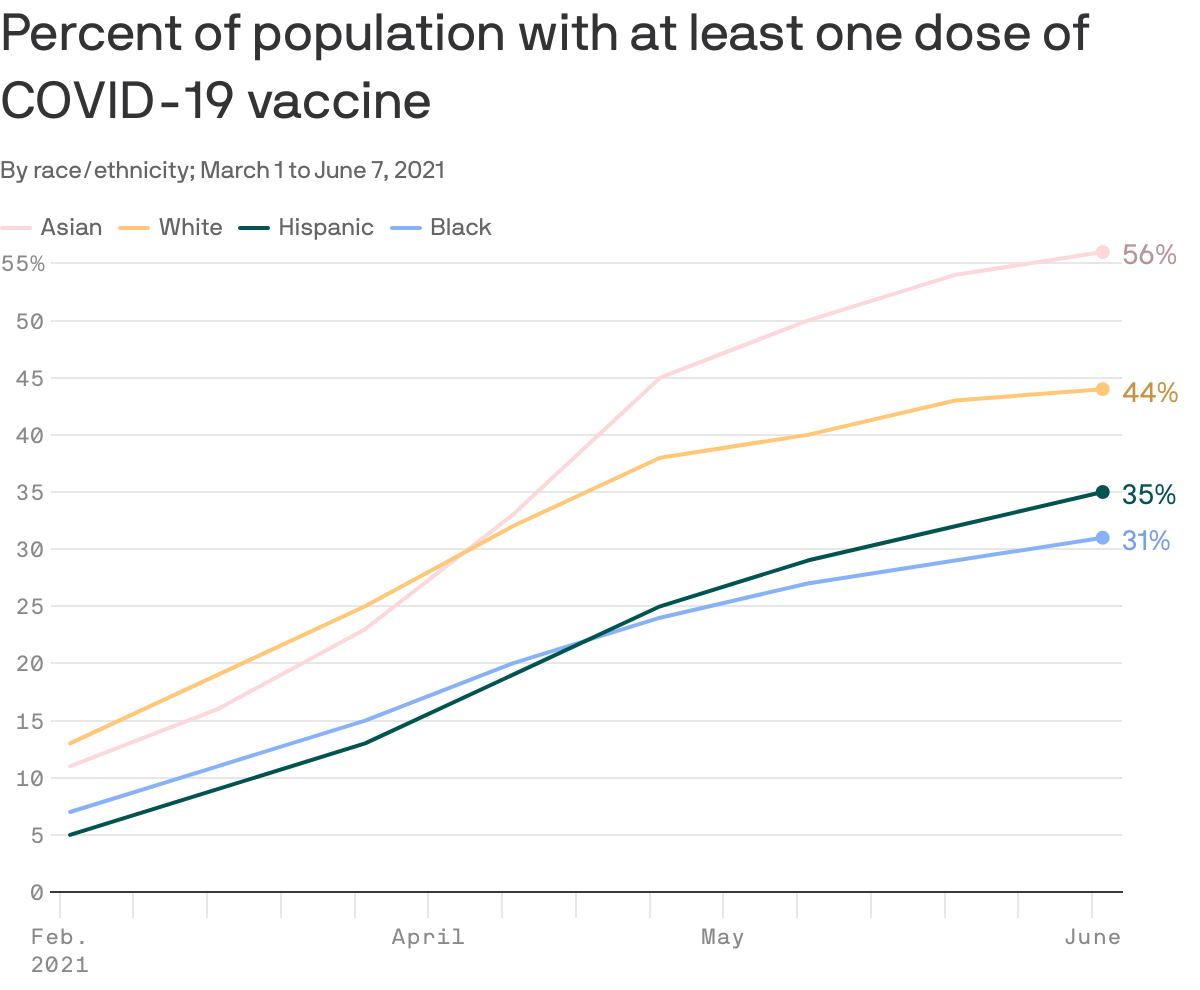
White and Asian Americans' vaccination rates continue to outpace those of Black and Hispanic Americans, though racial gaps have improved over time, per KFF.
Why it matters: The pandemic is concentrated almost entirely within the unvaccinated population in the U.S., at least for now.
Virginia-based AllyAlign Health, a Medicare Advantage insurance company focused on senior housing, just raised a nearly $300 million funding round led by New Enterprise Associates.
The global vaccine supply is finally opening up for countries that desperately need the ammo in the fight against the COVID-19 pandemic.
Driving the news: The Biden administration will buy 500 million doses of the Pfizer-BioNTech coronavirus vaccine to share with countries around the world, with the option to buy an additional 200 million.
A new poll of more than 1,400 people who work in the biotech and pharmaceutical industries by John Carroll of Endpoints News reveals a clear consensus: The FDA made a big mistake approving Aduhelm, Biogen's Alzheimer's treatment, and the $56,000 price tag does not match any possible benefit.
Why it matters: Even the industry's own experts are not defending the FDA and Biogen.
Children's hospitals and pediatricians across the country are bracing for pediatric emergency visits after seeing an unseasonably high spike in cases of respiratory syncytial virus, or RSV.
Why it matters: A year of masking and social distancing due to COVID led to an absence of other respiratory illnesses like RSV, which has no vaccine and can be dangerous in young children and the elderly. But that break appears to be over.
The Biden administration will ship the first batch of 500 million doses of Pfizer-BioNTech COVID-19 vaccines to 92 countries and the African Union from August, the White House announced Thursday morning.
Details: "200 million doses will be delivered by the end of this year and the remaining 300 million will be delivered in the first half of 2022," the White House said in a statement.