Friday's economy stories


Trump still defiant after a bruising week
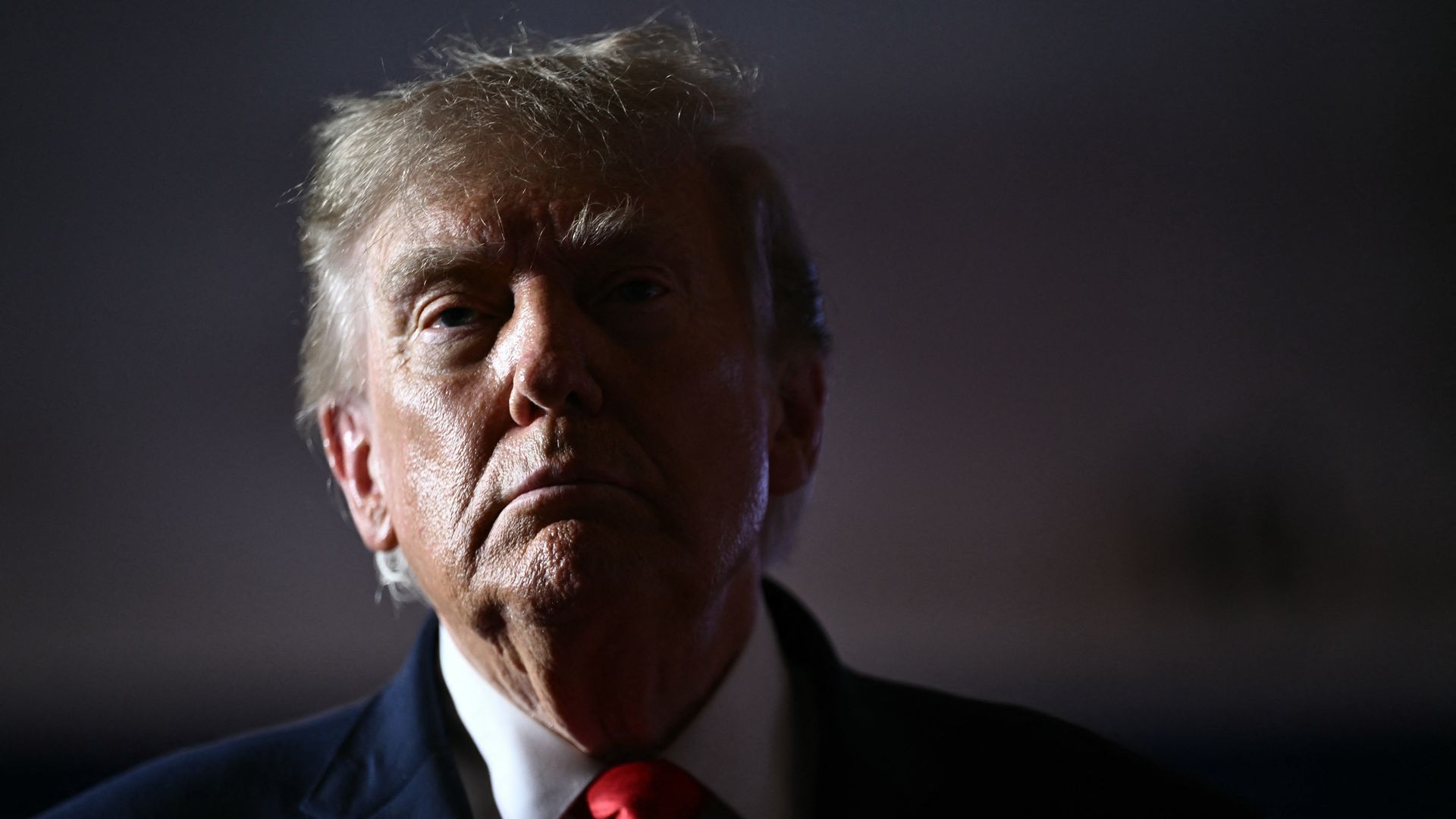
Between the GOP's thrashing at the polls, another one of President Trump's planned D.C. construction makeovers being halted and an uphill battle to overturn his conviction on 34 felony counts, this week has netted a string of setbacks for the president.
Why it matters: Trump's administration is entering its lame-duck era, facing criticism and potential investigations as its power to reshape the federal government dwindles.
- But Trump is showing little inclination to change course.

Private tech valuations in the spotlight after public market correction
Private markets have a history of following public markets, with a lag.
- We might be in the midst of that lag.
Driving the news: U.S. tech stocks lost trillions of dollars on Thursday, with the Nasdaq Composite suffering its worst percentage decline since President Trump unveiled his "Liberation Day" tariffs.

IRS reveals 2027 tax brackets. Find yours here
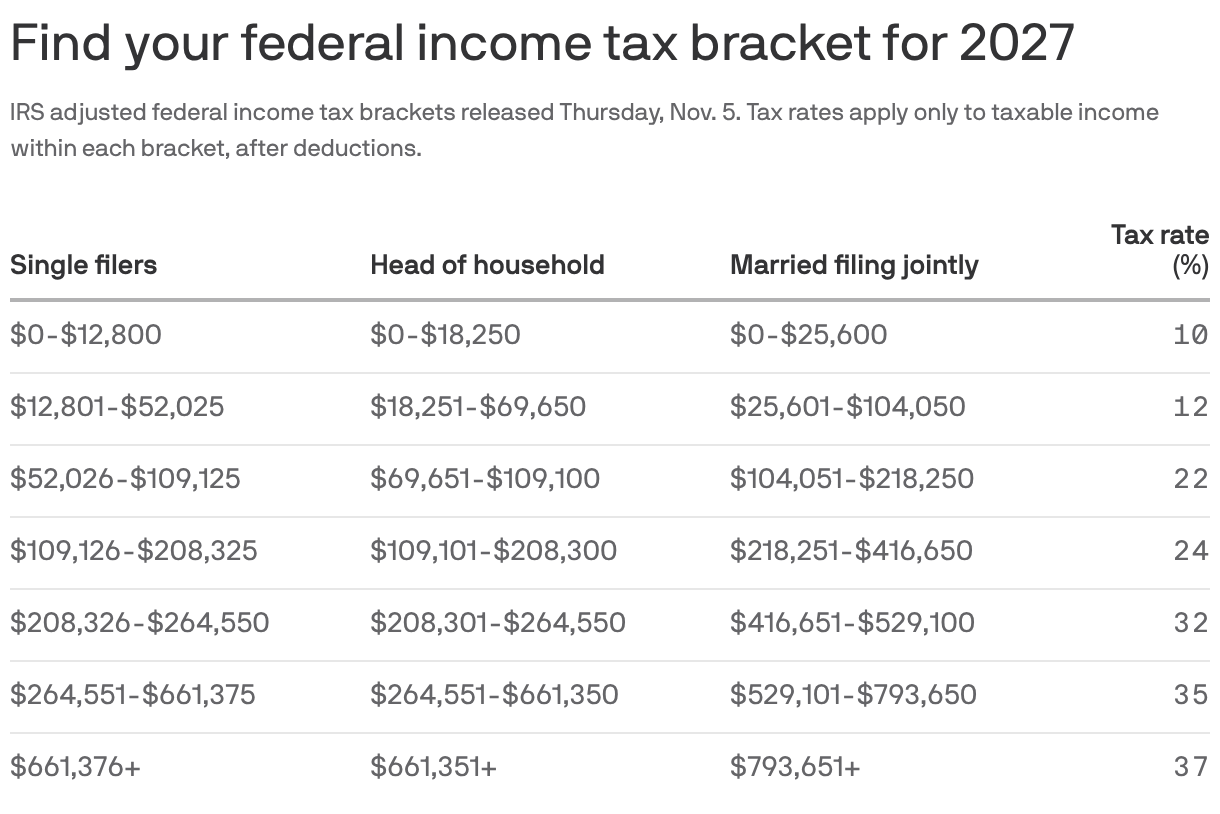
The Internal Revenue Service unveiled new federal income tax bracket thresholds for 2027 on Thursday.
Why it matters: The higher thresholds help protect Americans from paying more in federal income taxes simply because their wages have risen with inflation.

What October's jobs report means for Fed monetary policy
Looked at in isolation, the new jobs numbers bolster the case for more interest rate increases from the Federal Reserve. Monetary policy decisions, however, don't happen in isolation.
The big picture: The strong October labor market data comes at a moment when inflation, not employment, is the Fed's predominant focus. And it comes after the worst day for financial markets in 18 months, which raised the risk that a broader tightening of financial conditions is underway.
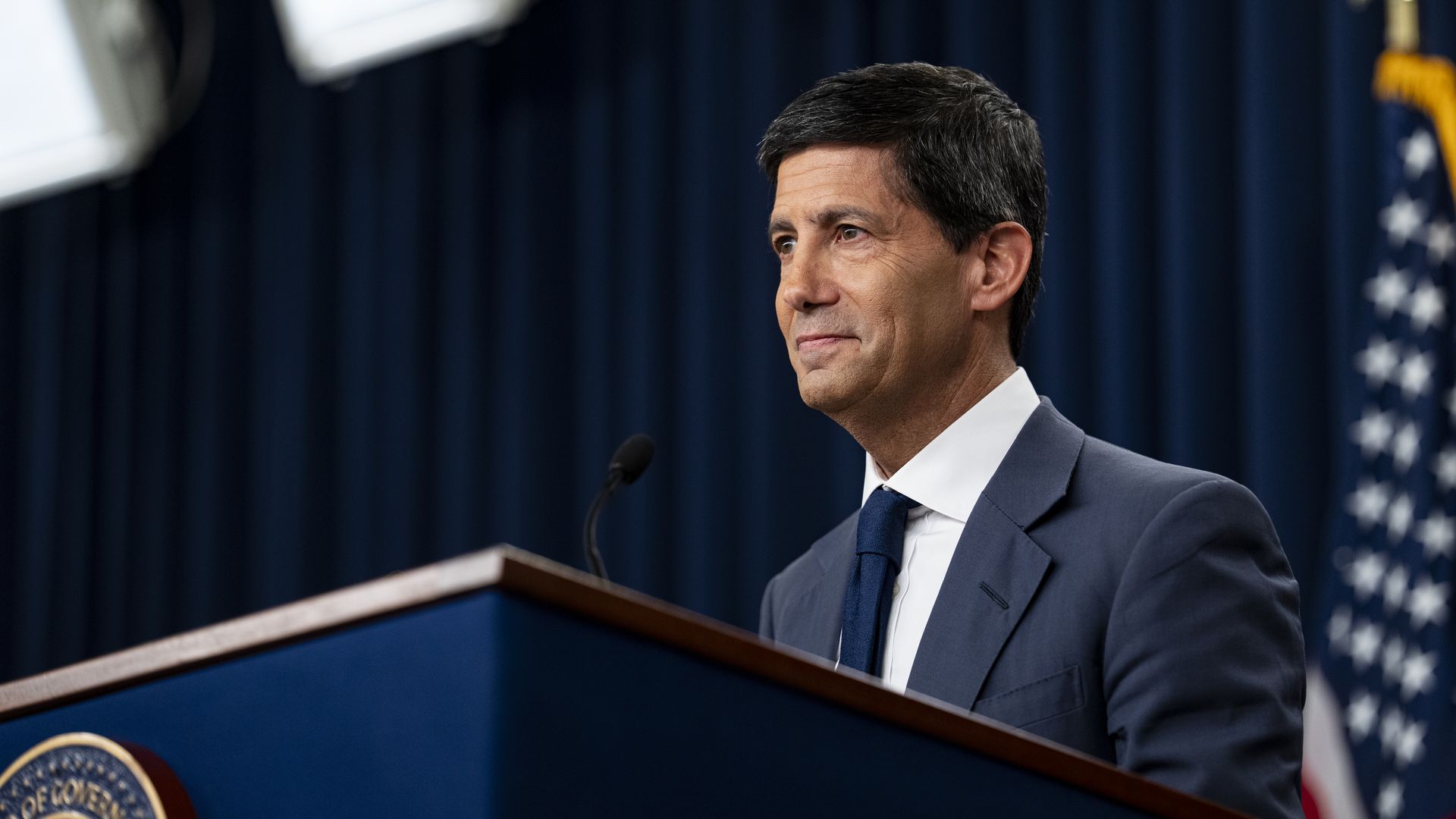
- The new data probably doesn't lock in the kinds of further interest rate hikes that it might against a different backdrop — or a different policy conjuncture, to use chairman Kevin Warsh's favorite phrase.

"Strong hire, low fire" labor market surprises economists


The American job market looks remarkably strong.
- Employers are hiring at a faster pace than almost any economist anticipated, unemployment remains historically low and wages continue to rise.
Why it matters: There are plenty of reasons businesses might be reluctant to hire, including geopolitical uncertainty and the proliferation of AI. Yet the blockbuster report shows employers have continued to add workers at a robust pace, and layoffs remain low across the economy.

U.S. labor market zooms ahead with 165,000 jobs added in October


The U.S. economy added 165,000 jobs in October, while the unemployment rate ticked down to 4.1%, the Labor Department said Friday.
Why it matters: Hiring unexpectedly picked up sharply last month, offering fresh evidence that the labor market is gaining momentum alongside strong economic growth.

It's going to be tough to tap the brakes on the AI race
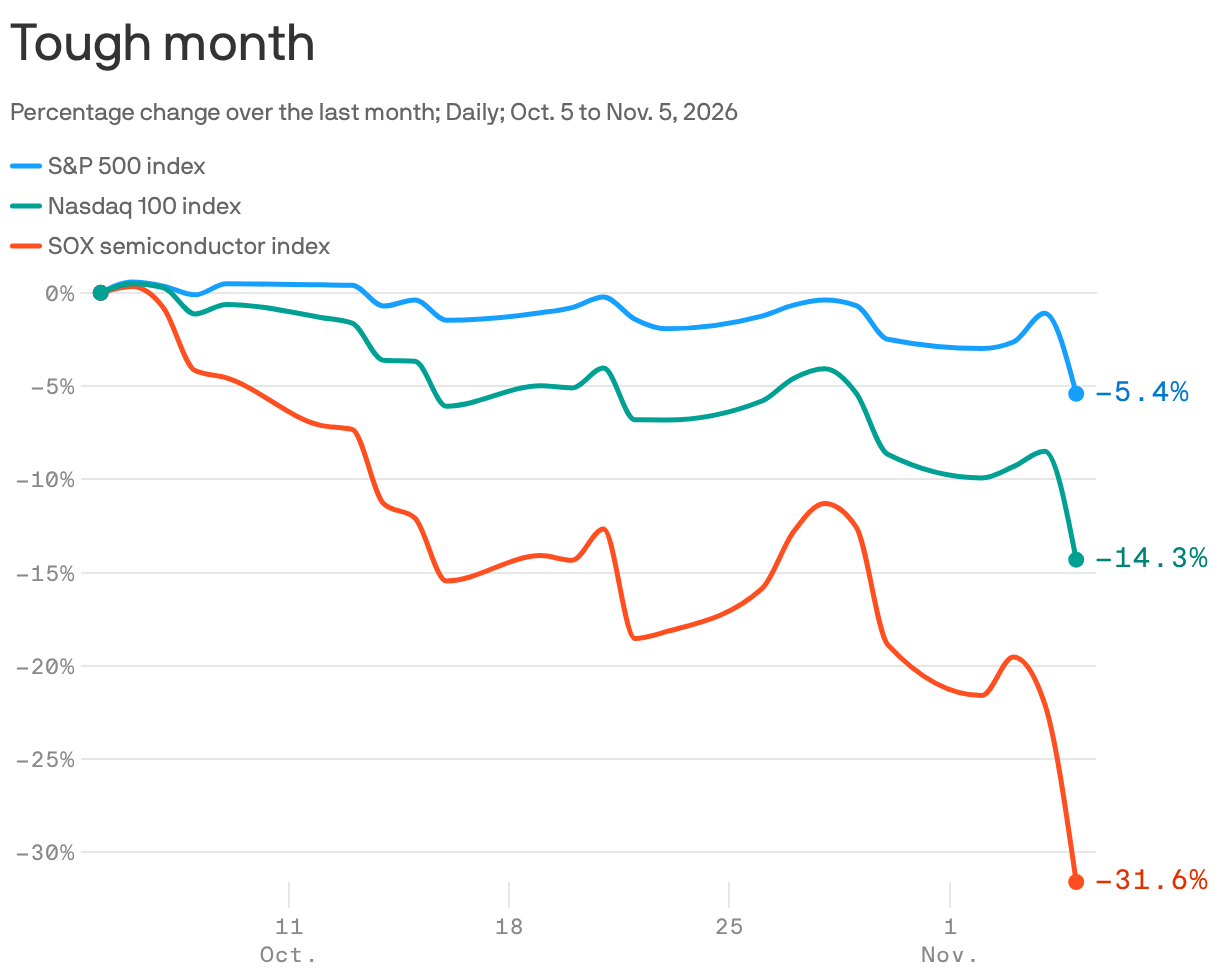
Slowing an investment boom on the scale of the AI build-out is a tricky business — as Thursday's rout in the stock market demonstrated.
Why it matters: Americans may have voted in the midterms to tap the brakes on the AI race, but curbing the investment boom — or some might say, gently deflating the AI bubble — is easier said than done.
The big picture: The historical record shows that once major investment booms are in motion, it can be difficult to temper them without sparking a stampede of investors out of assets.
- That's why market collapses have featured prominently in past investment booms like those in canals, railroads and the internet.
- "We can't control it," John D. Turner, a finance professor at Queen's University Belfast who co-wrote "Boom and Bust: A Global History of Financial Bubbles," tells Axios.
- "People just get spooked, and as soon as they do, then, you know, prices head down. And that's what happens in historical bubbles, and it can happen quite quickly."
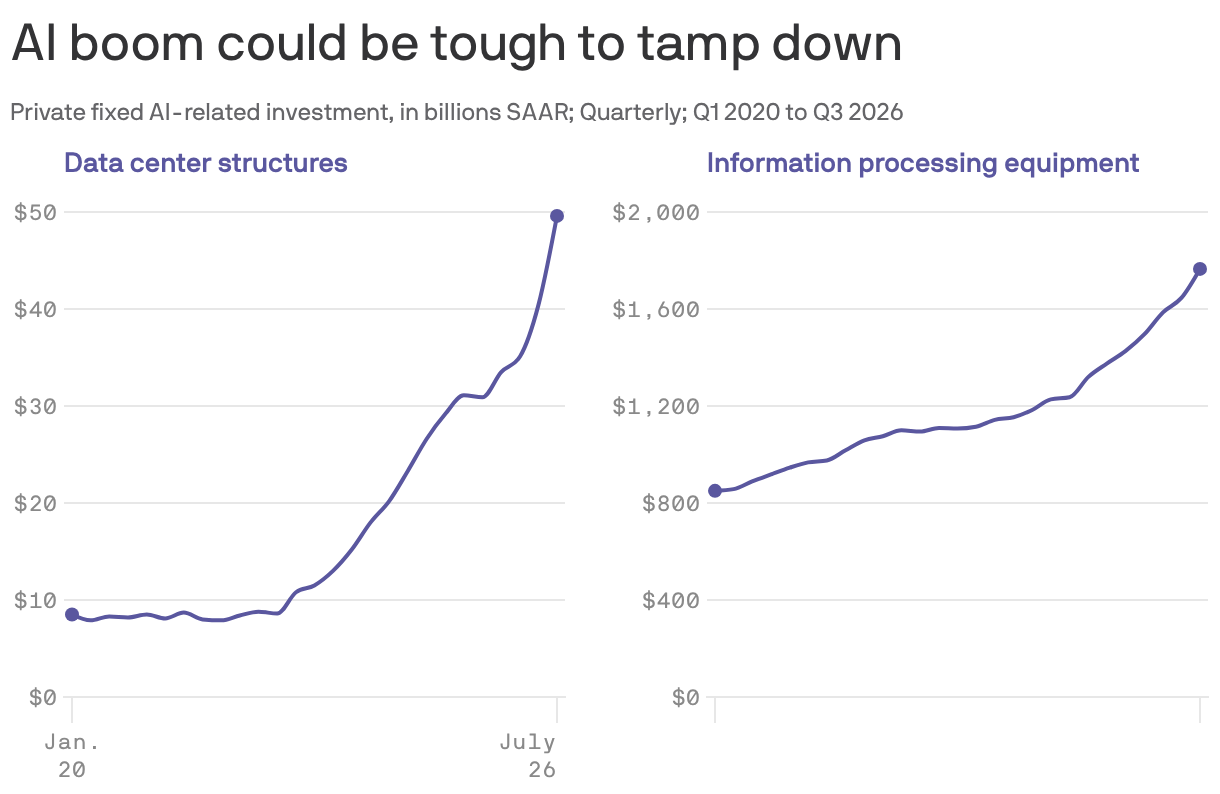
State of play: Tech stocks plunged Thursday as the week has developed into a major test for the market.
- The Nasdaq Composite Index fell 5.5% — its worst daily showing since the quasi-panic of President Trump's "Liberation Day" tariffs in April 2025 — and is down roughly 10% from the high it hit a month ago.
- On Wall Street, a drop of that magnitude is known as a "correction," a term of art indicating a sell-off more serious than a garden-variety decline.
- The Nasdaq 100, a measure of the largest tech stocks, is now down roughly 14% since its Oct. 7 peak. Its 6.4% drop Thursday was its steepest since the March 2020 pandemic panic.
- The SOX semiconductor index also endured its worst day since the pandemic, plummeting 12.3% on Thursday. The broader S&P 500 index slumped 4.4%.
Reality check: The 4-year-old bull market for the blue chips still holds: The S&P 500 is off 6% from its high and is up 7.4% on the year.
Catch up quick: The overwhelming rejection of AI in this week's elections — from wins for AI-cautious Democrats in governors' races in hotbeds of development to overwhelming support for ballot measures restricting data center construction — has pushed investors to reevaluate their previous bets on companies profiting from the data center boom.
Stunning stat: Over 50% of the planned data center capacity is in just three states, Ohio, Georgia and Texas — all states where Democrats just defeated Republicans in gubernatorial races.
- "If you were thinking that there might be some issues when it came to AI investment in the first place — and the AI build-out — well, now you have three key states, all with new governors-elect who are not friendly to the cause," says Steve Sosnick, chief strategist at Interactive Brokers.
Zoom in: Many of the proposed constraints on AI are limited in nature and do not apply to projects already underway. Even so, the market reaction has been ferocious.
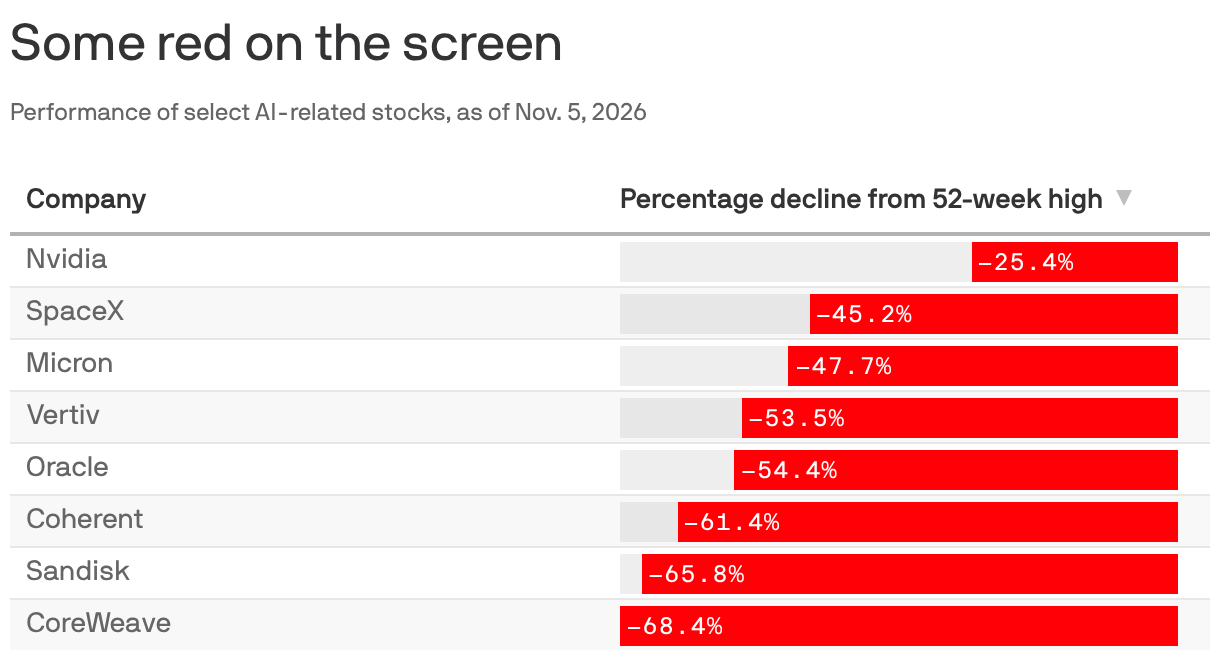
- Stocks tied to the AI build-out were hit particularly hard Thursday, with makers of everything from fiber optic connections (Coherent down 13%, Ciena down 15%) to HVAC systems (Comfort Systems, -11.6%), servers (Dell dove 15%) and semiconductors (Advanced Micro Devices, -17.3%) knocked down, some after enduring deep losses Wednesday.
- Engineering, electrical and industrial equipment stocks closely tied to the boom also collapsed. Quanta Services and Vertiv Holdings plunged 12% and 14%, respectively.
- The so-called hyperscalers — Amazon, Alphabet, Microsoft, Meta and Oracle — were all down, too, though their losses were less lurid, as they could benefit from any slowdown in AI spending as a result of increased regulatory scrutiny.
Between the lines: To some, the sudden tumble in the markets — futures were actually up a bit in premarket trading — suggested that a large institutional investor may have moved to sell a sizable chunk of a portfolio that had turned south after Wednesday's post-election slump in AI shares.
- Hedge funds had already been selling, as they unwound positions last month at their highest rate in over a decade, per a Morgan Stanley note cited by the Wall Street Journal.
- Elsewhere, retail investors, who in past market downturns have swarmed in to buy the dip, instead dumped shares, acting as heavy sellers of tech stocks Thursday, said Jai Malhi, senior equity strategist at Vanda Research, which tracks trading by individual investors.
What we're watching: For any indications that the volatility hitting the AI trade could prompt Anthropic and rival OpenAI to reconsider plans to offer shares to the public.
- And will the stock market jitters spread to the more sober-minded markets for corporate debt, where a large chunk of data center construction is expected to be financed?
The bottom line: To be continued.

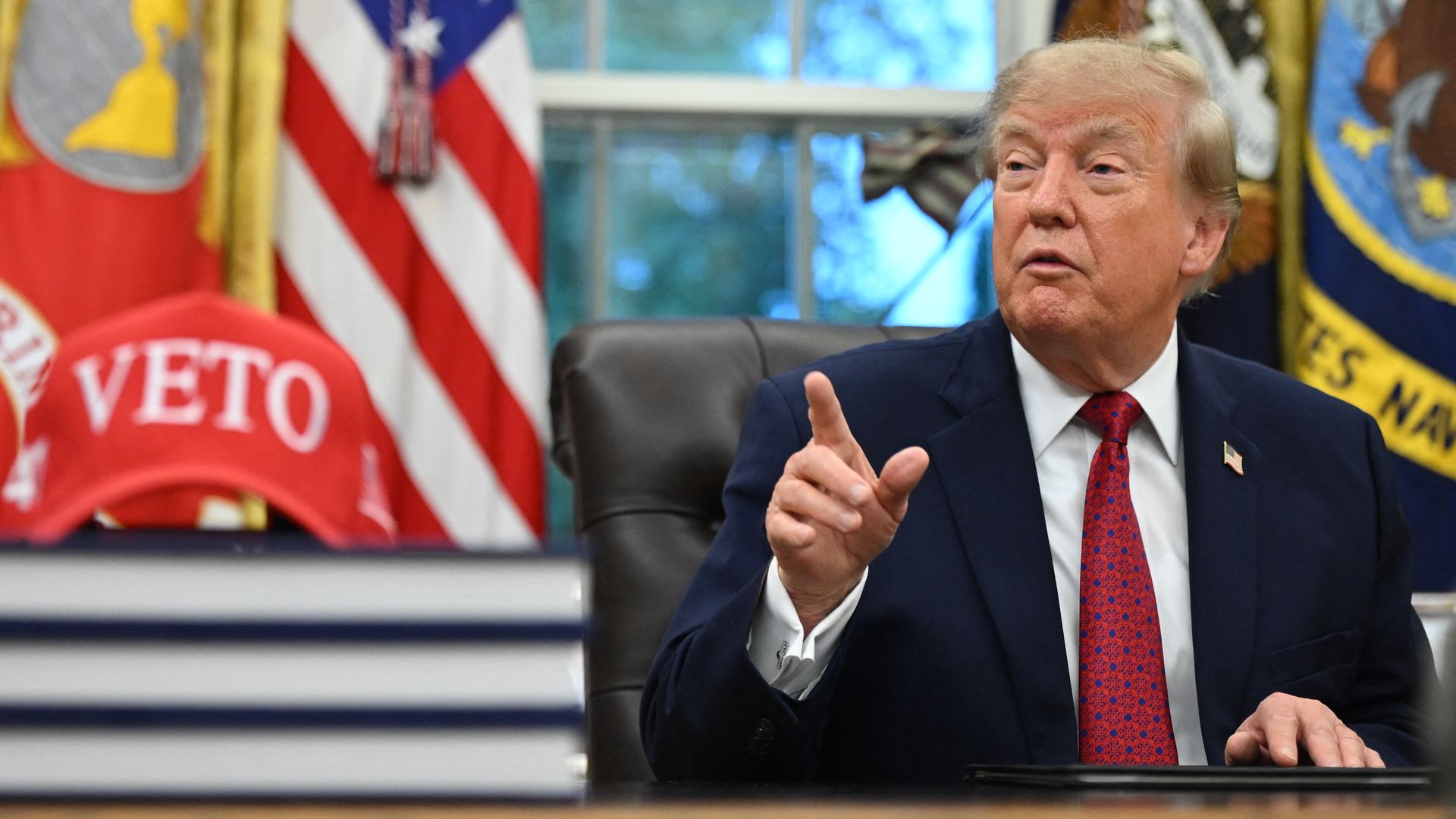
Trump says voters should blame themselves for stock market rout
President Trump said Thursday night that voters had themselves to blame for the stock market's historic sell-off.
Why it matters: Two days after Republicans lost the midterm elections in historic fashion, the president is lashing out at the voters who rejected his candidates and message.

Raman ousts Bass in LA mayor race for historic socialist win
Democratic socialist Nithya Raman toppled embattled Los Angeles Mayor Karen Bass in a stunning upset, putting South Asian immigrants on course to lead America's two largest cities.
Why it matters: With New York's Zohran Mamdani already in office, Raman's win puts democratic socialists on track to run two of America's most powerful city halls — testing whether their promises on affordable housing and better government can survive the pressures of governing.

Tech stocks tumble as election rattles AI trade


Tech stocks plunged Thursday in the most visible sign yet that investors are growing worried about a slowdown in the AI boom.
The latest: The tech-heavy Nasdaq Composite index was down 4.7% at 3 p.m., with just an hour left in trading. The broader stock market was also down sharply.
- The sell-off is shaping up to be the stock market's worst showing since the April 2025 tariff panic.

Saudi-backed LIV Golf is dead
LIV Golf is officially shutting down, with attorneys on Thursday telling a bankruptcy court in New Jersey that the Saudi-backed league would transition from a restructuring plan to a liquidation.
Driving the news: This comes less than 24 hours after investment firm BC Partners walked away from a $300 million investment in LIV Golf, which had been on life support since Saudi Arabia's Public Investment Fund pulled its financial support.

Strong Q3 labor output shows a productivity surge


Productivity growth was strong in the third quarter, the latest sign that America's growth potential looks bright.
Driving the news: Output per hour of labor rose at a 3.6% annual rate in the July through September period, the Labor Department said Thursday morning, the strongest in a year.


Now comes the test for Dems: household budget relief
Democrats won the midterms on voter frustration with high prices. Now they face the same problem that sank Republicans: Americans want lower prices, and there is little that policymakers can do to deliver them quickly.
Why it matters: Prices for necessities like groceries and gas can fall in a healthy economy. But the kind of broad price declines that would reverse years of price gains would likely come with job losses and falling incomes, leaving households worse off than before.
- It sets up an early test for the incoming Democratic-controlled Congress and Democrats in statehouses across the country: delivering relief that voters can actually feel in their household budgets.

Zipline raises $1.5 billion to expand drone delivery
Zipline, a South San Francisco-based drone delivery service, on Thursday announced that it's raised $1.5 billion at a $21.5 billion post-money valuation. It also expanded its Walmart partnership.
Why it matters: Drone delivery may eventually supplant data centers as the target of local community ire against Big Tech, as evidenced by a recent battle between my hometown and Amazon.

Big Tech scrambles to offer voters a new AI deal
The AI industry is scrambling to repackage a $10 trillion infrastructure buildout to appease a hostile electorate that overwhelmingly voted to restrict data center construction in ballot measures across the country.
- It's not just changing the name of data centers to "compute campuses," but offering communities real money, including dividends and benefits for schools or cities, plus environmental concessions and labor protections.
Why it matters: Tuesday's election proved voters won't tolerate unchecked growth, although the market and many analysts see the blue wave slowing — but not stopping — data center construction around the U.S. To prevent an existential threat, the world's biggest companies are working on a rebrand.
- How well they execute on their promises will determine the pace of the global AI race.


Why this could be the AI pause that refreshes
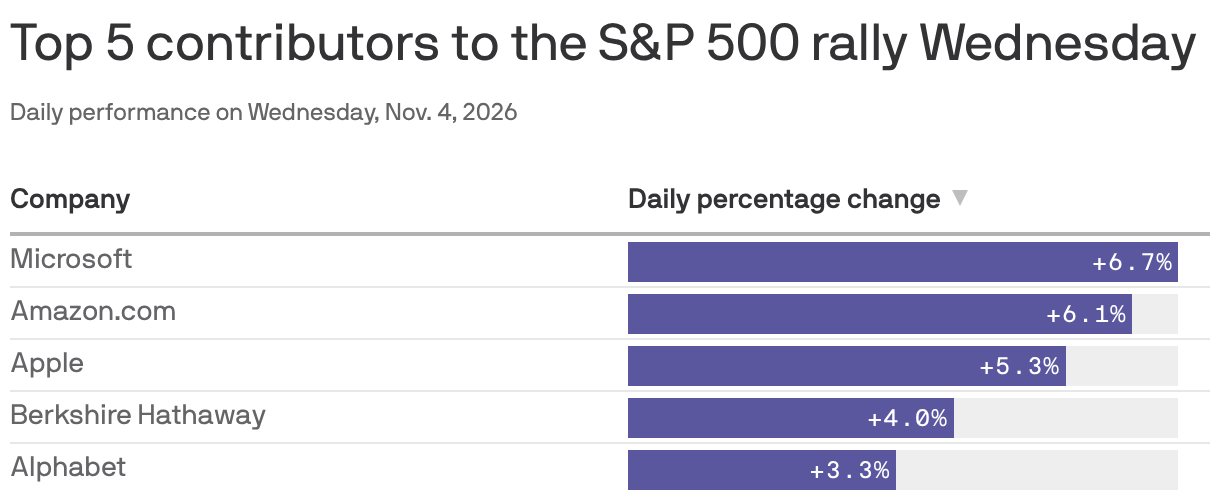
Voters clearly put the brakes on the AI buildout this week, but the biggest tech companies kept on rolling.
Why it matters: The rally in the shares of the likes of Microsoft and Amazon reflects a growing realization on Wall Street that a slowdown in the AI race may not be such a bad thing.
- If companies can put off enormous spending commitments, they get to show healthier cash flows, avoid financing costs and possibly sidestep risky investments.

After midterm defeat, Trump faces mostly bad options in Iran
President Trump has conceded that the Iran war cost Republicans dearly in the midterms. Now he must decide whether to cut his losses and reach a deal — or double down and go back to bombing.
Why it matters: All of Trump's options are problematic:
The first is to strike. But going back to war would be highly unpopular — keeping gas prices high and probably not yielding a better military result.
Another is to negotiate. But if Iranian officals refuse to make concessions — or, sensing weakness after the president's political loss, up their demands — Trump will have a hard time reaching a deal.