IRS reveals 2027 tax brackets. Find yours here

Add Axios as your preferred source to
see more of our stories on Google.
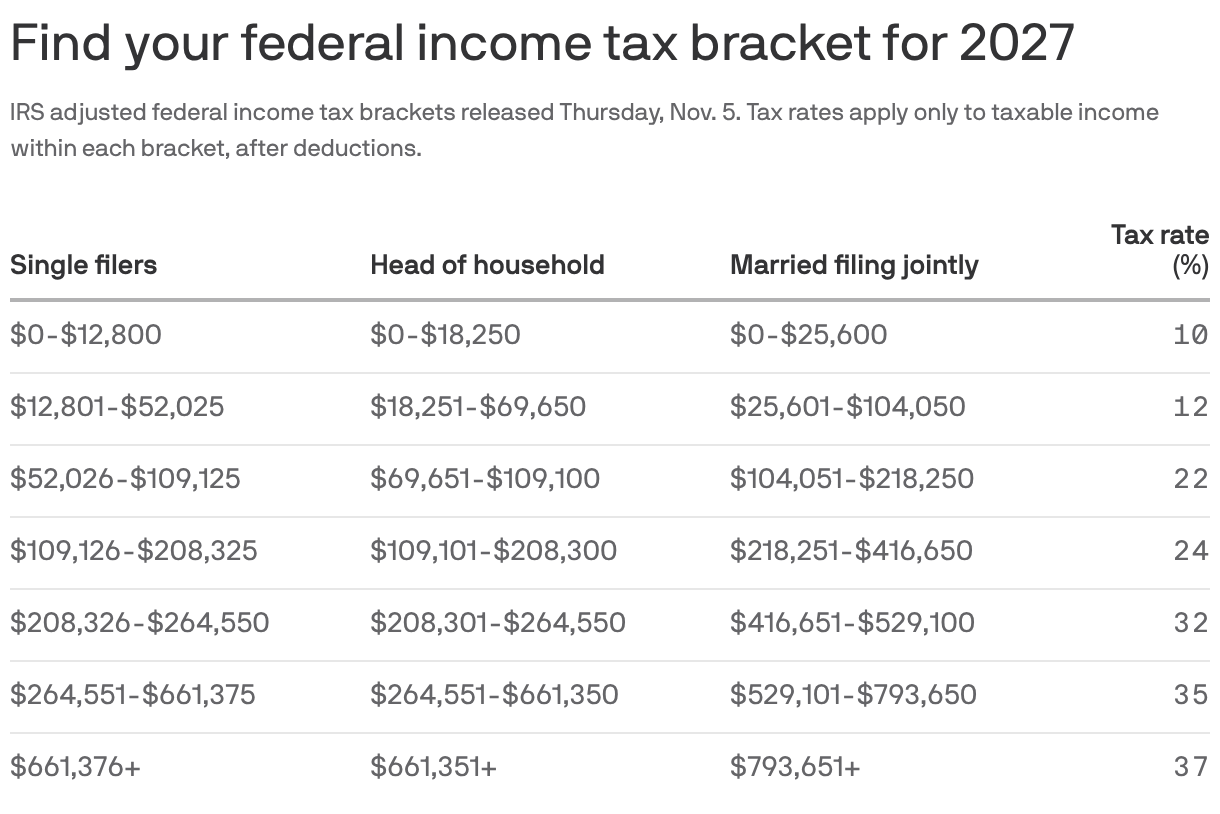
The Internal Revenue Service unveiled new federal income tax bracket thresholds for 2027 on Thursday.
Why it matters: The higher thresholds help protect Americans from paying more in federal income taxes simply because their wages have risen with inflation.
Driving the news: The IRS said the seven federal income tax rates will remain unchanged in 2027, ranging from 10% to 37%, while the income thresholds for each bracket will rise.
- Standard deductions will climb to $16,600 for single filers and $33,200 for married couples filing jointly, up by $500 and $1,000 from 2026, respectively.
- For heads of households, the standard deduction will be $24,925.
- The IRS said the maximum child tax credit for 2027 is $2,300, an increase of $100 from 2026.
The big picture: Annual adjustments are designed to prevent "bracket creep," when inflation pushes taxpayers into higher tax brackets without increasing their purchasing power.
The fine print: Tax brackets apply to taxable income after deductions, with each rate applying only to income within that bracket. The 2027 figures apply to tax returns filed in 2028.
