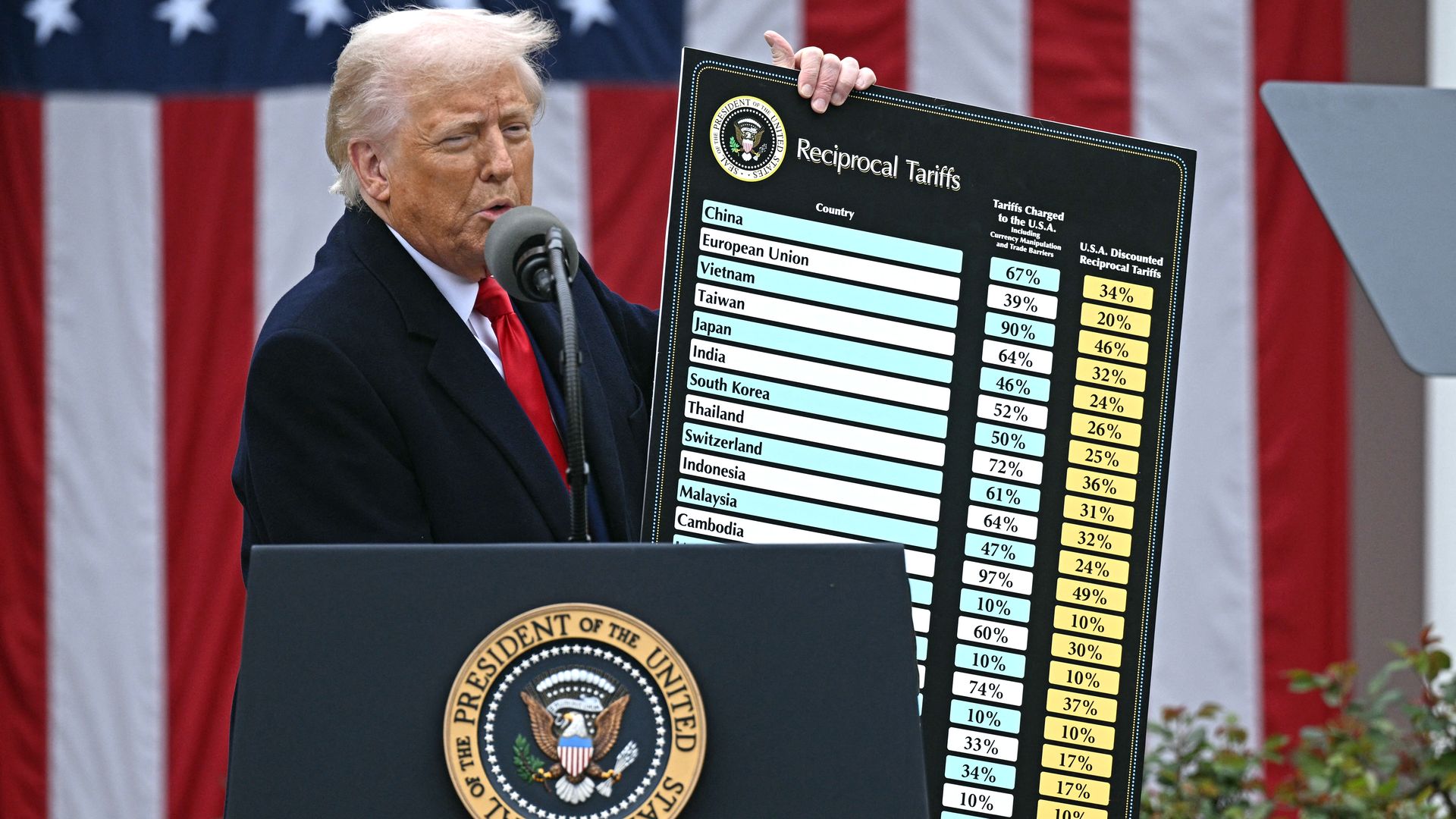
Costco said Thursday it would return any recovered tariff charges to members through lower prices and better values, even as CEO Ron Vachris warned that the "future impact of tariffs remains extremely fluid."
Why it matters: The warehouse giant is positioning itself as a buffer between trade policy volatility and shoppers' wallets.
The Commerce Department is moving ahead with draft rules to expand federal oversight of AI chip exports, but President Trump opposes any approach that mirrors former President Biden's restrictions, a senior White House official told Axios.
Why it matters: The draft regulations would give the government sweeping control over AI chip exports abroad as companies like Nvidia and AMD seek to enter more markets.
The Trump administration is reportedly weighing rules that would require foreign buyers to obtain licenses from the U.S. government to buy American AI chips.
Why it matters: The AI chips sector has been flourishing as tech companies ramp up their spending on data centers and new AI models, underpinning the broader market.
Why it matters: While the new index from Claude's maker shows "limited evidence" that AI has affected joblessness so far, the effort enters a larger debate among economists over how a possible "AI labor doom and gloom" scenario should be tracked in the first place.
Victoria's Secret is betting that making lingerie "fun" again can reverse years of heavy discounting and sliding sales.
Why it matters: Results released Thursday suggest the company is beginning to rebuild brand relevance and pricing power after a decade marked by an outdated image, cultural backlash and intensifying competition.
When war breaks out, micro issues have a way of quickly becoming macro issues. Specific blockages and bottlenecks tend to cause broad supply disruptions and price pressure.
And so it is with the war in Iran.
Why it matters: Global supply chains have already been facing years of stress, first from the COVID-19 pandemic and then from the rise of tariffs and other trade barriers. The Middle East conflagration adds a new layer of stress.
The good news for American consumers is that the biggest effects on the U.S. economy are likely to be second-order — but that's not the same as non-existent.
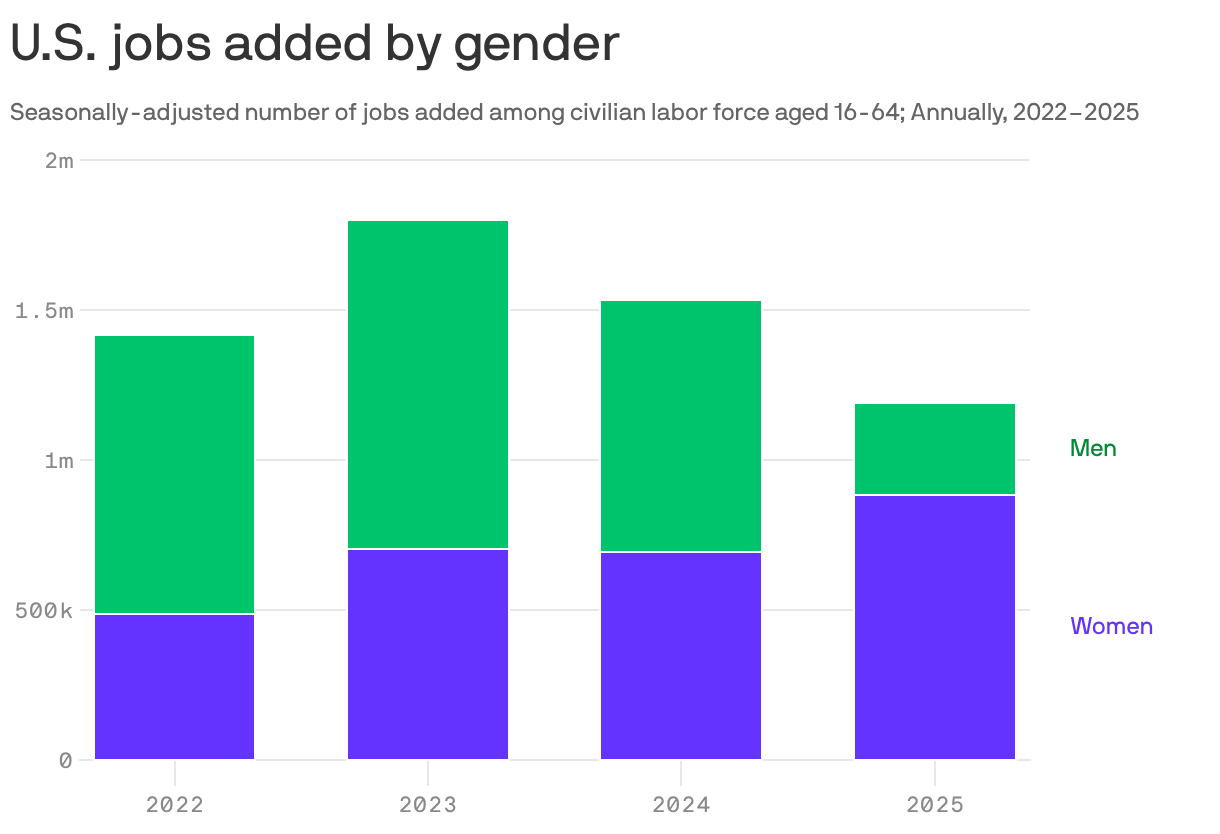
Data: Bureau of Labor Statistics via Bank of America Institute. Chart: Axios Visuals
Women's History Month is here, along with some data showing that women drove most of the job growth in the U.S. last year.
Why it matters: The strongest areas for job growth were in health care and education, two areas where women dominate.
On the flip-side, male-dominated sectors, like construction, had less growth, in part because the White House immigration crackdown made it harder to find workers.
Zoom in: Last year, the number of jobs added by women was nearly three times the rate of men, according to data from the Bureau of Labor Statistics highlighted in a new report from Bank of America Institute.
Private education and health care — where women account for 77% of workers — drove the increase, the report explains. Those sectors added around 800,000 jobs in 2025.
All other sectors, including the government, lost around 500,000 jobs.
Reality check: It was a weak year for the job market overall. Black women, for instance, saw a spike in unemployment.
What to watch: We'll get a better sense of the labor market tomorrow, when the Bureau of Labor Statistics releases employment data for February.
The January report found that health care was still driving much of the nation's job growth this year. Construction employment showed signs of improvement, after growth was essentially flat in 2025, per the report.
The dollar is so back. The U.S. currency — subject to a good deal of bad press for the past year or so — has strengthened in value against other currencies since the Iran war began.
Why it matters: It's not that people are falling in love with America again. It's more as if investors are running for safety toward the best option. And, like it or not, that's still the U.S. dollar.
Target is expanding its store footprint — opening its 2,000th location this month and outlining plans to add more than 30 new stores in 2026.
Why it matters: The Minneapolis-based retailer is betting that better stores, faster fulfillment and more locations will fuel its next growth chapter under new CEO Michael Fiddelke — choosing to expand while many retailers scale back.
A top trade court ordered the Trump administration on Wednesday to start refunding tariffs to U.S. businesses.
Why it matters: The order is the most significant to date in what is expected to be a politically fraught, and possibly lengthy, process of getting hundreds of billions of dollars back to importers.
Robinhood rolled out new products to let families manage money together on the platform, including a feature that allows users to share or not share certain accounts — which could include prediction trades or other investments — from other family members.
Why it matters: Robinhood says prediction markets are its fastest-growing business ever.
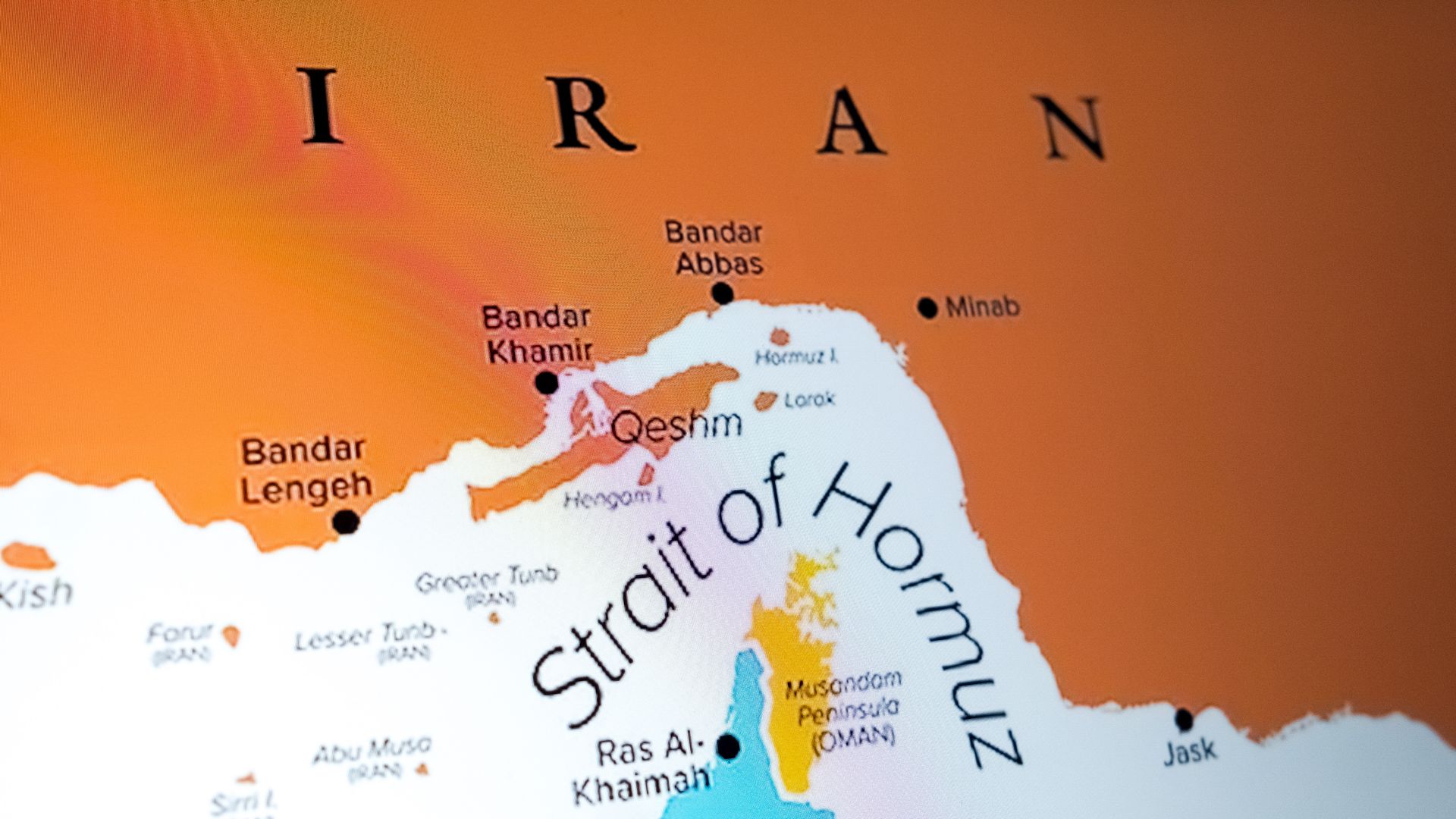
The U.S. and Israel's war with Iran is likely to impact people around the world as tensions escalate around the Strait of Hormuz, a waterway on Iran's southern coast, where traffic has ground to a halt.
Why it matters: Trade disruptions along this key waterway on Iran's southern coast that handles 25% of the world's maritime oil trade and 20% of liquefied natural gas shipments will likely produce a domino effect across the global economy.