Iran war adds new layer to supply chain stress

Add Axios as your preferred source to
see more of our stories on Google.
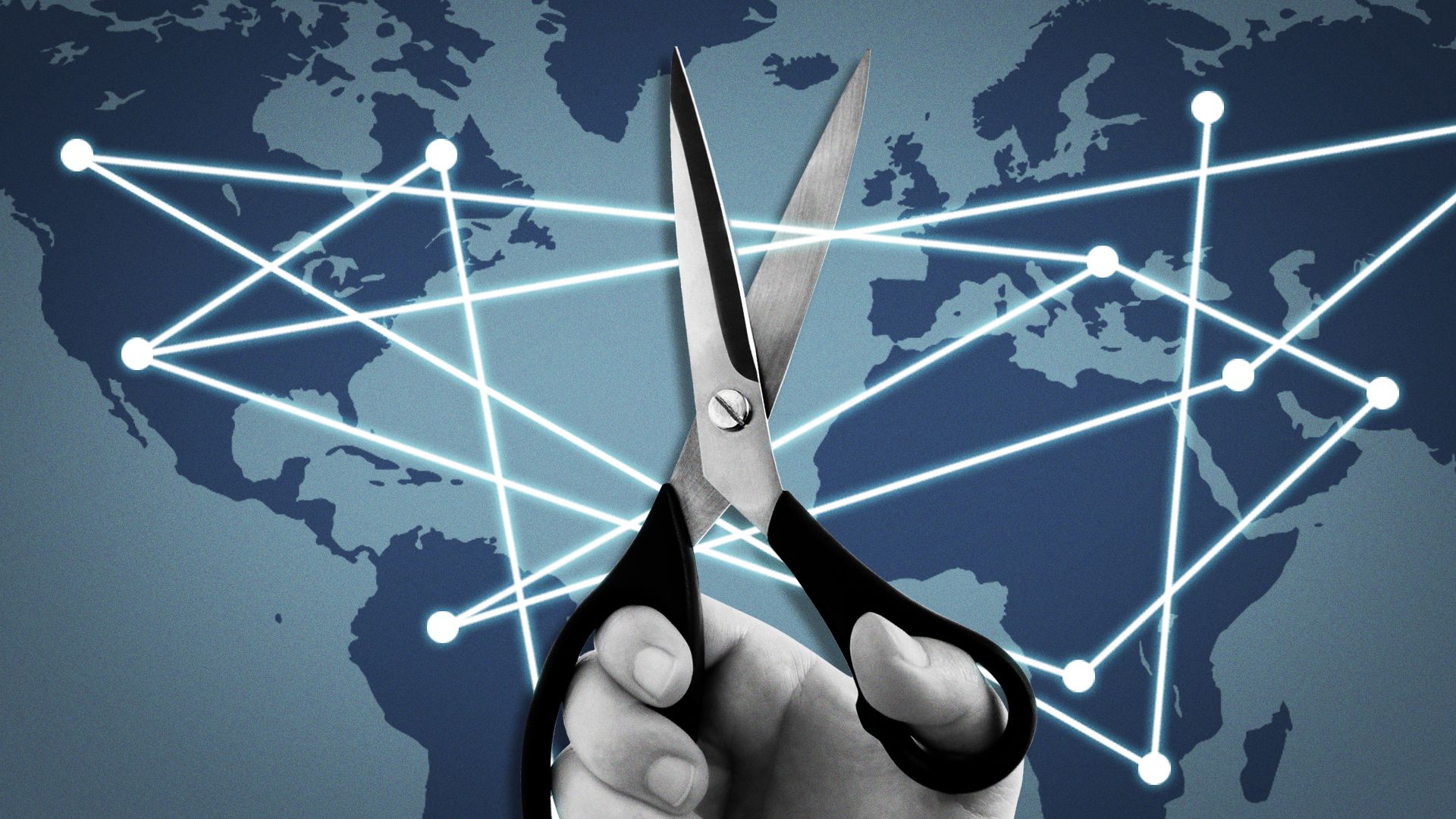
Illustration: Maura Losch/Axios
When war breaks out, micro issues have a way of quickly becoming macro issues. Specific blockages and bottlenecks tend to cause broad supply disruptions and price pressure.
- And so it is with the war in Iran.
Why it matters: Global supply chains have already been facing years of stress, first from the COVID-19 pandemic and then from the rise of tariffs and other trade barriers. The Middle East conflagration adds a new layer of stress.
- The good news for American consumers is that the biggest effects on the U.S. economy are likely to be second-order — but that's not the same as non-existent.
State of play: Iran has vowed to attack commercial ships seeking to pass through the Strait of Hormuz, the chokepoint that connects the Persian Gulf to the Indian Ocean, and thus Asia and Europe.
- It has also launched drone strikes that have disabled production of liquefied natural gas in Qatar for export, which reports say will take weeks to restart — thus limiting exports of an important fuel for electricity generation and industrial uses.
- On the other side of the Arabian Peninsula, container ship traffic through the Suez Canal connecting Asia and Europe has already been rerouted around Africa due to attacks by Houthi rebels. The Iran conflict threatens to prolong that disruption.
Between the lines: The direct hit to energy and other supplies falls most heavily outside the U.S., as reflected in stock prices being down much more in Europe, Japan and South Korea than in the U.S.
- Yet markets are global. Disrupted energy supplies to those nations are also likely to mean higher prices for Americans, as the worldwide price of oil and natural gas rises and the production of goods that the U.S. imports is impaired.
- That's all the more true when global supply chains are already under extreme strain.
What they're saying: "I liken global supply chain linkages to financial linkages around the world," Christopher Hodge, chief U.S. economist at Natixis CIB Americas, tells Axios.
- "You can see some direct links, but there are these indirect links you can't necessarily see or predict," says Hodge, a former U.S. Treasury and New York Fed staffer. "One small ripple in one place turns into a tidal wave elsewhere."
- "Shipping costs can ripple across the globe and put upward pressure on costs, even for goods that are not going through the Strait of Hormuz."
Reality check: As the last several years have shown, global supply chains can be surprisingly resilient even when under extreme stress.
- The U.S. government is using targeted actions to try to keep commerce flowing.
- And President Trump said Wednesday that the U.S. will offer "political risk insurance and guarantees" for tankers in the Persian Gulf, as well as Navy escorts through the Strait of Hormuz.
Yes, but: That may help avoid disruption in the near term, but isn't a long-term solution for shipping if the Middle East remains a conflict zone.
The bottom line: "Global supply chains are a lot less resilient than they once were," Hodge says.
- "We've gone from a global supply chain that was trying to maximize efficiency to one that is a lot tighter, and I think there's going to be a more direct pass-through from energy shocks to consumer goods."
