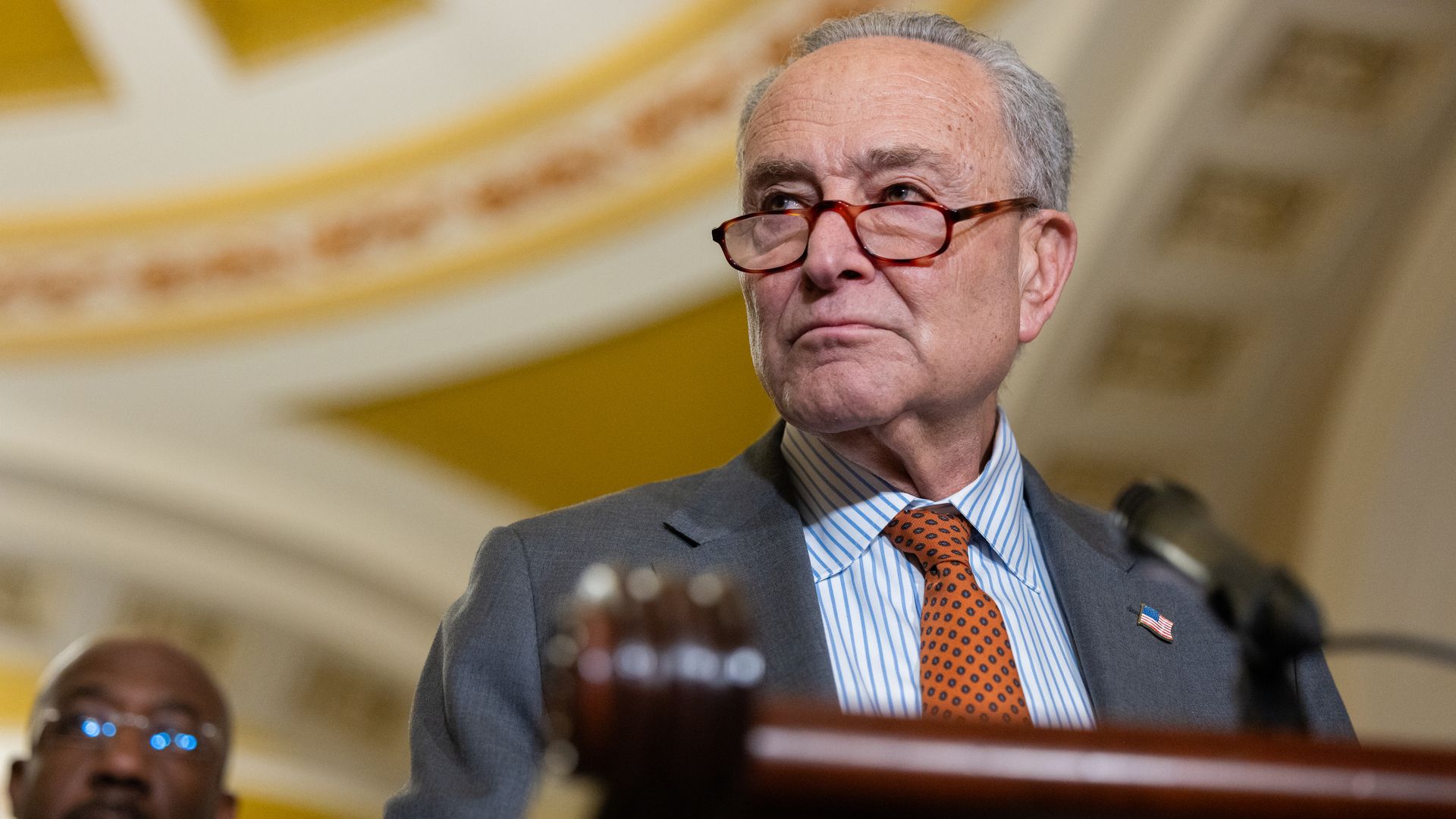
Senate Majority Leader John Thune is blazing forward with a controversial move to repeal California's EV mandate — and Democratic Leader Chuck Schumer is warning it will come back to bite him.
Why it matters: Schumer (D-N.Y.) all but threatened to deploy similar strategies to get around opinions by key, nonpartisan rule makers if and when he grabs back control of the chamber.
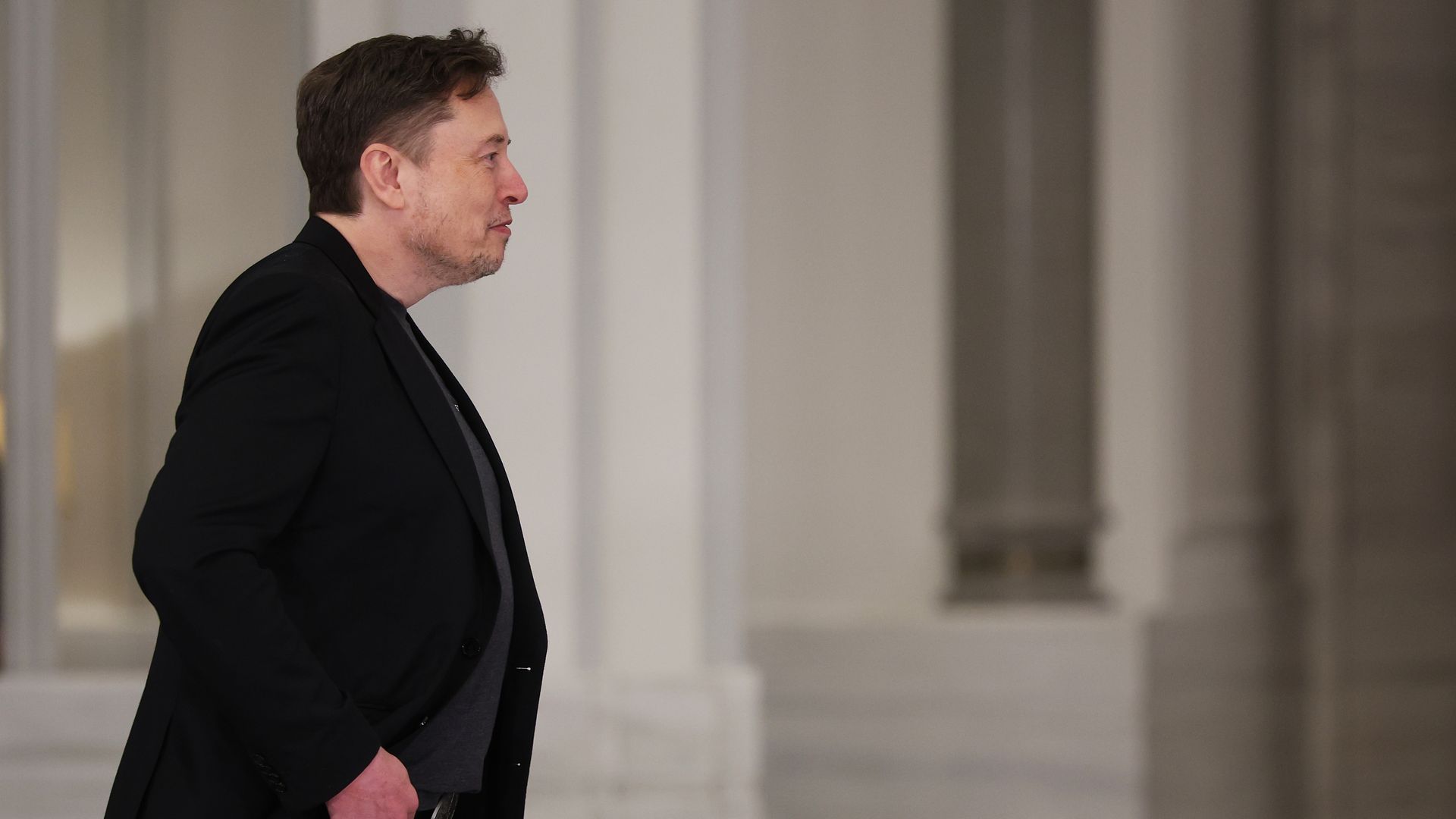
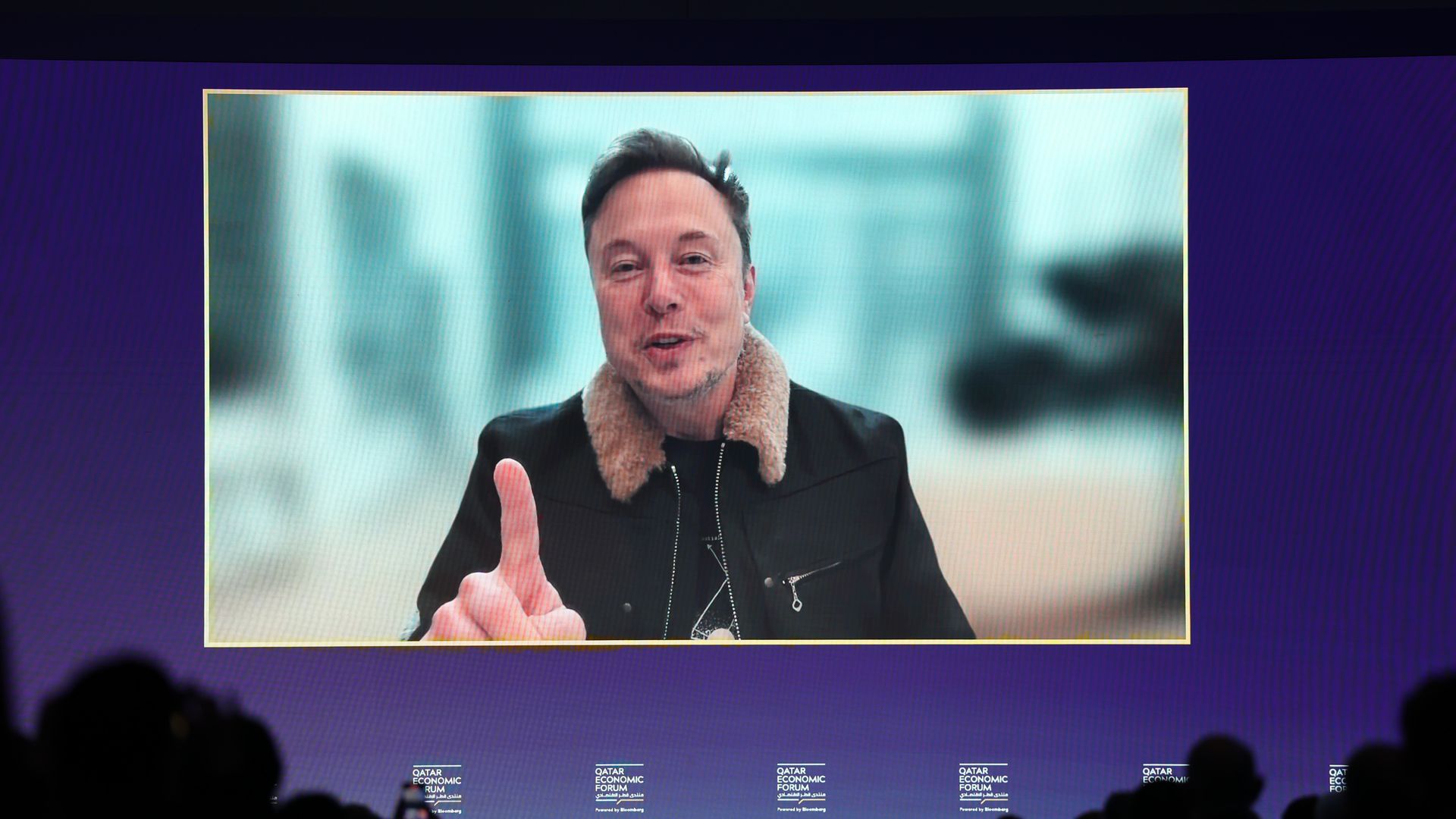
Elon Musk ramped up his effort to turn the wheel back toward Tesla today, after coming under pressure to contain the political firestorm threatening to scorch the brand.
Why it matters: Tesla's sales declined in the first quarter amid a backlash to his political support for President Trump and his leadership of the budget-slashing Department of Government Efficiency.
Driving the news: Musk today focused largely on Tesla's future during live interviews with CNBC and Bloomberg's Qatar Economic Forum. He said:
He'd remain CEOfor at least five years, and he's dialing back his political spending after pledging last month to reduce his time on DOGE.
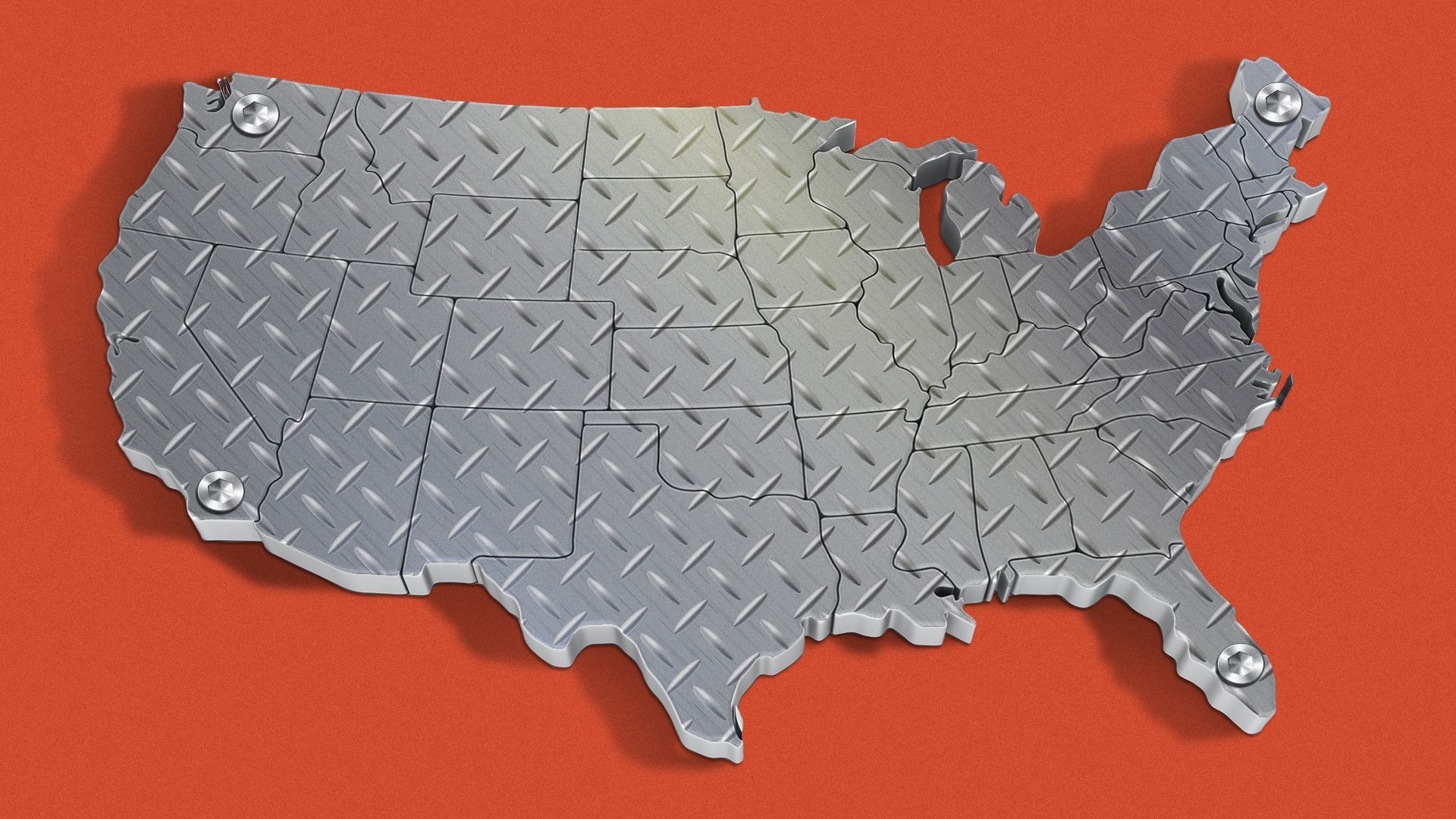
Not to pour cold water on the make-it-in-America movement, but if showerheads are any indication, it's going to be an uphill battle.
State of play: Showerhead maker Afina recently offered two versions on its site as an experiment to see how customers would respond:
A "made in Asia" version for $129.
A "made in the USA" version for $239 (to cover the extra costs of an American supply chain).
The results: 584 sales of the imported model.
Zero sales of the domestic version.
What they're saying: "I was expecting the cheaper, Made-in-Asia [version] to quote-unquote 'win.' But I was not expecting that the results were this off balance," Afina founder Ramon van Meer told NPR.
💭 Nathan's thought bubble: People like the idea of buying something made in the USA unless it hurts their pocketbooks, in which case values have a peculiar way of fading away.
Google's AI shopping tools will now let you virtually try on clothes using your own photo, the tech giant announced Tuesday at its I/O developer conference.
Why it matters: AI is reshaping how we shop. It's going beyond recommending products and helping consumers visualize and buy products.
Why it matters: The company's sales declined in the first quarter amid a backlash to his political support for President Trump and his leadership of the budget-slashing Department of Government Efficiency.
Come June, the CFTC will have just two of five commissioners — a leadership gap that could slow things down unless the White House and Senate pick up the pace.
Why it matters: The CFTC oversees derivatives markets, making it the closest thing to a regulator for trading in assets like bitcoin, ether and prediction markets.
And there's talk about giving the agency expanded authority over crypto spot markets in legislation expected this year.
The big picture: That's a good chunk of new policy in need of crafting, a task made even more daunting considering a new chair is waiting for confirmation, too.
Federal prosecutors are proceeding with their case against Roman Storm, one of the developers of Tornado Cash.
Why it matters: The DOJ's decision comes as many talking heads interpreted a recent internal department memo to mean the Trump administration didn't intend to pursue crypto-related crime.
Catch up quick: Tornado Cash is a privacy protocol running on the Ethereum blockchain.
Its use was prohibited under the Biden administration, until the courts revoked that designation in November. Then the Trump Treasury dropped the sanctions in March.
Yes, but: That hasn't seemed to have helped the team that built the protocol, including Storm, who was arrested in the U.S. in August 2023 and charged on three counts (originally, it was only two).
Texas looks like it could become the latest state to pass Strategic Bitcoin Reserve legislation.
The latest: SB 21 is up for a vote in the state's House of Representatives today, according to the Texas Blockchain Council. It has passed the Senate.
Between the lines: The legislation would just set up the fund.
Catch up quick: Following President Trump's bitcoin reserve initiative, Texas was one of the first to follow his lead, but New Hampshire and Arizona beat it to the finish line.
What's next: The council'sLee Bratcher tells Axios that there is separate legislation in the works to make an allocation to the fund, but just how much has not been decided.
White House economists project that the budget legislation pending before the House will, if enacted, contribute to a stunning rise in the economy's growth path.
Their numbers are eye-popping — and far higher than those that analysts outside the Trump administration are projecting.
Driving the news: In its new analysis of the "big, beautiful bill" that has cleared a key committee and will now go to the floor of the House, the White House Council of Economic Advisers finds that it would add 4.2% to 5.2% to GDP in the short run.
President Trump has opposed Nippon Steel's proposed acquisition of U.S. Steel since almost the moment it was announced. He also is fixated on signing deals that include large foreign direct investment commitments.
Why it matters: We're about to learn which force is stronger.
Pfizeron Tuesday announced a cancer drug licensing deal with Chinese biotech 3SBio that includes a $1.25 billion upfront payment and $4.8 billion in potential earnouts. Pfizer also plans to invest $100 million for an equity stake.
Why it matters: This highlights how globalization is still finding a way in pharma, despite trade tensions that threaten to fracture the market.
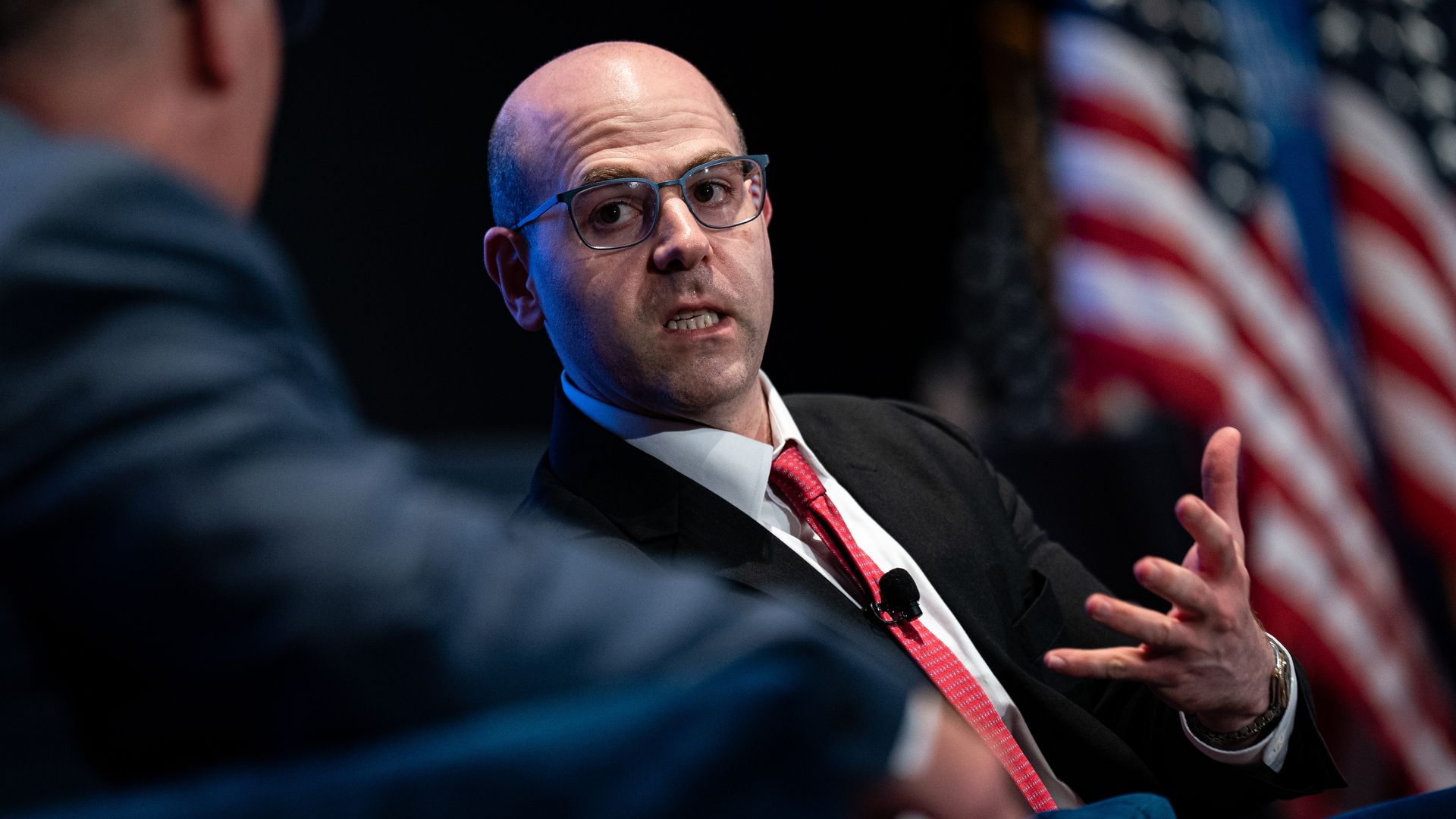
The traditional way to approach projecting the economy is to describe a baseline scenario — what seems like the most likely trajectory — with risks on either side.
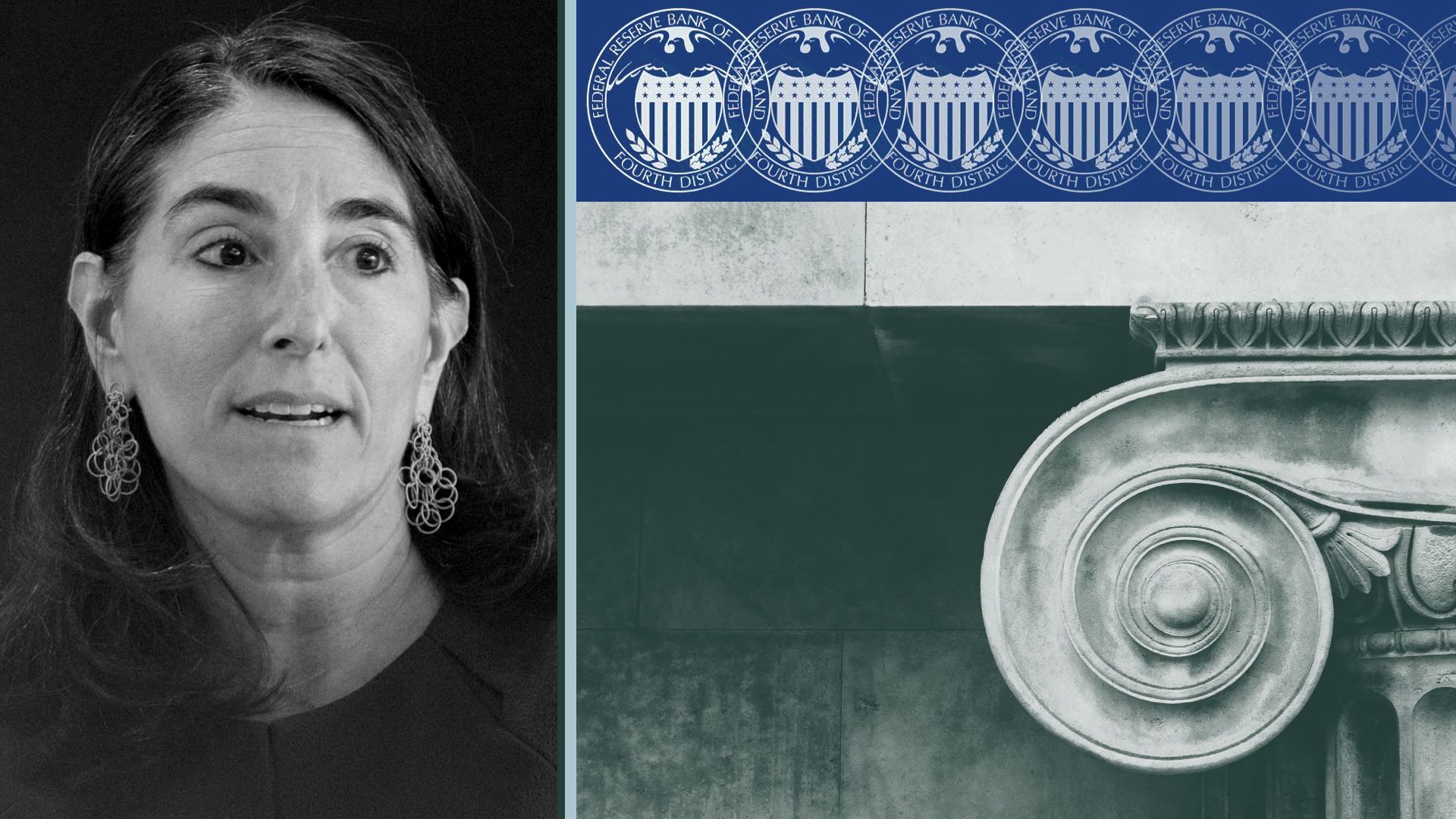
That may not be the best way to think of the outlook right now, a top Fed official tells Axios.
The big picture: With uncertainty around both what trade and other policy changes will bring, and how they will affect employment and inflation, Cleveland Fed president Beth Hammack is thinking about a range of distinct economic scenarios, rather than one base case.
Business reputation is eroding due to consumer concerns about rising costs, according to this year's Axios Harris Poll 100, which assigns reputation scores based on seven categories like trust, products and services, vision and culture.
Why it matters: Companies that have kept costs low while standing firm on their corporate values rank highest on this year's list.
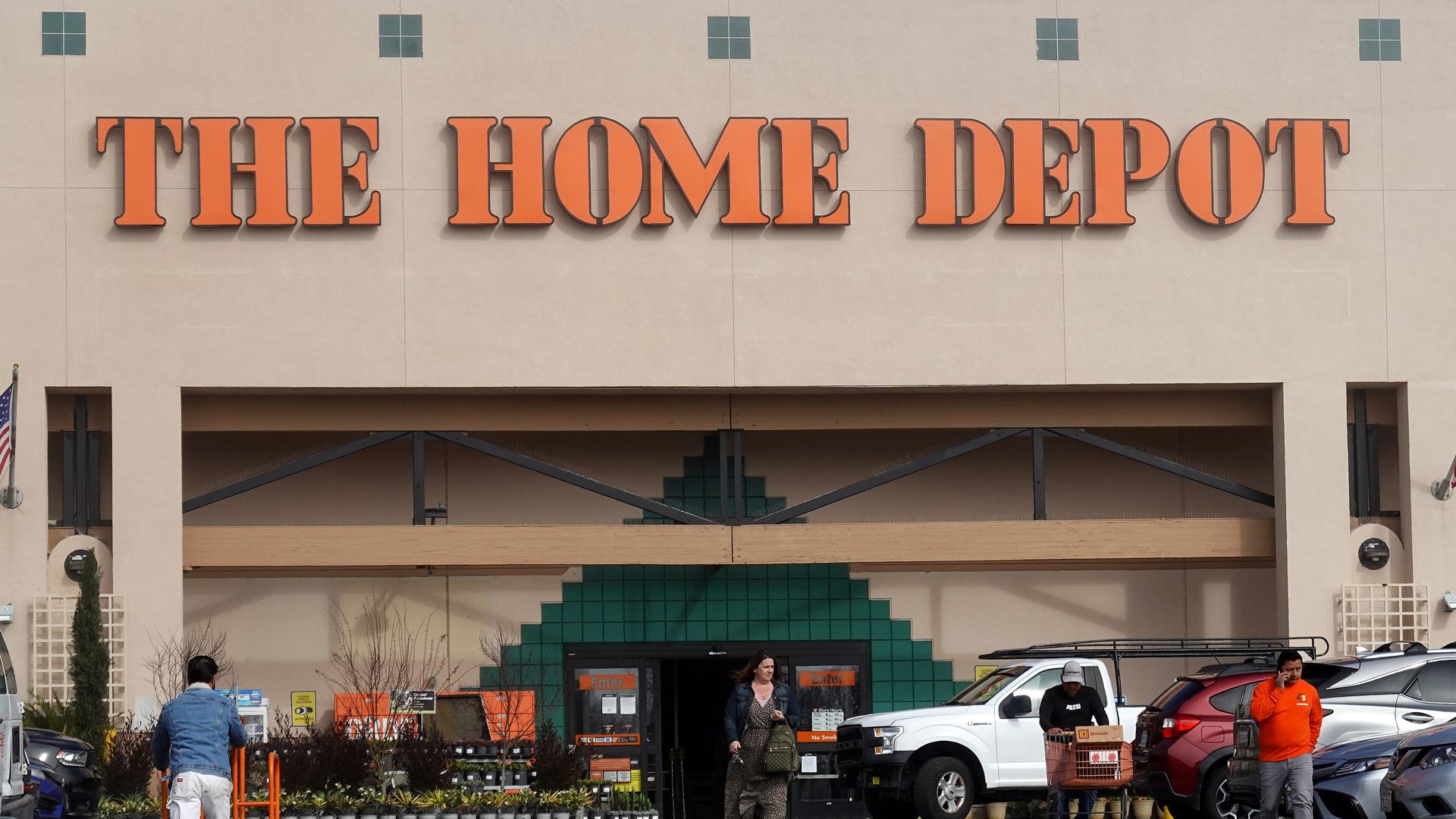
CEO Ted Decker said Tuesday he anticipates that 12 months from now "no single country outside of the United States will represent more than 10% of our purchases."
Why it matters: The Atlanta-based home improvement retailer is handling the impact of tariffs differently from other businesses, especially Walmart, which last week said it would need to raise some prices.
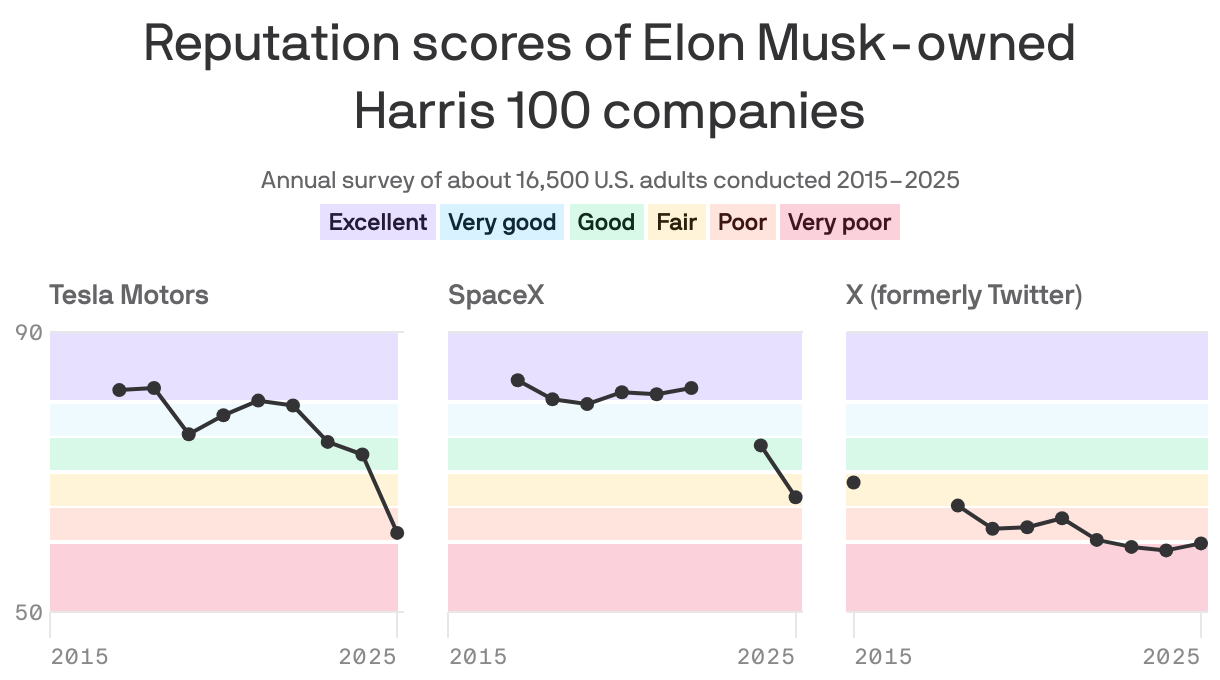
Tesla Motors and SpaceX saw their brand reputations crater in the past year, according to new Axios Harris Poll 100 survey results.
Why it matters: Elon Musk's polarizing political activism appears to have come at the expense of his largest companies, as Republicans expressed more favorable opinions than did Democrats.
There's a good reason why customer ratings on sites like Amazon or Tripadvisor are presented with a visual star rating: Those ratings are perceived as being higher than those presented numerically.
Why it matters: Consumers evaluate ratings differently depending on the format in which the ratings are presented, per a new paper published in the Journal of Marketing Research.
Usually, there's at least one big group that stands to benefit from White House economic policy: businesses, workers or consumers.
Why it matters: In this moment, it's not exactly clear who wins from the current administration's triple play of raising tariffs, cutting workplace regulations, and cracking down on immigration.




/2025/05/20/1747762757183.gif?w=3840)