Exclusive: Cleveland Fed official's three scenarios for tariff-hit economy

Add Axios as your preferred source to
see more of our stories on Google.
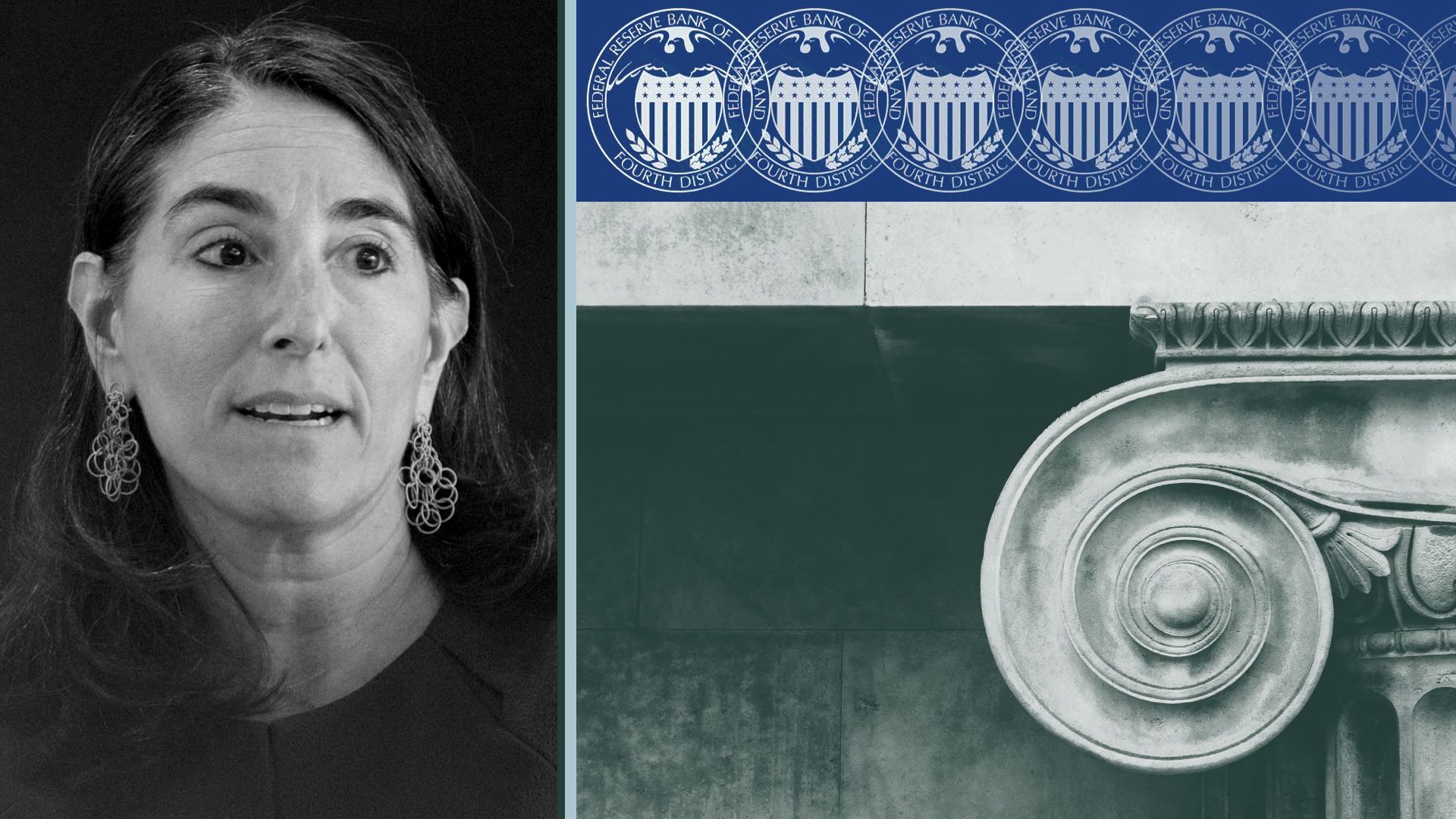
Cleveland Fed president Beth Hammack. Photo illustration: Axios Visuals. Photo: Bess Adler/Bloomberg via Getty Images
The traditional way to approach projecting the economy is to describe a baseline scenario — what seems like the most likely trajectory — with risks on either side.
- That may not be the best way to think of the outlook right now, a top Fed official tells Axios.
The big picture: With uncertainty around both what trade and other policy changes will bring, and how they will affect employment and inflation, Cleveland Fed president Beth Hammack is thinking about a range of distinct economic scenarios, rather than one base case.
- She and other leaders of the central bank will submit their projections for GDP, inflation, interest rate policy and more next month. It's an especially fraught time to be doing so, given complex policy crosscurrents around trade, tax and other policies.
- The so-called Summary of Economic Projections will be published when the Fed's next two-day meeting concludes on June 18.
What they're saying: "I'm grateful that I have four weeks to work on coming up with a modal case, because right now I haven't really been operating with a base case," Hammack said. "I've been operating in a couple different scenarios."
- "To come up with a modal case that you have a lot of confidence in, I think at this particular moment is going to be really challenging," Hammack says.
Scenario 1: Tariffs have a one-off price effect, but economic growth takes a hit from policy uncertainty.
- The possibility that tariffs bring up price levels, but don't do so consistently, results in a one-time increase in prices.
- But Hammack says this might come alongside a "tremendous amount of uncertainty that weighs on economic activity," with growth declining and the labor market falling off.
- "In that situation, we'd want to be attentive to the employment side of our mandate and potentially ease policy — and potentially very quickly, if we had the evidence that this is what was happening," she says.
Scenario 2: The labor market holds up, but tariffs are inflationary.
- It's possible that businesses hold the line on their workforces, a pandemic-era fear that they might not be able to replace staff when the economy bounces back.
- "Because it took them so long and it was so difficult to hire and train their staff over the past several years, it could be the case that they hold on to people for a really long time," Hammack says.
- She adds that in this scenario, price pressures from tariffs become sticky because of the way the levies have been rolled out.
- "It becomes more persistent and more inflationary because the tariffs are layered in — the announcement, the withdrawal, and then the possibility of new announcements," Hammack says.
Scenario 3 is what Hammack sees as most likely: a stagflationary outcome where the economy slows alongside higher inflation.
- "That's where it's really difficult for monetary policy," Hammack says.
- "We're going to have to have good insights and good understanding of how much we're missing each side of the mandate and how long those misses persist — and then we can decide what the right course of action is."
Yes, but: Hammack says there are other factors — including the White House tax bill or its deregulatory efforts — that complicate the forecast.
- "There are a number of other policies that are still yet to be implemented that could have offsetting effects" on trade policy, Hammack says.
- "We don't want to overreact to trade — that's certainly the topic of conversation right now — because there are other policies that are coming into play," she says.
