Nvidia's stock popped after hours following its latest earnings report, which showed the AI boom is still booming.
By the numbers: Revenue from the chip maker's data center unit, which fuels AI efforts for thousands of organizations, reached $18.4 billion in its fourth quarter compared to analyst expectations of about $17.1 billion and up about 409% from $3.6 billion last year in the same period.
Boeing has replaced the head of its troubled 737 MAX program following an emergency blowout involving one of the aircraft during an Alaska Airlines flight last month, according to a memo sent to employees and seen by multiple media outlets on Wednesday.
Why it matters: The executive's departure comes after a federal watchdog said the near catastrophe that's renewed scrutiny on the company was likely caused by missing bolts.
Spiking mortgage rates and high home prices — a dreadful combination that brought America's housing market to a standstill in recent years — is making a comeback after a brief respite.
Why it matters: Financial markets no longer see near-term interest rate cuts after a run of hotter-than-expected inflation data. Those dimmed expectations have consequences for would-be homebuyers waiting for cheaper borrowing costs.
Federal Reserve officials worried about cutting interest rates too soon — fearing progress on inflation could stall out, according to minutes of the central bank's late January policy meeting released on Wednesday.
Why it matters: Most Fed policymakers last month agreed more proof of receding price pressures was necessary before the central bank lowered borrowing costs.
Why it matters: The strong labor market of the past few years emboldened workers and union organizers to take a harder line, pushing more folks to the picket line.
Black women face a wide range of economic factors that inhibit their ability to build generational wealth, according to a new survey by Goldman Sachs' One Million Black Women initiative shared exclusively with Axios.
Why it matters: Income inequality has a wide range of personal and societal implications, undermining families, individual dignity, the economy and political cohesion.
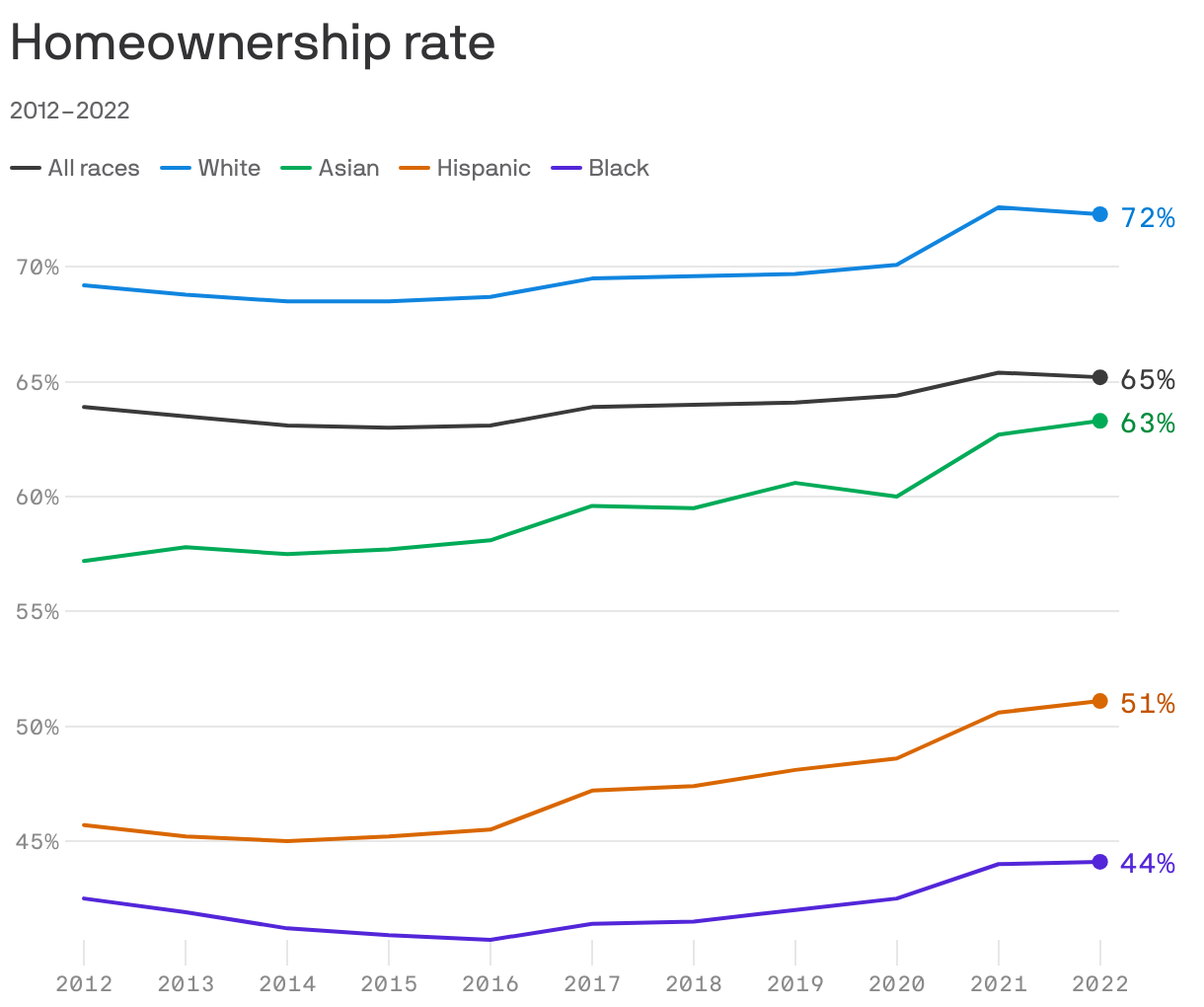
Data: National Association of Realtors; Chart: Will Chase/Axios
The share of Hispanic, Black and Asian Americans who own a home grew over the past decade despite soaring interest rates in the past few years, according to the National Association of Realtors.
Why it matters: Homeownership is "Americans' biggest asset," says Jessica Lautz, deputy chief economist and vice president of research for the association.
The Biden administration approved another $1.2 billion in student loan forgiveness for nearly 153,000 borrowers on Wednesday.
The big picture: The administration has now provided almost $138 billion in relief for more than 3.9 million student borrowers, finding workarounds after the Supreme Court blocked President Biden's signature student loan forgiveness plan last year.
Capital One's $35.3 billion deal to acquire Discover presents a conflict for competition regulators, Axios' Pete Gannon writes.
Why it matters: The combination raises concerns in one area, but it could offer a solution in another.
Zoom in: The proposed deal could create the largest credit card issuer in the U.S., accounting for 20% of outstanding card loans in the U.S., BofA analyst Mihir Bhatia notes today.
That's bad timing politically, with bank M&A under scrutiny and Americans' card balances — and rates — increasing after years of soaring inflation.
On the other hand, there's another part to this deal — Discover's credit card network.
The slowdown in home improvement spending is continuing to undermine Home Depot's revenue — and the retailer expects it to get worse in 2024, Nathan writes.
Zoom in: Home Depot today reported that its comparable sales fell by 3.5% in its fiscal fourth quarter — and 3.2% for the full year.
"After three years of exceptional growth for our business, 2023 was a year of moderation," CEO Ted Decker said in a statement.
In central banking, if you're not a step ahead, you're two steps behind. Economic policy choices shape results for several months into the future, not for today.
Why it matters: This marks a delicate moment for the Federal Reserve, as the data sends mixed messages about whether continued expansion is in peril and whether inflation will continue its downward glide.
Why it matters: A raft of data strongly implies workers are still productive outside traditional office confines. But some employees are balking at working continuously at home or in loud coffee shops.