The big picture: The end of theemergency allotments aimed at combating food insecurity will impact more than 41 million Americans who received the increased benefit last year alone.
The first two months of the year have left Asian Americans reeling as they attempt to reconcile their reality with a seemingly unending string of violence — and many are homing in on the lack of mental health care available to some of their most vulnerable.
The big picture: Amid recent high-profile attacks and the larger surge in anti-Asian hate, young Asian Americans — for whom the leading cause of death was suicide even prior to the pandemic — are calling on schools to invest in the sustained mental health resources they need to cope.
Officials in Texas and Michigan are raising concerns about the water and soil transported from the East Palestine train derailment into their jurisdictions.
Why it matters: Their comments come as East Palestine residents report diagnoses of bronchitis and other conditions which they attribute to the crash. The freight train was carrying hazardous materials, including the carcinogenic gas vinyl chloride, when it derailed on Feb. 3 and forced the company to release and burn the contents of several cars.
Over the last several years, the venture capital industry has made countless pledges about hiring and funding more Black investors and entrepreneurs. However, venture dollarsunder Black management remain small.
By the numbers: Of the U.S. venture assets under management (about $1.42 trillion) in 2020, a slim 1% worth of capital was managed by Black investors, according to data compiled by Harvard Business professor Paul Gompers and Cleo Capital managing director Sarah Kunst.
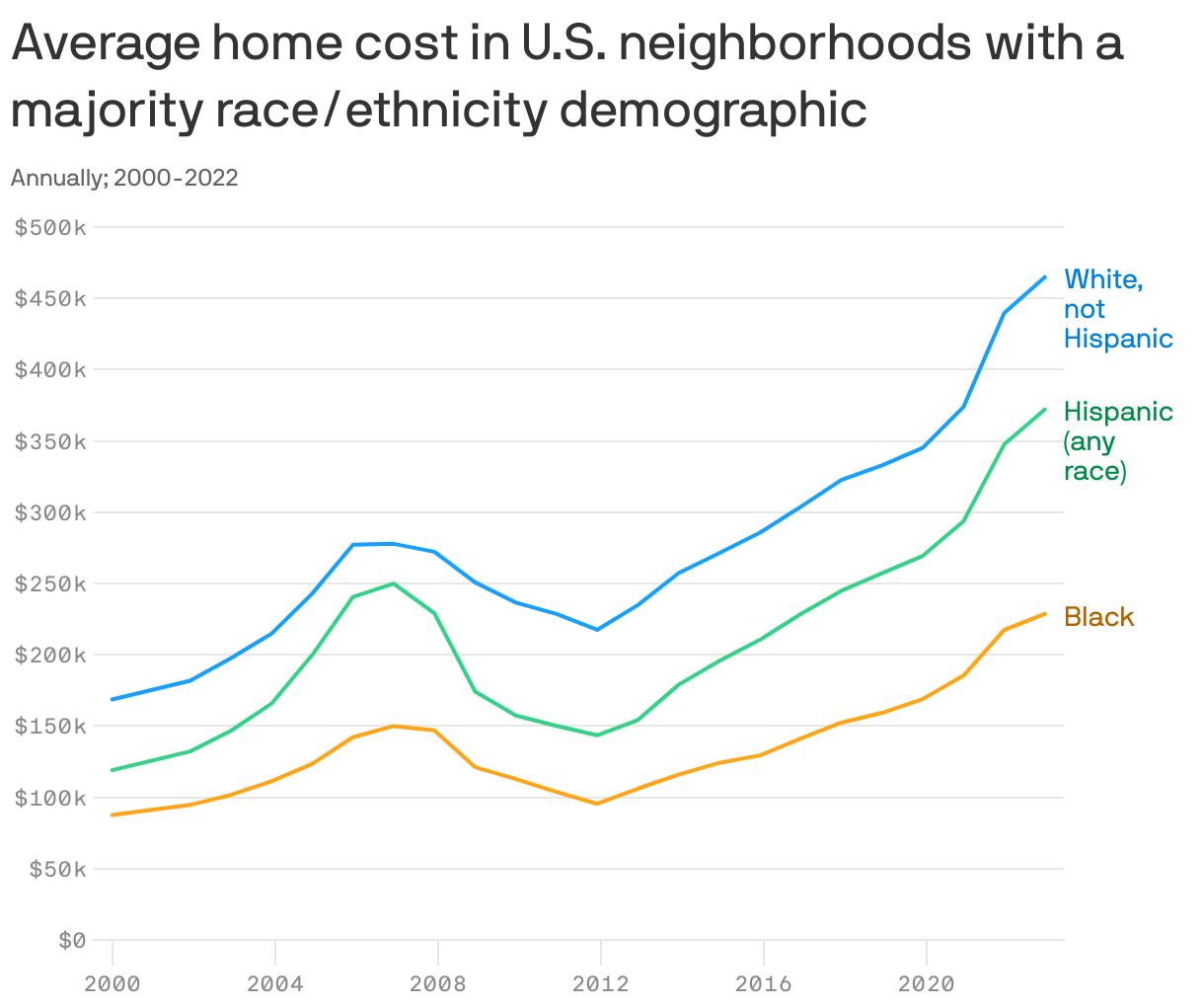
Data: Redfin; Note: Majority neighborhoods defined as U.S. Census tracts in which demographic makes up more than 50% of owner-occupied households; Chart: Tory Lysik/Axios Visuals
If you're looking for affordable housingin America, much of it is in majority-Black neighborhoods, thanks in large part to the legacy of structural racism. The average such home costs less than half the price of a house in areas where most people are non-Hispanic whites, which is one major driver of gentrification.
Why it matters: Black Americans have a higher proportion of their wealth tied up in home equity than their white counterparts, but the value of that home equity has been growing much more slowly.
In 2019, per the Fed's Survey of Consumer Finances, the average Black family had a net worth of $142,500, of which about $90,000, or 63%, was equity in the family's primary residence.
In comparison, the average non-Hispanic white family had a net worth of $983,400, of which $261,500, or 27%, was in the primary home.
If you can manufacture something in high demand, then you have a huge incentive to create more of that thing — whether it's watches or sneakers or shares of a company. When that happens, the law of supply and demand tends to ensure that the secondary-market price of that object is likely to fall.
Why it matters: The price of collectibles seems to be falling back into vaguely rational territory. There are lots of reasons why that might be happening, but the simplest possible explanation is just that more of them are being made.