Another pre-pandemic metric has returned and looks here to stay: mortgage rates.
For the first time since May 2019, the 30-year fixed-rate exceeded 4% this week, FreddieMac reported today.
The big picture: While a sharp uptick from a record low of 2.65% last January, the rate is still historically low.
Also worth noting: The latest average was recorded before the Fed raised interest rates yesterday, but mortgage rates were already on the rise in anticipation.
By the numbers: The median price for a home was $277,000 the last time the 30-year mortgage rate topped 4%, according to the WSJ.
The rate a year ago was 3.09%. The rate average 3.85% last week.
What to watch: How much impact higher rates might have on demand for homes, which are still at historically low inventory levels.
Russia has avoided defaulting on its debt, as some creditors received their dollar bond coupon payments on Thursday, the Wall Street Journal reported.
Why it matters: Russia owes a series of interest payments to bondholders in the months ahead and a default on its debt could have the potential to ripple outward.
The nation’s SUV and pickup boom is killing pedestrians.
Driving the news: Those larger vehicles are “substantially more likely than cars to hit pedestrians when making turns,” according to a study by the Insurance Institute for Highway Safety released Thursday.
Startups that finance climate-friendly home improvement projects are raking in venture capital as the slow-but-steady electrification movement eyes its e-commerce moment.
Why it's the BFD: Financing these projects as a sort of home improvement BNPL could tip the scales in favor of mass electrification across the U.S. if the startups — and their investors — are successful.
Finance on blockchains keeps getting more refined, with an eye to really taking on the banks. Prime Protocol, a decentralized prime brokerage that will work on multiple blockchains at once, has raised $2.75 million in a round co-led by Arrington, Jump and Framework, with multiple angels also participating.
Why it matters: As crypto-powered credit services get more sophisticated, that should eventually put pressure on the traditional banking system to lower fees for users.
Electric vehicle makers in the U.S. and Europe are scrambling to manage threats to supplies of key battery materials and the global supply chain following Russia's invasion of Ukraine.
Why it matters: Russia supplies nearly half of the world’s palladium and roughly 10% of the market's supply of nickel, as well as large quantities of aluminum and copper — key ingredients in EV batteries.
Koch Industries will continue operating in Russia amid the country's invasion of Ukraine, the company’s president and chief operating officer said in a statement Thursday.
Driving the news: Koch’s Guardian Industries runs two manufacturing plants with roughly 600 employees. Ceasing operations would “hand over these manufacturing facilities to the Russian government so it can operate and benefit from them,” according to the statement from Dave Robertson.
Listen to editors. That is the implication of some new research on how economic ideas are propagated — not just something your newsletter writer is saying to ingratiate himself with the boss.
Driving the news: Three researchers in New Zealand took unedited papers by Ph.D students in economics and provided professional editing services to try to improve the quality (h/t to Marginal Revolution).
The expansion of the 2010s was way too slow. That is the embedded conventional wisdom of economic thinkers across the ideological spectrum, including those with different ideas about how it could have been better.
Driving the news: But the experience of the last year shows that there are also hazards in an expansion that moves too fast.
The age of unicorns may soon give way to the age of zombies.
Driving the news: These are startups that raised big cash at nosebleed prices over the past year, but which now will struggle to grow into their valuations.
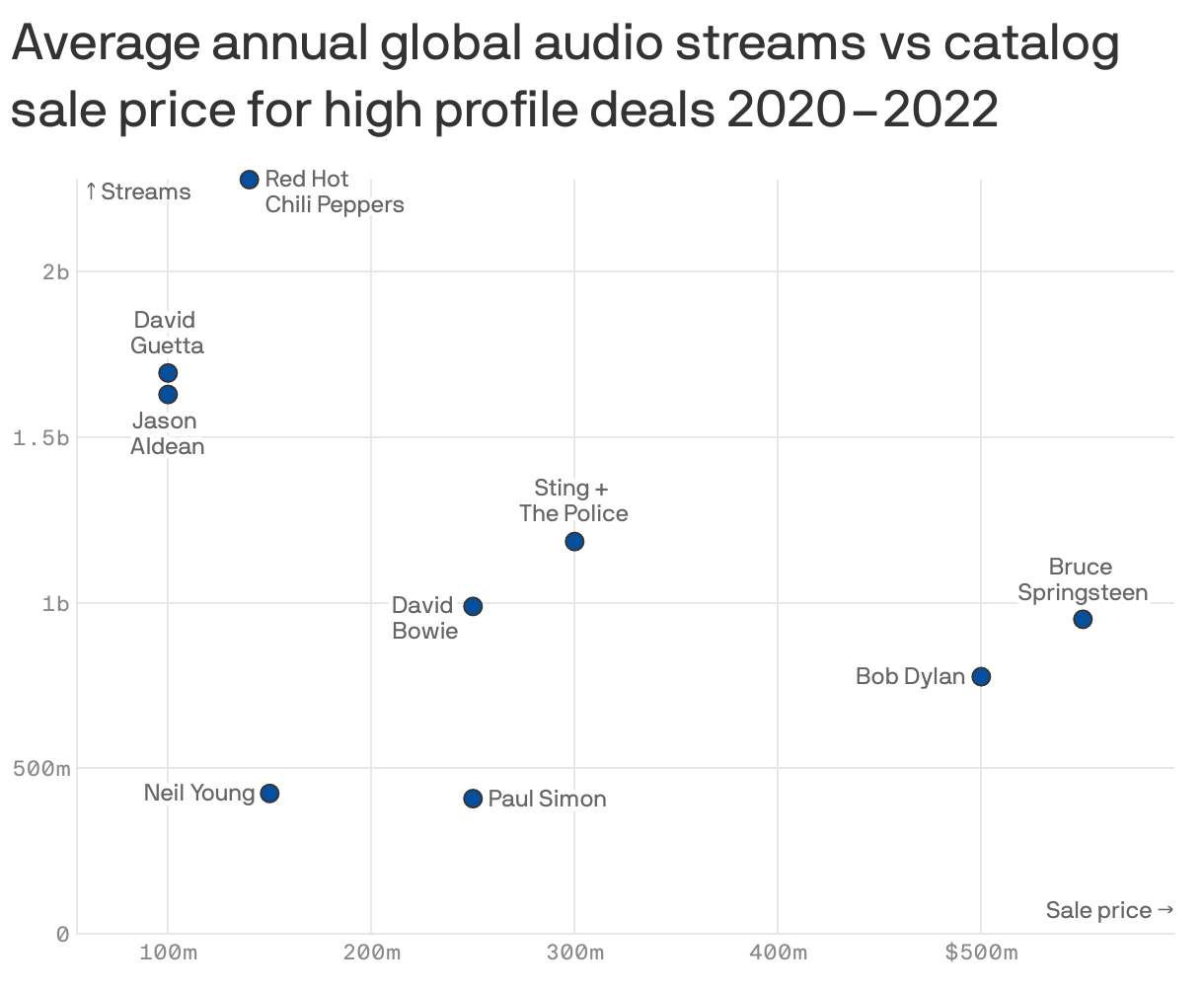
Eager investors scooped up artists' music catalogs over the past couple of years, paying hundreds of millions of dollars for some of the most beloved boomer music from Bruce Springsteen, Bob Dylan and Paul Simon.
Crypto apps are in. The last three months of 2021 saw more than 100 million downloads for the first time ever in a single quarter, according to data firms Adjust and Apptopia in a new report released today.
Why it matters: The increased popularity of crypto applications shows how crypto assets are becoming more and more popular with the mainstream. Many investors rely on third party apps to do the heavy lifting for them, rather than the more technical approach of interacting directly with blockchains.
The Russian stock market is shuttered. Gasoline prices are soaring, yet the U.S. won't buy cheap Russian oil. The market for nickel stopped trading for a week, tried to restart, then stopped almost immediately.
Why it matters: Sanctions, government actions and remarkable price moves are rocking our once-unshakable reliance on rational markets as a pillar of the world economy.
A company called Staxxon in Montclair, New Jersey, is planning to sell a newfangled shipping container that's "designed to fold in an accordion-style fashion, and shrink to 1/5 the size of a regular container."
Why it matters: Most standard shipping containers return home empty, so if cargo ships can fit more of them on a return journey by collapsing them, it could help ease today's notorious supply chain woes.
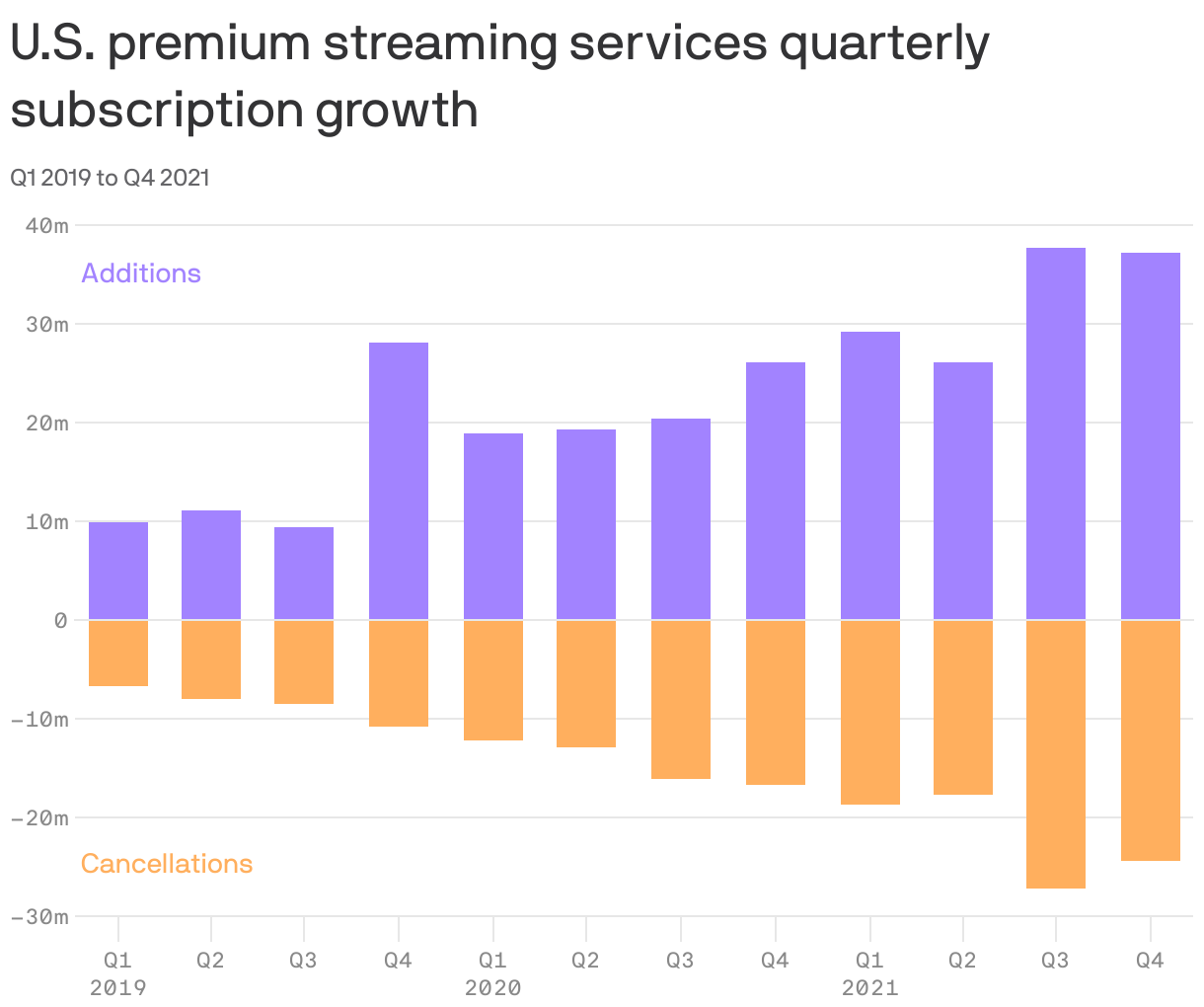
Data: Antenna; Note: Services include Apple TV+, Discovery+, Disney+, HBO Max, Hulu (SVOD-only), Netflix, Paramount+, Peacock, Showtime and Starz; Chart: Jacque Schrag/Axios
Streaming companies are cracking down on password sharing, as the number of quarterly subscription cancellations in the U.S. grows.
Why it matters: Password-sharing used to be a feature of the video subscription economy, allowing consumers to easily sample content across different services. Now that there's so much competition, it's a bug.
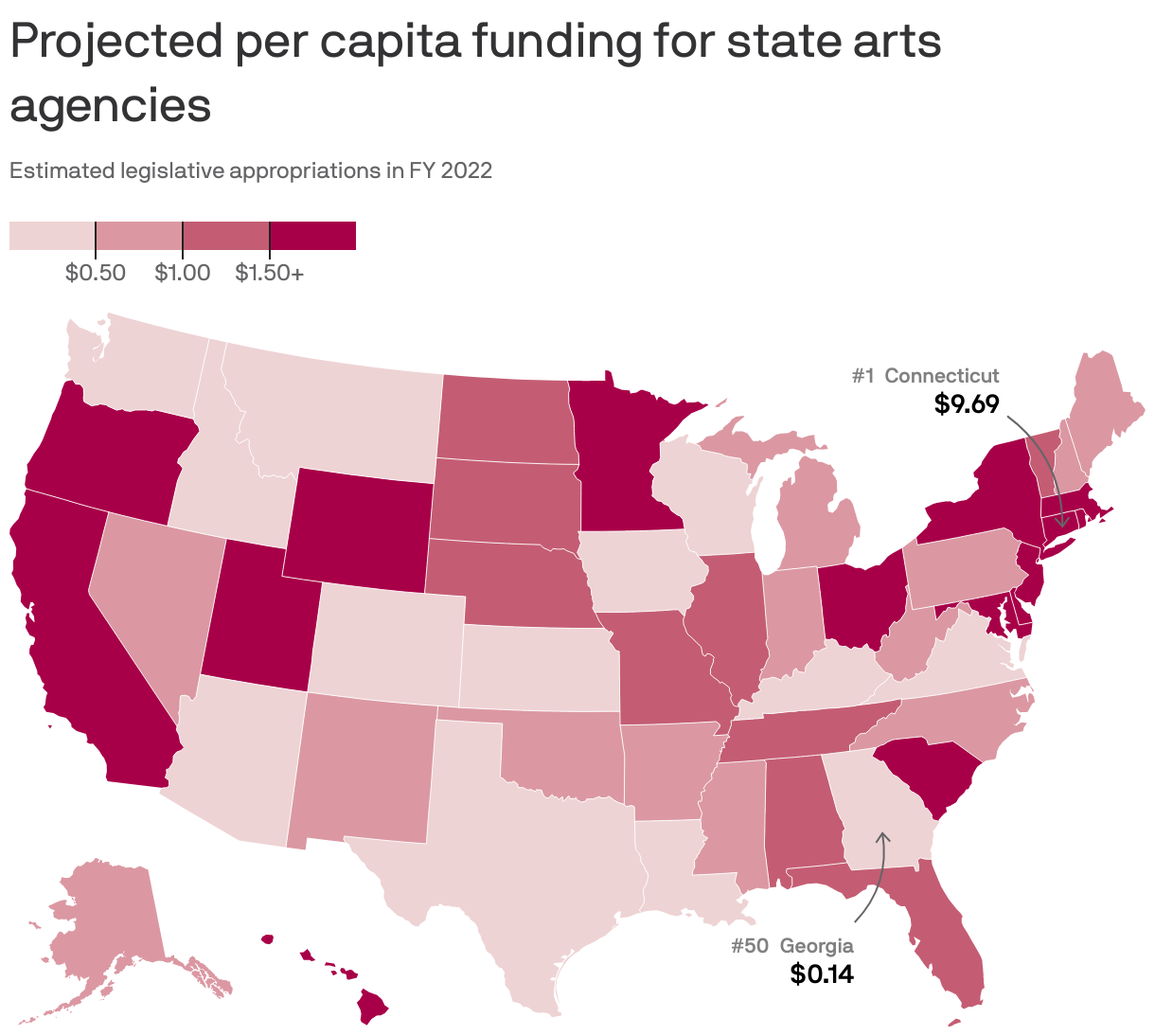
State legislatures more than doubled the money appropriated to arts agencies this fiscal year, setting aside $820.8 million for 2022 versus $402.8 million in 2021, according to the National Assembly of State Arts Agencies (NASAA).
Why it matters: Artists have the power to lift people's spirits — an important role as we recover from the pandemic — and state arts agencies help pay for artists' work and make it more accessible to the public.
Russia’s invasion of Ukraine is prompting American CEOs anew to build their own mini-State Departments as they navigate the uncertainties of a war and world increasingly unbound by norms and institutions.
Why it matters: Executives traditionally rise to power by creating successful products and business lines, managing expectations and turning profits — not mastering foreign policy. With little margin for error, many are turning to D.C. experts with heightened urgency.