Fund and money managers with stock and bond picks tied to Russia have been adjusting their positions to limit exposure.
Why it matters: Financial sanctions have had a direct impact on Russia — and Russian markets — but they’ve so far had a less direct impact on the vast majority of investors.
The world's biggest shipping companies are suspending shipments to and from Russia amid Russian President Vladimir Putin's ongoing invasion of Ukraine.
The big picture: Maersk, MSC and CMA CGM are all turning from Russia in light of safety and operations concerns, the companies said Tuesday. The move underscores Russia's increasing isolation as businesses and organizations around the world cut ties.
Uber is adding the ability to book real-world experiences through its platform.
Catch up quick: The company announced a new app feature today called “Explore” which enables people to do things like look for and get restaurant reservations or concert tickets directly in the Uber app.
From camps for girls to networking events for grownups, organizations all over the country are working to promote Latinos in tech.
Why it matters: The numbers of Latinos and Latinas in the industry has been rising gradually in the past few years, but they're still disproportionately low in most companies.
Crypto exchanges are at the center of U.S. efforts to carry through with sanctions, but most are refusing calls to block Russian addresses en masse.
Why it matters: Ukrainian Vice Prime Minister Mykhailo Fedorov asked major crypto exchanges to go beyond sanctions and block the addresses of all Russian users. But Binance, Coinbase and Kraken say it goes against their core beliefs.
Russia's brutal invasion of Ukraine has finally pushed Western institutions to crack down on Russian state-backed media outlets like RT, Sputnik and TASS, which have long served as a propaganda arm of the Kremlin.
Why it matters: Russia seeded the war through disinformation spread by its state-backed media channels. It still relies on those networks to spread disinformation beyond its borders and to sell the war as a success domestically.
Abbott Nutrition is expanding its recall of baby formulas to include one lot of Similac PM 60/40 powder, the company announced Tuesday.
Driving the news: The recall comes after the death of an infant who tested positive for Cronobacter sakazakii, a dangerous bacterial infection, after consuming Similac PM 60/40 produced at Abbott's Sturgis, Michigan, facility.
Daybreak Health has done its homework. The school-facing behavioral health startup raised $10 million in a Series A round led by Lightspeed Venture Partners, the company tells Axios exclusively.
Why it matters: Most venture capital funding for behavioral health goes to employer-facing offerings, but investors are increasingly turning to new areas.
Crypto-focused venture firm Electric Capital has raised a $400 million for its third early stage fund, as well as a $600 million digital token-fund.
Why it matters: Raising huge pools of capital to invest in crypto is becoming the norm as the industry's boom continues—despite regulatory uncertainty and ongoing concerns over scams.
A cargo ship carrying luxury cars that caught fire in February sunk in the Atlantic Ocean Tuesday despite efforts save it, according to the ship operator.
Why it matters: Therisk assessment company Russell Group estimated last week that the fire to the ship could cost Volkswagen, Porsche, Audi and Lamborghini at least $155 million in losses.
Disney on Tuesday will announce a new deal with Samba TV, a digital measurement company, to provide alternative data to Disney advertisers looking to better understand how their content is viewed in real-time via streaming.
Why it matters: Samba is the first third-party vendor that Disney has officially named as a partner, as it looks to broaden the types of measurement solutions it offers its advertisers in the digital world.
Greenwood Sustainable Infrastructure (GSI) tells Axios that it’s acquired a portfolio of utility-scale solar projects from Denver-based developer CMDAJ Holdings.
Why it matters: The transaction shows how some companies are preparing for expected supply chain constraints in 2022, especially in solar markets.
Antenna, a streaming measurement company, has raised a $10 million Series A round led by Bertelsmann Digital Media Investments (BDMI), a subsidiary of the global media and education company Bertelsmann.
Why it matters: The streaming boom during the pandemic has expedited the transition to alternative measurement sources, creating opportunities for new digital measurement companies.
For all the volatility in stock, bond and currency markets since Russia invaded Ukraine, it's the shifts in commodity markets that look most likely to ripple out and touch the world economy.
That was particularly true yesterday, as futures prices for many staple energy and food commodities soared, while stocks were down only modestly.
As broad-based sanctions cripple the Russian economy, the West is also ratcheting up economic pressure targeted at the country's oligarchs — known for their splashy yachts, big-name investments and piles of dark money squirreled away around the globe.
Why it matters: Some of these wealthy Russians may have a measure of influence over Russian President Vladimir Putin. The U.S. and Europe are hoping that if they squeeze the oligarchs, the oligarchs may pressure Putin. In the longer term, going after hidden Russian wealth could curtail the power of Putin and his circle.
Specialty lab testing company Rupa Health raised $20 million in Series A funding led by Bessemer Venture Partners, the company tells Axios exclusively.
Why it matters: Rupa's thesis is that clinicians often miss an illness' true cause because they're unable to assess someone's complete health, whether because of technological barriers, high costs or preconceptions.
The company's core product is a specialty lab-ordering platform that gives doctors access to roughly 3,000 diagnostics.
Driving the news: The company's offering capitalizes on two big recent health tech trends:
Rising interest among clinicians and the general public in how factors including genetics, lifestyle and medical history combine to impact health.
The role of diagnostics — particularly those that can be done at home — in helping to identify illnesses, their causes and potential treatments.
"Doctors right now are doing all this manual work of ordering different labs to help them come up with personalized treatments," Tara Viswanathan, Rupa's co-founder and CEO, tells Axios. "We’re moving into a space where it’s less manual and more systematic."
Details: The Series A round brings San Francisco, Calif.-based Rupa's total funding to $26 million.
Besides Bessemer, other venture firms include First Round Capital, Lachy Groom, SV Angel, Floodgate, Hustle Fund and Operator Collective.
The company also has an eclectic mix of celebrity investors including electronic music duo The Chainsmokers, actor Jared Leto and former NFL star Joe Montana — all of whom you should consider sharing this newsletter with.
What they're saying: Industry experts tell Axios the staffing squeeze in the medical field raises the profile of companies that can handle tasks with a high administrative burden, including ordering specialty tests.
"I think Rupa offers a step in the right direction towards less overhead, greater convenience and more access to specialty care," says Natalie Schibell, a senior health care analyst with Forrester.
The ongoing shift towards more holistic care, including value-based and preventive care models, also benefits Rupa.
"Across the sector we’re looking at more preventive and less reactive care," says Schibell. "And getting down to the root cause instead of treating symptoms starts with physicians... having more ability to treat the patient holistically without all these administrative hoops."
How it works: Rupa serves independent and mid-sized labs as well as large hospitals. The company offers discounted wholesale prices on lab tests plus a 7% service fee.
The company helps physicians explain test results to patients and offers a prebuilt tool to communicate the general process and answer questions.
Current clients include George Washington University, The University of California at Irvine's Susan Samueli Institute and Bastyr University in Washington.
What's next: Citing the shift toward whole person care, Viswanathan hopes Rupa can expand more deeply into helping clinicians develop personalized treatment plans for their patients.
Erin Brodwin co-authors the Axios Pro Health Tech deals newsletter. Start your free trial atAxiosPro.com.
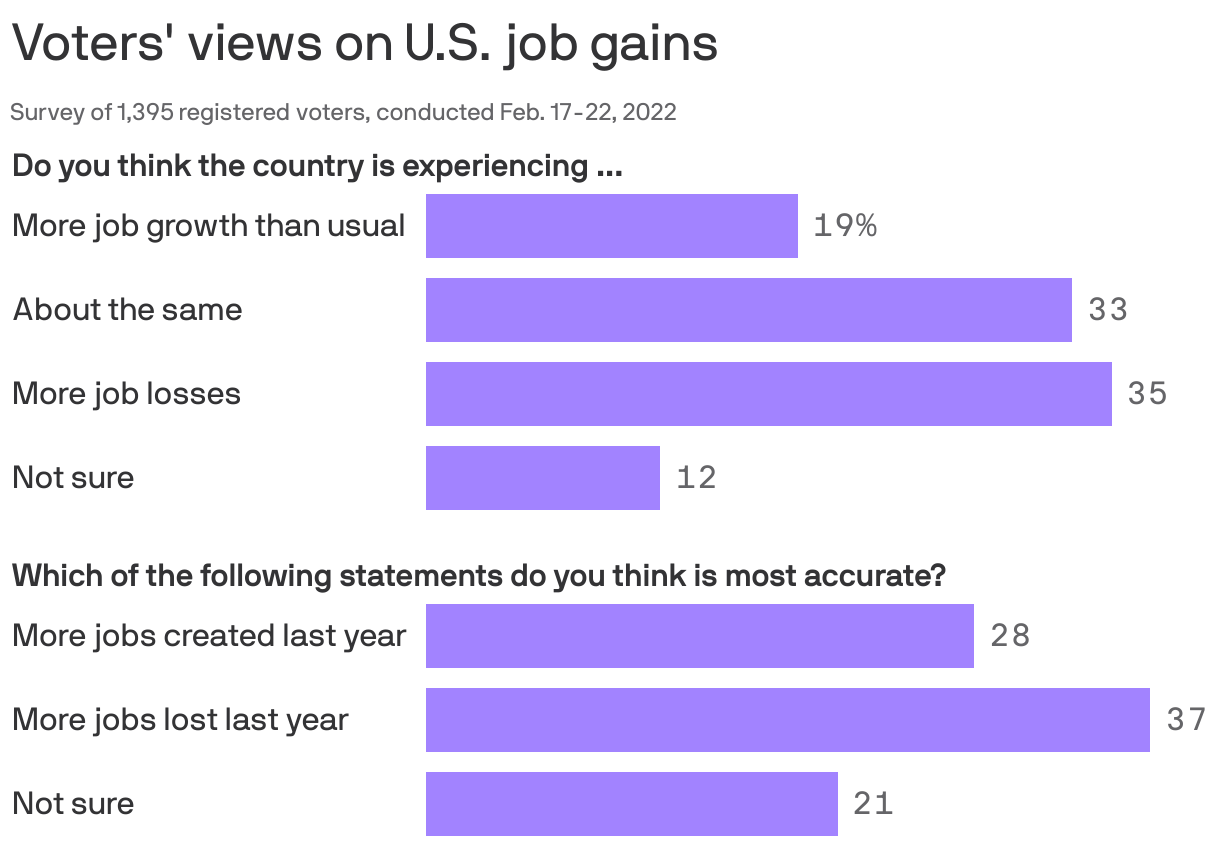
The U.S. economy saw record job growth over the past year, but a lot of regular folks apparently didn't get the memo. A new poll from a progressive data firm finds 35% of voters believe the country is experiencing more job losses than usual.
Why it matters: This is a political headache for President Joe Biden, who will be making the case in tonight's State of the Union that we're in "one of the strongest labor market recoveries in American history," according to the White House's notes.
The survey also follows numerous reports of Americans feeling like the economy is more bummer than boom — in part because record high inflation is mostly erasing any wage gains they might be seeing.
Details: In the survey, conducted last week by Navigator research, only 19% believed the U.S. is seeing more job growth than usual. This is the first time the polling firm asked voters for their views on job growth.
Background: The U.S. has been through a wild up-down on jobs since spring 2020 when the unemployment rate reached levels last seen during the Great Depression. Since then, we've seen an astonishing recovery.
The economy added 6.6 million jobs over the last 12 months. And while we're still not quite back to normal, there is no doubt — at least among economists and observers — that the labor market is hot right now.
Bottom line: The jobs recovery has been impressive, but in so many other ways Americans' lives are in a state of flux.
Justin Smith, the former head of Bloomberg Media, and Ben Smith, the former New York Times media columnist, have approached some of the biggest names in media in an effort to raise $20-30 million to launch a news organization by fall of 2022, according to people they've pitched.
Why it matters: The Smiths, who tell investors they'll burn through $50 million in cash before breaking even, have approached Bob Iger, Michael Bloomberg and Laurene Powell Jobs' Emerson Collective, sources tell Axios.