A rush of companies say they are putting their money where their mouth is. From McDonald's to Wells Fargo, a record number of big businesses say how they fare on a slew of goals — like diversity — will impact part of CEO pay.
Why it matters: It's kicked into high gear in the past year, as companies try to signal they are serious about their role in improving society.
OnlyFans, an online creator platform known for its adult content, announced Thursday that it will prohibit creators from posting "sexually explicit" content starting in October.
Why it matters: The company, which has been struggling to find outside investors, said it made the decision at the request of its banking and payout partners, though it is unclear how it will decide what content is sexually explicit.
The Federal Trade Commission on Thursday took a second shot at alleging Facebook is an illegal monopoly in a new complaint that accuses the social media company of buying up potential competitors or thwarting their access to the platform.
Why it matters: The FTC, now led by Big Tech critic Lina Khan, is trying to save its case against Facebook after a judge dismissed its first attempt.
Illumina completed its $7.1 billion acquisition of Grail, a Menlo Park, Calif.-based developer of liquid biopsies for early cancer detection.
Why it matters: This is Illumina shoving its thumb in the eye of U.S. antitrust regulators, who in March sued to block the deal. An administrative court trial is set to begin next week, but the FTC had dropped an earlier injunction request because it (wrongly) believed a European regulatory review would prevent the merger from closing.
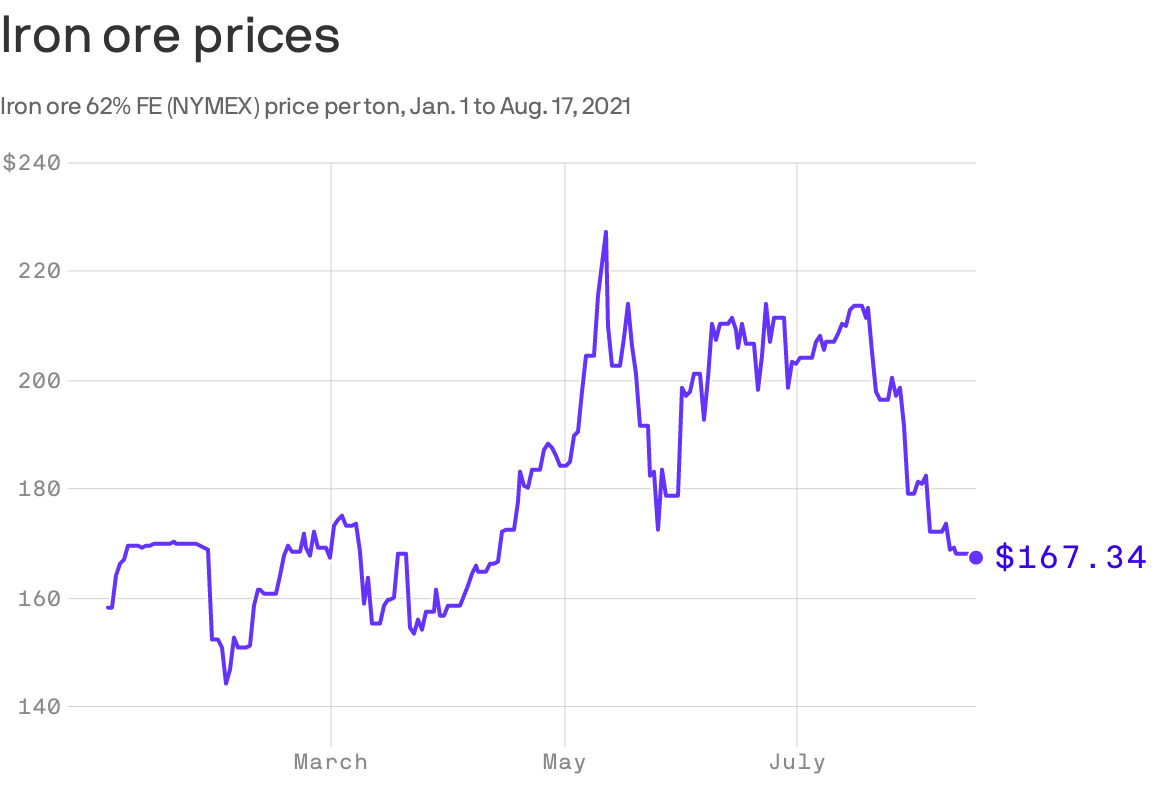
Iron ore priceshave taken a dive over the last month as the largest buyer of the commodity, China, pulls back.
The big picture: Iron ore is a key input in crude steel production. A Beijing directive earlier this year called for lower production in order to curb carbon emissions. The Chinese government also raised export taxes to make it less attractive for steel mills to sell abroad.
The Federal Reserve is happy with the progress the economy has made so far but cautions that the trajectory of the pandemic could derail things.
Driving the news: According to the minutes of the Federal Open Market Committee policy-setting meeting July 27-28, "various" participants said that tapering of the Fed's asset purchases should start relatively soon, while "several others" said it should start "early next year."
The number of new homesunder construction has soared — to levels not seen since the housing market crash 14 years ago.
Why it matters: Home prices have been surging as the demand for houses has outpaced supply. Homebuilders are doing what they can to keep up, but supply chain bottlenecks have led some to turn away buyers as they try to catch up.
Why it matters: Robinhood gained popularity as a brokerage app offering commission-free stock trading. But the company's recent performance suggests the current crop of retail traders are more interested in cryptocurrencies than stocks.
Facebook is pitching a new option for distant coworkers who want to gather and regain some of the spontaneous creative space lost in a world of Zoom meetings: Strap on a VR headset.
Why it matters: Facebook is debuting Horizon Workrooms, a free app that is part of the company's effort to create a broad "metaverse" in which physical distance is removed as a barrier for those who want to interact with one another.
There's a lot of pent-up demand for overseas travel, but one thing holding Americans back is the worry that they'll be stranded in a foreign country if they contract COVID-19 while traveling.
Why it matters: The U.S. requires all arriving air passengers — vaccinated or not, including Americans returning home — to test negative for COVID-19 no more than three days before their trip.
Isolating for an extra 10 days in a hotel room, even in paradise, can be expensive — not to mention risky, if you get really ill and need medical care in a foreign country.
What's happening: A company called Covac Global will send a medical jet, helicopter or even a speed boat — "whatever it takes," they say — to rescue COVID patients in other countries and bring them home for care.
Some vacation destinations are even partnering with Covac to prevent infections from spreading in their country.
The Bahamas government is a client, doing weekly evacuations to transport positive visitors off the island, the company says.
And some hotels, like the Eden Roc in St. Barts, are including evacuation service in their vacation packages.
Context: Most travel insurance policies like Allianz Travel Protection Plan generally don't cover COVID-19 claims because a pandemic is "foreseeable." Nor do they cover fear of travel.
During the ongoing health crisis, however, Allianz says it will temporarily cover emergency medical care as well as trip cancellation for a traveler who becomes ill with COVID-19.
Covac Global focuses on getting them home, regardless of whether they are sick.
The intrigue: It's not trip insurance — it's a membership-based service.
Membership for a 15-day trip is $675 per person; a 30-day trip costs $995. Annual membership is $2,400, for unlimited trips up to 90 days each.
How it works: Unlike most insurers, Covac doesn't require customers to be hospitalized before it authorizes a medical evacuation.
All the company needs is a positive COVID test result and one self-reported symptom, like a scratchy throat, cough or runny nose.
Covac medical personnel will pick up the patient wherever they are and transport them back to the U.S.
They don't have to comply with the CDC's rules on isolation if the medical team delivers them directly home.
"All they have to do is wait in the hotel, and we pay for the whole thing, up to a million dollars, to take them home," CEO Ross Thompson tells Axios.
The bottom line: Since launching the service early in the pandemic, Thompson says Covac has sold "tens of thousands of memberships" and performs "about a dozen" evacuations per month.
Most are fully vaccinated travelers who still contracted COVID while abroad, he said.
The catch: Non-members are eligible for evacuation service too, but it could cost as much as $250,000 door-to-door, depending on where they are.
A federal judge on Wednesday voided the permits for a ConocoPhillips oil project in Alaska's North Slope.
Why it matters: The ruling deals a blow to the Willow oil project, which could produce up to 160,000 barrels of oil per day, after the Trump administration approved drilling for it. The government's support for the project continued into the Biden administration.