General Motors, the largest U.S. automaker, is seeking to become more of an energy company, turning electric vehicles into grid assets and batteries into fuel for AI data centers.
Why it matters: The moves are another sign of how automakers are investing in opportunities far beyond transportation, leveraging battery technology as EV growth has cooled.
A White House Correspondents' Association member last week sent an email to select WHCA members informing them that regular access to the White House campus "will NOTbe permitted on June 14, the day of the UFC fight," and that "the UFC — not the White House — is handling all press credentials for covering the event."
Why it matters: Outsourcing press credentialing and access for a White House-hosted event to a commercial third party is highly unusual and historically unprecedented.
Another sharp selloff hit tech stocks Tuesday, with some AI-related shares posting double-digit losses shortly after noon ET.
Why it matters:Tech shares have been the engine of a stock market rally that has driven the S&P 500 up more than 75% over the last three years through last week.
Traditional financial firms are rapidly embracing crypto, marking a turning point for an industry that once viewed digital assets as a threat.
Why it matters: A long-running rivalry between Wall Street and crypto is disappearing, with financial institutions racing to meet growing demand for digital assets from retail and institutional investors.
It's a foregone conclusion that SpaceX will raise at least $75 billion in its record-wrecking IPO, with pricing set for Thursday and first trades for Friday.
Artificial intelligence will fuel job creation on main streets across America, Small Business Administration administrator Kelly Loeffler predicted Tuesday at Axios' AM Live in Washington, D.C.
Bank of America's top U.S. stock market analyst called out a number of red flags she has seen emerge from the recent market run-up.
Why it matters: It's rare that analysts employed by Wall Street come close to suggesting that investors "sell." (After all, Wall Street is in the business of distributing stocks and bonds to the public. That sales job will likely be tougher if analysts at Wall Street banks are warning that prices for those securities are going to fall.)
Driving the news: Bank of America's head of U.S. equity and quantitative strategy, Savita Subramanian, published a note late Friday entitled "Too many red flags. Take profits." She wrote:
"Our bear market signposts — the triggers that typically precede an S&P 500 peak — suggest additional caution may be warranted. Today, 70% of our signposts are triggered, in line with the average observed in prior market peaks."
These "signposts" are market condition metrics. They include unusually high expectations for long-term earnings growth, very easy credit conditions and extreme dispersion between the performance of stocks with high and low price-to-equity ratios, to name a few.
What they're saying: "Dispersion has been most pronounced within Tech, where the spread between the best/worst performing quintiles' median stock is a whopping +120 [percentage points], the highest since Feb. 2000, which reached +130 [percentage points] ahead of the market peak of March 24, 2000," she wrote.
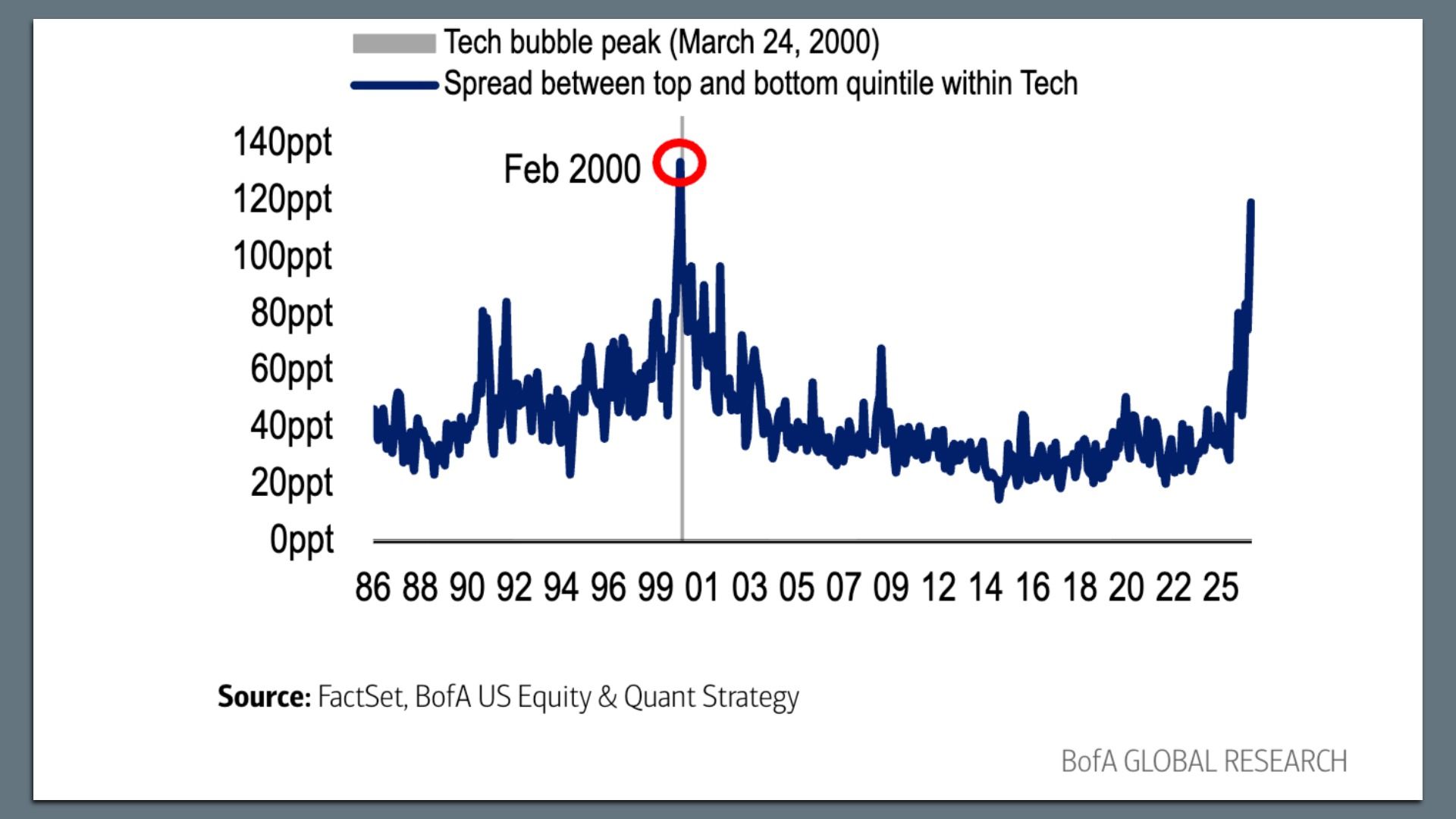
Image: Bank of America Global Research
Yes, but: This is just one analyst's view. After Friday's market jolt — in which the Nasdaq 100 tumbled 4.8% and the SOX semiconductor index dove 10.3% — plenty on Wall Street had more reassuring things to say.
Morgan Stanley's chief U.S. equity analyst, Mike Wilson, wrote that "in our view, a correction was inevitable and ultimately healthy if this bull market is going to extend into year-end, which remains our baseline."
Americans are starting to realize that "passive" investment funds aren't actually that passive — and they have Elon Musk to thank for the lesson.
Why it matters: Ordinary people have trillions of dollars invested in broad-based index funds meant to be a low-cost way to basically buy stocks and chill.
Paramount has held preliminary conversations with several candidates for a business-side counterpart to CBS News editor-in-chief Bari Weiss, according to two sources familiar with the network's inner workings.
Why it matters: The search implies that if Paramount Skydance's deal with Warner Bros. Discovery goes through, Weiss would oversee all news editorial across both CBS News and CNN. Her potential counterpart would manage business operations across both companies.
Add birth control to the list of things an iPhone can do: The introduction of Apple's smartphone in 2007 helped lower U.S. fertility rates, especially among teens and young adults, a new paper concludes.
Why it matters: Researchers and policymakers have been scrambling to pinpoint why exactly birth rates are falling in the U.S. and around the world.
Smartphones and the rise of social media are hardly the sole factor — birth control access and economic concerns like child care and housing costs are also debated — but the paper offers some intriguing evidence that helps explain the overall trend.