Monday's business stories

Nvidia CEO Jensen Huang: "No one" better with robots than Hyundai

Nvidia CEO Jensen Huang heaped praise on Hyundai's robotics and said the two companies will broaden their partnership — a significant endorsement from the AI kingmaker in a rapidly emerging space.
Why it matters: Hyundai's Boston Dynamics division is racing with the world's leading robotics companies — including Tesla — to deliver groundbreaking humanoids.

OpenAI files paperwork for an IPO
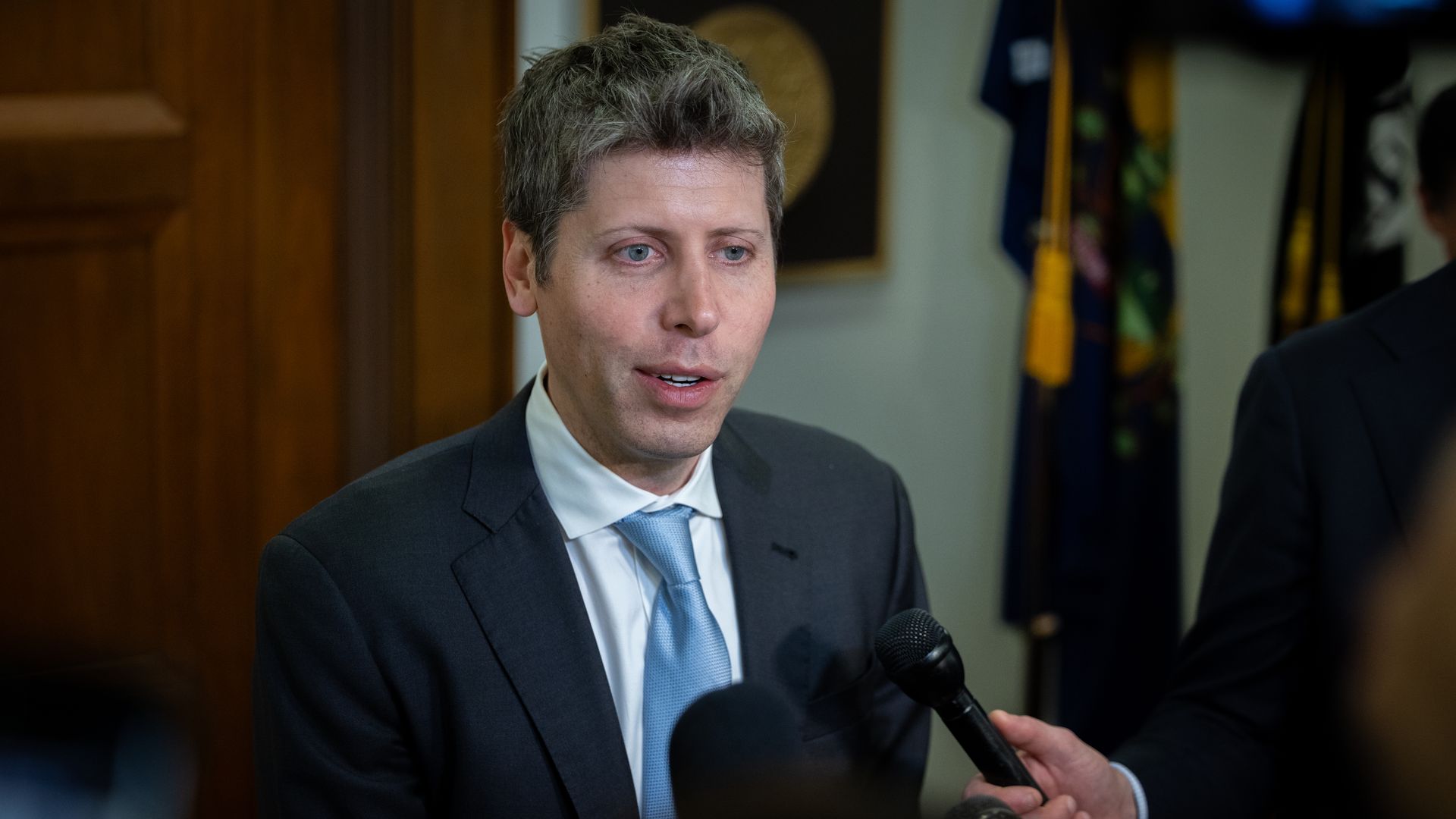
OpenAI said Monday it has confidentially filed draft IPO paperwork, giving itself the option to tap public markets — even as the company says its focus remains on building new AI products rather than preparing for a listing.
Why it matters: The race is on between Anthropic and OpenAI to go public and tap investors for tens of billions of dollars.

Axios AI+NY Summit: Brands get the message — AI is rewriting all the rules

NEW YORK — The generational shift in how people learn about a business due to AI requires planning, training and reassessing, communications leaders said at an Axios AI+NY summit Expert Voices roundtable.
Why it matters: A brand's reputation is now in the hands of AI bots that can grade, alter and distribute information about it without any input from the company.
- This makes what communicators produce that much more important, panelists warned.
Axios' Kerry Flynn and Eleanor Hawkins moderated the June 3 roundtable, which was sponsored by Allison Worldwide, part of New York Tech Week.
Five big takeaways from the conversation:
1. Brands must now write for artificial intelligence, not just people
- "We have to write two versions of things," said Marijke Shugrue, senior director of communications for PSEG. Her team writes one story for people, and a separate "bot-oriented piece" for AI sent on PR Newswire.
- Michael Marinello, JPMorgan Payment's global head of communications, explained that AI is the next phase of media disruption, calling it "the biggest shift" since the "advent of the 24/7 news cycle."
2. New data shows Axios tops list as AI reshapes how stories are discovered
- Marinello highlighted a Muck Rack study of more than 25 million AI links that found Axios was the most-cited news source across major platforms.
- He added that internal tracking showed "11% of the coverage that we were generating was AI-driven."
3. Switching to an AI-driven internet creates friction as companies try to protect their data while training teams
- Making complex technical work accessible means building entry points "where people want to be," said Sarah Meron, chief communications and brand officer for IBM.
- Building AI capabilities internally can also be slow, forcing companies to rethink how employees spend their time. Lance Frank, Beehiiv's vice president and head of communications, said its AI strategy is to help "humans be more human, and creators be more creative."
4. Smart brands are hunting for new ways to be seen as bots outnumber clicks
- Edie Kissko, head of products and services communications at HP, noted that because AI bots love scraping tech reviews, outlets like PC Mag are now more important for her team's product coverage.
- On apps like TikTok, short video clips showing women how to use basic AI tools to save time and make money are exploding in popularity, said Hot Smart Rich founder Maggie Sellers Reum.
5. Leaders are investing in human contacts, cutting through AI noise
- "Making connections, relations and networking, it's very important right now," said Monica Del Vecchio, chief marketing officer at TrueLogic.
Content from the sponsor's remarks:
Allison Worldwide managing director Jaime Tero said trust is the most valuable asset in an AI-driven information ecosystem.
- "It is the one currency that we still have that is truly human," Tero said.
Editor's note: This piece was updated to clarify that Michael Marinello works for JPMorgan Payments.

Trump's $100K H-1B visa fee struck down

A $100,000 fee that President Trump imposed on employers for H-1B visa petitions is unlawful, a federal judge ruled Monday.
Why it matters: The ruling, which the White House vowed to appeal, blocks a major Trump immigration policy change and concludes that the administration imposed what amounted to a tax without congressional authorization.

Personal injury law giant Morgan & Morgan considers investment
Morgan & Morgan, the country's largest personal injury law firm, may seek to raise more than $1 billion via a minority investment, per multiple reports.
Why it matters: This could supercharge the regulatory debate over MSOs, a structure that law firms use to sidestep rules against non-lawyers owning their own practices.
Bending Spoons, owner of AOL and Eventbrite, files for IPO

Bending Spoons, an Italian holding company that buys and seeks to revitalize legacy tech brands, on Monday filed for a U.S. IPO that could fetch around a $20 billion valuation.
Why it matters: This would be a return to the public markets for AOL, Eventbrite, and Vimeo, all now owned by Bending Spoons.
Schwab: Investors remain bullish, yet cautious
Stocks rallied like gangbusters in May, so it's perhaps not surprising that retail investors were net buyers of stocks for the month, new data from Charles Schwab shared exclusively with Axios shows. Yet investors also showed some caginess.
Why it matters: Investors remain bullish amid an AI-fueled rally that has lifted the S&P 500 and Nasdaq indexes to new highs, even as they may be seeking to limit their risk.

Elon Musk's market magic
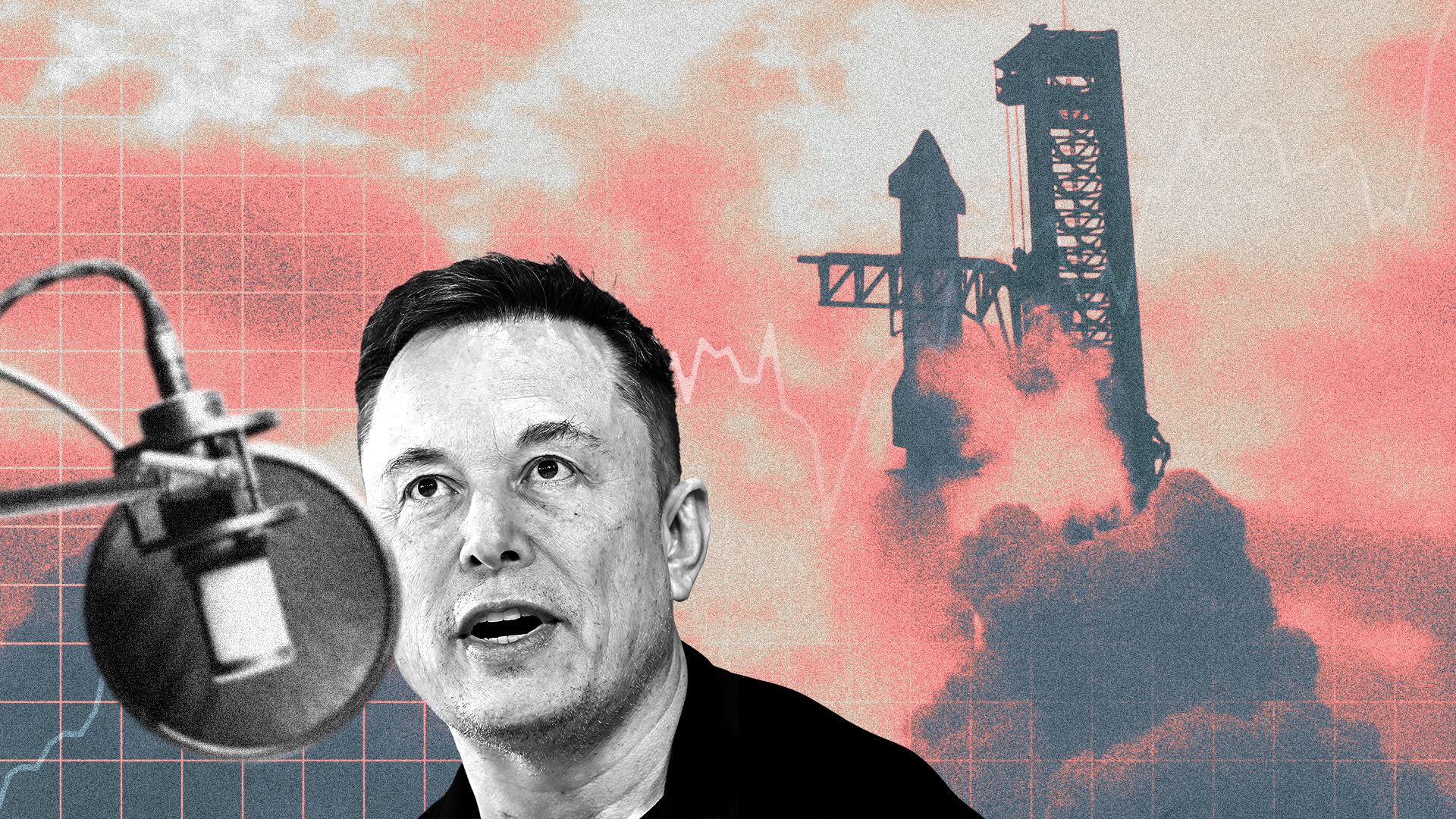
We'll find out this week if Elon Musk still has the magic touch to abracadabra the biggest IPO ever.
Why it matters: A successful trading debut for Musk's SpaceX would confirm his knack for using sci-fi-worthy pronouncements, outlandish personal behavior — and actual innovations — to grab investor attention and turn it into cash for his companies.

Why stocks didn't like a strong jobs report


The job market is holding up way better than expected, and when that became clear on Friday with the release of the May employment report, the major stock indexes fell.
Why it matters: It was just the latest reminder that the stock market is not the economy.

Axios C-Suite: What Jim learned for the week of June 6

🚨 '28 intrigue: Ignore the Vance-isn't-running for POTUS speculation. He is.
- Yes, Secretary of State Marco Rubio is surging in prediction markets (and often in President Trump's mind). But Rubio is doing nothing in terms of prep (staff, donor chats, base appeasement). Vice President Vance is.
- IF Rubio were to run, the MAGA base would torch him for pushing Trump into the Iran war. Steve Bannon and others blame him, even though it was Trump's call against the advice of Vance and others.
💰 An AI reality check, via Bain: Only 7% of companies report using AI agents operating fully autonomously, the key to AI investment truly juicing profits.
- I'm skeptical the numbers are even that high, beyond easily automatable work. (More on this below.)
🛢️ Price shock: Lots of oil execs are back-channeling alarm to Trump and the White House that oil prices will soon surge.
- Oil majors are depleting strategic reserves to hold down prices, but are running out of options.
- Their warning: $150+ per barrel is WEEKS away if the Strait of Hormuz stays closed.
🤷♂️ Sign of the times, flagged by Ben Sasse in the WSJ: 60% of 6-year-olds have access to internet-connected tablets. Yet 58% of kids that age aren't allowed to play unsupervised in their yards.
📈 If you're a CEO or on a CEO's team: Ask to join Jim's new weekly Axios C-Suite newsletter.
Confessions of an AI lab rat
I've spent the past year using AI obsessively, inputting copious amounts of personal and business data, turning myself into a CEO lab rat.
Why it matters: This experiment has shown me in clinical ways the superhuman possibilities and real workplace limitations hitting or awaiting us.
Axios C-Suite: CEOs need to be their organization's chief teacher, too

I Zoomed with Pearson CEO Omar Abbosh, who studies and monetizes the reskilling of massive workforces. Three vital insights from our conversation that I wanted to share with you:
- Teaching is no longer delegable. Traditional L&D wasn't built for this moment. Rewiring work at this scale — new processes, new systems, new culture — is CEO-level work. The leaders winning on AI aren't the ones who handed it to HR.
- Deploy-and-train-later is dead. People lose 70% of new knowledge in 48 hours unless it's applied immediately. Abbosh is blunt: "If learning isn't in the flow of work, there is no learning."
- Teaching velocity matters big time. 53% of employers can't find AI-ready entry-level workers. That means even your youngest hires need reskilling from day one. The winners will be the ones teaching new skills faster than the competition.
The bottom line: This is "reengineering the corporation" turned up a notch — the same scale as the '90s process revolution, compressed into 36 months.
📈 If you're a CEO or on a CEO's team: Ask to join Jim's new weekly Axios C-Suite newsletter.
Axios C-Suite: 3 new AI developments for the week of June 6
1. Fast action AI software: OpenAI launched Sites, a Codex feature that lets your staff create, host and deploy work-related web apps from prompts internally — instantly.
- Why it matters: Custom software usually requires vendor contracts, engineering time or a long IT queue. Non-engineers can skip all that and build, ship and USE internal tools themselves.
2. AI's cheaper future: Nvidia's RTX Spark and Microsoft's Project Solara aim to move AI inference from the cloud onto personal devices.
- Why it matters: Companies are starting to ration AI as token costs rise. Local AI will make usage less metered, like a shift from paying by the minute for long-distance calls to an unlimited plan.
3. Physical AI's GPT moment: Nvidia unveiled Cosmos 3, a foundation model for physical AI.
- Why it matters: The first wave of AI read and wrote. The next has to see, move and react to power a factory robot reaching for a part. Trained on physics rather than text, Cosmos 3 aims to be the infrastructure for that shift.
📈 If you're a CEO or on a CEO's team: Ask to join Jim's new weekly Axios C-Suite newsletter.

Axios C-Suite: Why Kai Cenat is an influencer you should know
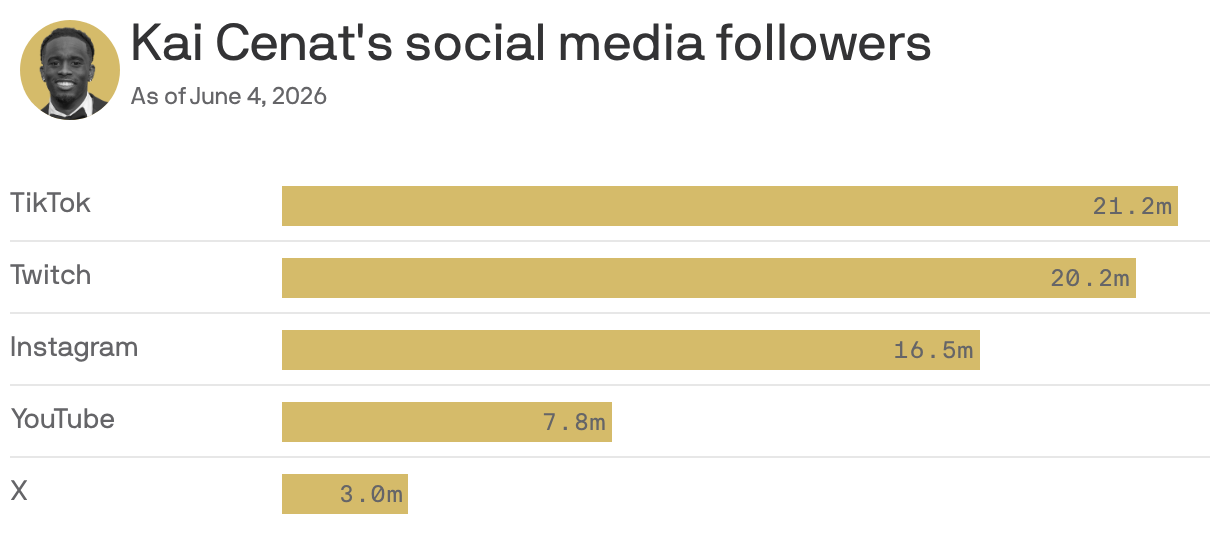
The unattainable educational dream for millions of young people isn't Harvard. It's getting picked by Kai Cenat to learn the skills needed to be the next Kai Cenat.
- The 24-year-old streamer, the most-followed person on Twitch, teased the return of his Streamer University this week. Its first edition, featuring four days of all-expenses-paid instruction from top influencers, pulled in more than 1 million applications for about 200 spots.
Why it matters: Most companies only think about creators when they're buying reach, but young people increasingly see it as a viable career path — largely because of Cenat and his peers.

Hustle culture's pricey hangover

Rest, longevity and fitness are the new status symbols, and burnt-out Americans are spending big on all of the above.
Why it matters: The wellness economy is in its next phase, beyond fancy gym memberships and meditation apps. The money is going to sleep retreats, executive function coaches, and longevity doctors baked into premium urban real estate. Recovery is its own arms race, if you can afford it.