More jobs for robots?

Add Axios as your preferred source to
see more of our stories on Google.
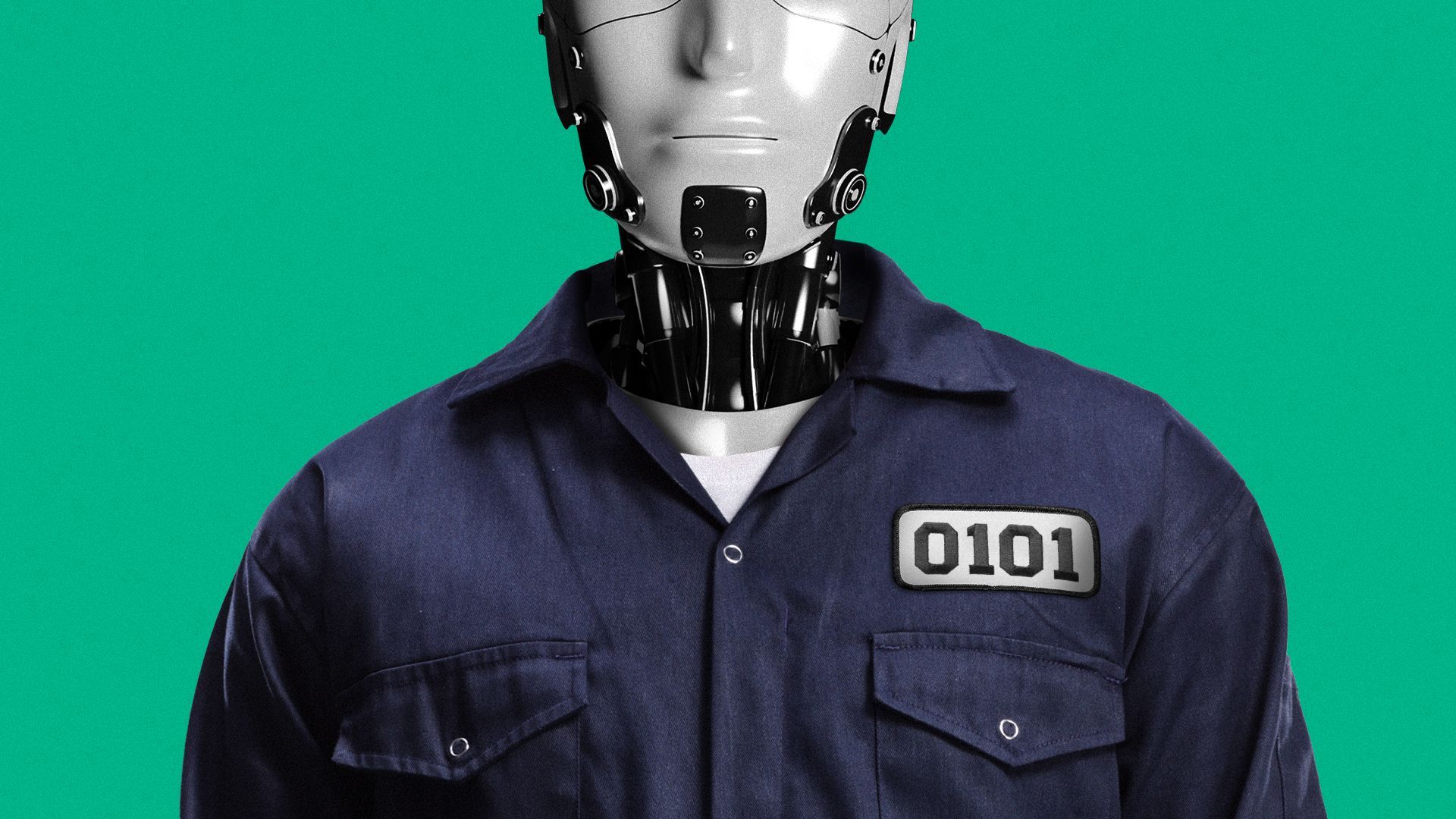
With his sweeping tariff and trade policies, President Trump envisions a U.S. manufacturing renaissance that will bring back good-paying, working-class jobs to America's auto industry.
- But advances in AI and other technologies paint a different picture of the future: Armies of robots — some in human form — doing difficult or repetitive tasks once done by people, who instead put their brains to work in different ways.
Driving the news: Humanoid robots are inspiring much fascination at the moment, with Morgan Stanley projecting 1 billion of them walking around by 2050, starting first in factories and warehouses.
Despite the hype, though, their practical use in manufacturing is still a few years off.
- Elon Musk told investors April 22 he expects "thousands" of Optimus robots operating in Tesla factories by the end of this year, but when pressed for details, said the bots are still in development and that Tesla might build "a few" this year.
- BMW has been testing Figure AI's humanoid robots at its Spartanburg, South Carolina, factory, but isn't saying when it might integrate them into its production lines.
A more realistic view of the future is Hyundai Group's new $7.6 billion factory near Savannah, Georgia, arguably the world's most technologically advanced vehicle assembly plant — for now, at least.
- It started building electric vehicles last November, and plans to build as many as 500,000 cars a year by 2031.
- It's designed for flexibility to build both EVs and hybrids, as demand warrants, starting with the Hyundai Ioniq 5, the Kia EV9 and Waymo's next-generation robotaxi (based on the Ioniq 5).
Zoom in: Instead of human-operated forklifts or tuggers, autonomous mobile robots (AMRs) roam freely around the plant, delivering parts, modules and vehicle bodies to the right place at the right time.
- Elsewhere, giant robot arms twirl tires, seats and center consoles in the air before dipping into the belly of unfinished cars to attach them in a single sweeping gesture.
- Instead of gloved inspectors feeling for surface imperfections, Spot, the four-legged robot from Hyundai-owned Boston Dynamics, scans the exterior to check quality against specifications and transmits real-time feedback to the assembly robots. (Robots helping robots!)
- At the end of the line, flat robots that look like giant Roombas work in pairs to carry cars away. (Musk says Teslas can drive themselves off the line.)
- All of those jobs used to belong to humans.
/2025/04/29/1745957517591.gif)
Follow the money: Using robots, instead of people, to move parts or inspect quality can mean huge savings, according to manufacturing experts at Oliver Wyman, which analyzes every carmaker's labor cost per vehicle.
- "Your labor costs per vehicle could be $100 lower, and if you're making 300,000 vehicles a year, that's big bucks," Oliver Wyman vice president Jim Schmidt tells Axios.
- "Yeah, there's a big up-front investment in equipment, but the payback is fast, and after that, it's all gravy."
What they're saying: The United Auto Workers union doesn't object to automation, especially if it makes jobs safer or less taxing, but it wants a say in how robots are implemented, says Jason Wade, a senior advisor to UAW President Shawn Fain.
- The union wants to protect paychecks and ensure workers whose jobs are replaced by robots are retrained to oversee them, he said.
By the numbers: When fully up to speed in Savannah, Hyundai expects to employ about 8,500 people building 500,000 vehicles a year.
- Ford's F-150 plant in Kansas City, which produced about 476,000 vehicles in 2024, has just over 9,000 employees.
