House lawmakers voted Wednesday evening to overturn a Securities and Exchange Commission staff bulletin related to digital asset custody accounting, with 21 Democrats voting "yea."
Why it matters: SAB 121 has become something of a lightning rod, uniting crypto shops and major banks against the SEC.
Shopify, the e-commerce logistics company, shocked investors today with its sales forecast.
By the numbers: While sales growth reached 23% in the first quarter, Shopify says it expects its Q2 growth rate to fall to the high teens.
The stock plummeted more than 21% earlier in the day and closed down 18.6%.
💭 Hope's thought bubble: As consumers continue to battle inflation and budget for events and travel, Shopify's double-digit growth rate — in its 18th year of operation — speaks to how strong demand for goods continues to be.
And the sell-off, especially in the context of the company's near 50% margins, shows how sensitive and unforgiving financial models are to changing winds.
Trading app Robinhood reported record revenue in the first quarter, helped in large part by a surge in cryptocurrency trading.
Transaction-based revenue for crypto more than tripled year-over-year.
Why it matters: The trading platform disclosed Monday that it's expecting a lawsuit from the SEC for alleged securities violations posed by its crypto business.
By the numbers: Amid a more favorable market backdrop this year, fees generated by trading Robinhood's 15-odd coins on its platform rose 232% year-over-year to $126 million, according to its quarterly filing.
Transaction-based revenue was primarily driven by the crypto business, up 59% year-over-year to $329 million.
The crypto boom helped lift total net revenue to a record $618 million, up 40% from the comparable year-ago.
Robinhood also posted record net deposits of $11.2 billion, which included "net positive transfers from every major incumbent brokerage firm."
Robinhood's stock was up more than 6% in post-market trading.
Zoom out: Robinhood's crypto business tends to swing with the times.
In 2021, crypto accounted for 23% of transaction revenue, and 7%, last year.
The big picture: The company that mainstreamed commission-free trading has historically taken a conservative approach to staying in line with regulatory expectations.
Now, it appears to be taking a more aggressive stance as the SEC threatens to come for its crypto business, just as that business is taking off again.
What we're watching: Robinhood's hosting an earnings call at 5:00 pm ET.
An ad for Apple's new iPad lineup that shows a massive hydraulic press crushing the artifacts of human and digital culture — from beautiful musical instruments to arcade video games — has triggered an online outcry in the 24 hours since its release.
The big picture: Creative professionals and artists — one of Apple's key constituencies — already fear AI's impact on their jobs and our culture. The ad, many felt, made the company look both callous and brutal.
Blockworks, a media company that covers cryptocurrency for professionals, has acquired The Breakdown, a podcast network, Blockworks co-founder Jason Yanowitz told Axios.
Why it matters: The deal marks the company's first acquisition since raising its first round of private capital last May.
Auction prices are the most transparent and reliable way to find out the value of an artist's work. But as Katya Kazakina reports for Artnet, they can also be highly misleading.
Why it matters: In general, auction prices tend to overstate the strength of the art market, thanks to survivorship bias — how auction houses gravitate towards the hottest artists. Sometimes, however, the bias can lean the other way.
Former President Trump is betting that high gas and grocery prices will fuel his return to the White House. But his second-term plans could make inflation worse.
Why it matters: President Biden's approval rating has suffered under the crushing weight of inflation, which voters consistently rank as their top issue for the 2024 election.
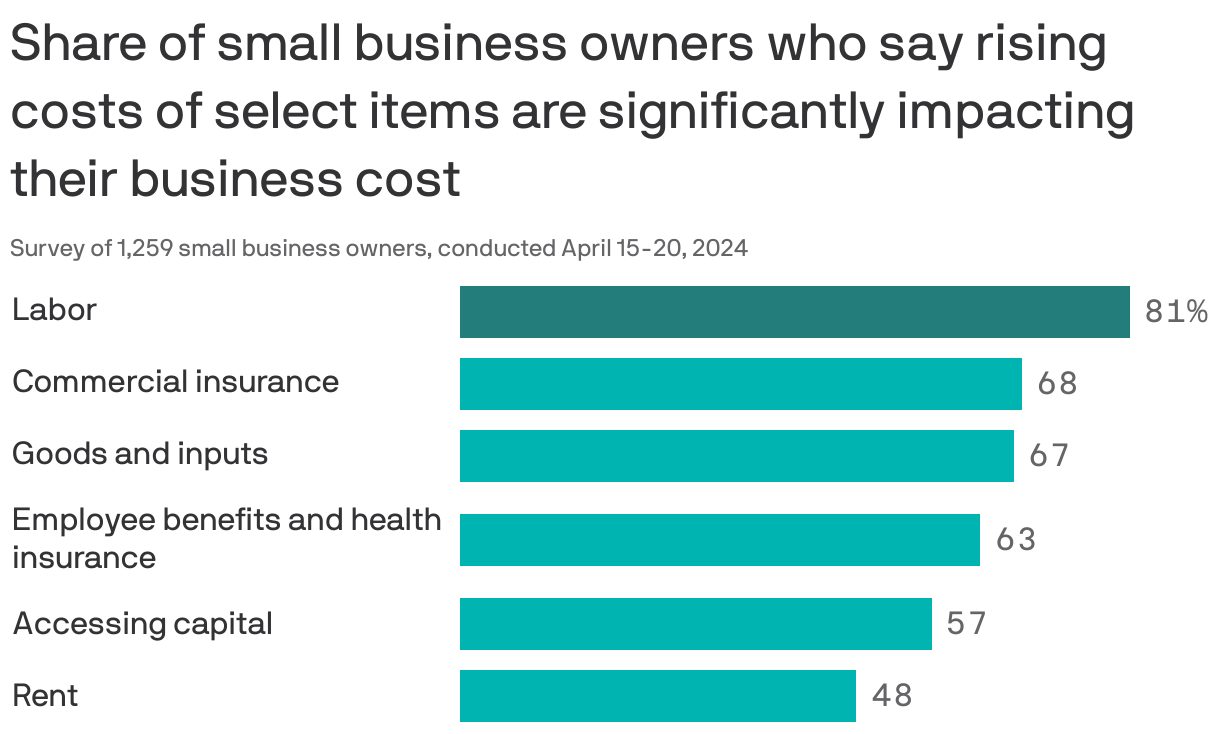
Data: Goldman Sachs 10,000 Small Businesses Voices; Chart: Axios Visuals
Small business owners are as preoccupied with stubborn inflation and economic uncertainty as the general public, yet many still embrace entrepreneurship — warts and all.
Why it matters: A slowing economy and stubbornly high prices have exposed a growing divide between Wall Street and Main Street.




/2024/05/08/1715190483525.gif?w=3840)






/2024/05/07/1715113863883.gif?w=3840)