There's an unprecedented building boom underway in America. With it has come a less-noticed phenomenon: a surge of investment into communities left behind in the last economic expansion.
Why it matters: Poorer counties with lower employment rates have attracted a large share of the hundreds of billions of dollars allocated for clean energy projects, semiconductor mega-factories and more.
Industry leaders convened at Axios BFD Miami on Feb. 13 to discuss the biggest deals in the market, what's driving the news and the future landscape of 2024.
Vox Media on Wednesday announced that acclaimed author and podcaster Brené Brown will be bringing her two award-winning shows, "Unlocking Us" and "Dare to Lead," to its podcast network.
Why it matters: Brown is one of the most popular podcasters and speakers in the world. Her shows have been on hiatus since she ended her exclusive deal with Spotify in January 2023.
Israel will allow a United Arab Emirates field hospital in the Gaza Strip to use Elon Musk's Starlink satellite internet service, Israeli Communications Minister Shlomo Karhi said on Wednesday.
The big picture: Israel must approve any use of the service in Gaza under the agreement between Starlink and the Israeli government, according to Karhi.
A group of senior investors, advisers, and founders gathered in Miami on Tuesday to discuss the growth of private credit. The "Expert Voices" roundtable was part of the Axios BFD conference held in the city.
What they're saying: The hour-long discussion featured a range of views and insights on the surge of private credit offerings, how companies and clients are utilizing the products, and where banks and non-bank lenders go from here in the current macro environment.
Below is a snapshot of views shared by speakers at the roundtable.
Competition is heating up across bank and non-bank lenders.
"I think the big competition you've seen today is really that private credit has grown significantly," said David Rosenblum, fund partner at I Squared Capital. "You still have enormous amounts of demand from the middle market. So I think what happens over time…is you're still going to always have this competition between syndication, syndicate execution and private credit execution. I think we're seeing exactly that right now."
Rosenblum later added that middle market private credit will compete less with syndication execution.
The acceptance of private credit offerings is widening.
"We're helping our corporate clients understand the full options available to them, and that these options may be different from what it used to be 10 years ago when it was somewhat limited to syndicated capital or syndicated debt," said Ian Schuman, a partner at Latham & Watkins.
"Private credit is not necessarily bespoke to just distress situations. A lot of companies that we represent are on the IPO launch pad waiting for more favorable conditions. They don't necessarily want to do a super dilutive process. They'd rather have a strategic partner involved."
"There are some companies that would like to capitalize. They don't love their stock price right now. They'd rather turn to a pipe transaction or a preferred transaction and keep executing on the model, and have just one party to deal with, as opposed to competing parties within the same piece of paper in a syndicated loan," Schuman added.
A range of businesses are exploring private credit options.
"So think about a company that has made it through the FDA, they start to execute. They have $10-15-25 million dollars in revenue, they need money to invest in sales, manufacturing, marketing distribution. Why would you go raise an expensive crossover round ahead of a sale to a strategic or at an IPO, when you can raise what looks on a relative basis, like relatively cheap, structured debt?" said Kennedy Lewis president Doug Logigian.
"And then you execute for the next year, year and a half, maybe raise more equity," Logigian added.
Certain types of debt remain risky.
"[Y]ou have a $2 billion valuation and we're lending $20 million in venture debt. It's a really low loan-to-value ratio, but it's very binary the outcomes of a lot of those businesses. That's been the challenge is when there's not profitability or assets to back up the debt," said Brian Harwitt, partner at CoVenture.
"With venture debt, I've seen companies go out of business for their founders being greedy. ... If you're not [profitable], it's a very risky thing not just for the lender but for the founder," said Carlos Domingo, co-founder and CEO of Securitize.
"As a startup founder and not being profitable, I wouldn't take venture debt. With equity financing, you won't go out of business. You might have to raise more but the company stays there and you have more time to make it work," Domingo added.
Editor's note: This article was updated to include additional comments from Rosenblum.
Jon Stewart's "Daily Show" comeback on Monday night drew the show's biggest audience since 2018.
Why it matters: The reunion — almost nine years after Stewart departed — marked a key moment for a show that has struggled to retain viewers since he left.
Since the pandemic, wage gains for Black Americans have outpaced those for white people — but wealth inequality deepened, finds new research from the New York Fed.
Why it matters: The research, which looks at changes from 2019 to the third quarter of 2023, demonstrates how firmly entrenched the racial wealth gap is in the U.S.
American automakers increasingly view Chinese electric cars as an existential threat, despite the fact that Chinese-branded cars aren't even for sale in the U.S. yet.
Why it matters: For big legacy automakers like Ford and General Motors, budget-priced Chinese cars represent another Tesla-like seismic disruption.
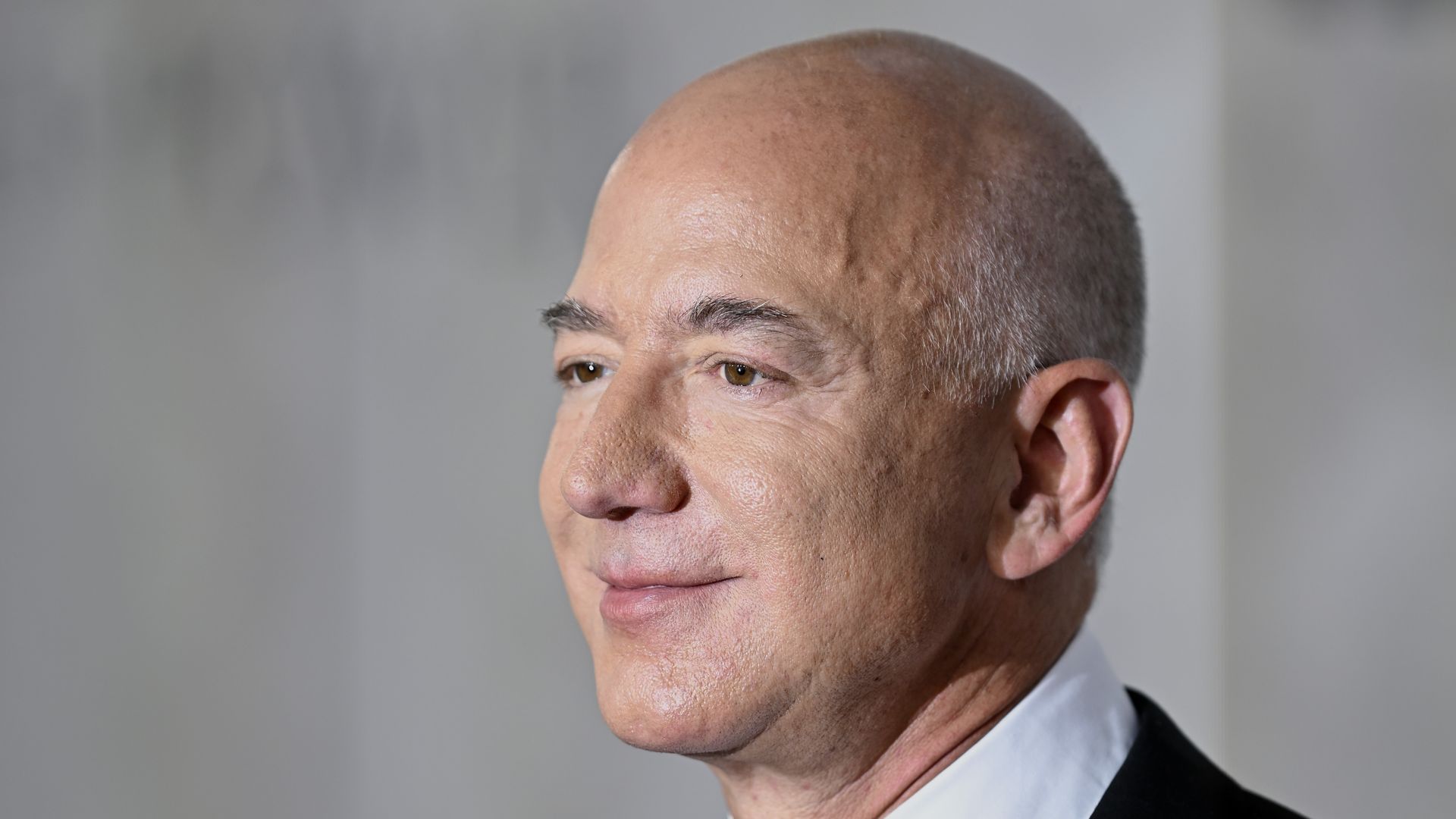
Jeff Bezos has sold more than $4 billion of his shares in Amazon over the past week as the e-commerce giant's stocks surged, according to new regulatory filings.
Why it matters: Bezos' sale of some 24 million shares in four trading days since Friday mark the first time the billionaire Amazon founder and executive chairman has offloaded the company's stock since 2021.