Thursday's technology stories

Abu Dhabi forms company to license app to other governments
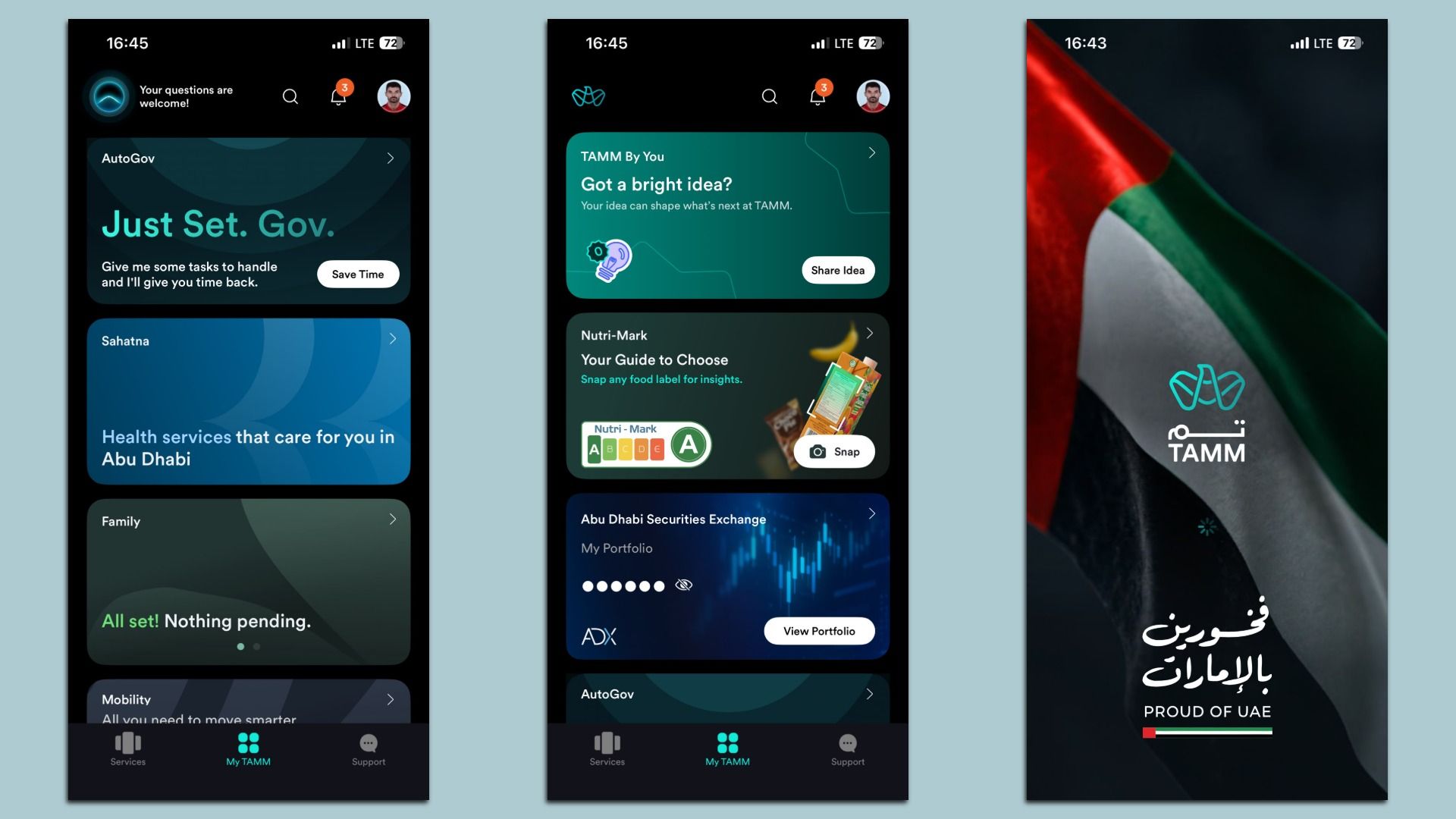
Abu Dhabi — which pioneered TAMM, an AI-driven app that eases citizens' day-to-day interactions with government — is launching TAMM Global, a new company that will make TAMM's technology and operating model available to governments worldwide.
- Other governments now can modernize service delivery by licensing and deploying "bespoke versions of TAMM, adapting the platform to their own laws, policies, public services and citizen needs," the announcement says.

Apple and Meta bury the hatchet — for AI

Apple and Meta, whose leaders have spent years trading barbs over privacy and the future of computing, are joining forces to bring one of America's most powerful open-weight AI models to Apple's high-end Macs.
Why it matters: The collaboration marks a striking détente between two longtime Silicon Valley rivals, underscoring how the AI race is reshaping relationships across the technology industry.
- The companies still compete over devices and the next generation of computing, but both see an opportunity in bringing powerful AI capabilities to personal computers.
"We're excited for mommy and daddy to be playing nice again," Meta's AI chief Alexandr Wang told Axios.
Driving the news: Meta is releasing Muse Spark Open, a model similar to Muse Spark 1.3, that it says is the most powerful U.S.-developed open-weight AI model available.
- Meta joins a host of Western AI companies that have released powerful open-weight systems that promise to slash AI costs, provide companies with more control and offer an alternative to the Chinese AI ecosystem.
- Nvidia on Tuesday released updated versions of its Nemotron family of models, and U.S.-based Reflection AI and France's Mistral both released new open source models last week.
- As proof of Muse Spark Open's capabilities, Meta worked with Apple to make the model run locally across two or four connected Mac Studios powered by Apple's M5 Ultra chips, using Apple's MLX framework.
Zoom in: The prospect of a powerful model — it has 816 billion parameters — running on Apple hardware offers a proof of concept about just how much companies will be able to build their own AI systems.
- That could give companies more alternatives to Nvidia GPUs and proprietary models from leading AI labs, potentially shifting some of the economics of AI.
- Meta's model will be free to download, with a license allowing commercial use, and will also be available through cloud providers and developer tools.
What they're saying: Wang said the companies have been working together for several months, with Daniel Gross, a former Apple executive now at Meta, playing a key role in bringing the two sides together.
- "I think he played a really big role in kind of getting the two companies to work nicely together," Wang said in a telephone interview.
Flashback: Apple executive chairman Tim Cook and Meta CEO Mark Zuckerberg have repeatedly clashed over privacy and their competing business models.
- In 2018, amid Facebook's Cambridge Analytica scandal, Cook was asked what he would do if he were Zuckerberg. "I wouldn't be in this situation," Cook replied. Zuckerberg called Cook's comments "extremely glib."
- The rivalry intensified in 2021, when Apple introduced new privacy protections that struck at the heart of Facebook's ad business. Zuckerberg reportedly told employees that Facebook needed to "inflict pain" on Apple over the dispute, according to the Wall Street Journal.
The big picture: The AI race is making for some strange bedfellows, scrambling longstanding Silicon Valley rivalries and even bringing together political adversaries.
- Anthropic is leasing up to $15 billion per year of computing capacity from Elon Musk's SpaceX, even as it competes with his AI company.
- Microsoft, OpenAI's longtime partner, is investing billions in rival Anthropic and incorporating its Claude models into its own products.
- And in Washington, progressive Sen. Bernie Sanders and MAGA strategist Steve Bannon have found common ground in calling for tougher AI safeguards and challenging the power of Big Tech.
Between the lines: The Apple-Meta collaboration doesn't mean the companies have resolved their differences, but it suggests those disagreements no longer prevent them from working together when their interests align.
- Meta benefits from making its AI models widely available, while Apple can showcase the capabilities of its most powerful computers.
- And because the model runs locally, Meta doesn't receive users' prompts or other information — sidestepping the privacy concerns that have long divided the companies.
"Meta has no control or visibility to any of that," Wang said of how developers use the model.
Yes, but: Making powerful AI models openly available raises concerns that bad actors could remove safeguards and use the technology for cyberattacks or biological threats.
What we're watching: Whether the collaboration marks the beginning of a broader relationship between Apple and Meta.
- For now, Apple is helping demonstrate that Meta's AI models can run locally on its computers. A more significant step would be Apple incorporating Meta's models into Apple Intelligence, giving the Facebook parent a role in powering Apple's own AI features.
The bottom line: Wang acknowledged that Apple and Meta will continue to compete in some areas, but said that doesn't have to prevent them from working together.
- "Where it makes sense to collaborate and partner, we want to be able to do so," he said.

Fed's Beige Book tells inflation story

A grocery chain says it now costs more to ship a head of lettuce from California than to buy the lettuce itself. Tech companies are trying to purchase entire inventories of electrical equipment to build data centers.
Why it matters: These anecdotes from the Fed's latest Beige Book show how two extraordinary forces — the AI buildout and the Iran war — are changing decisions about spending, investment and hiring.
- The implications extend beyond individual firms, with consequences for inflation and employment, as the Fed weighs another rate hike.
Zoom in: A grocery chain told the Richmond Fed that diesel prices have risen 30% from a year earlier — making shipping lettuce more expensive than the cost of the vegetable — but price-sensitive customers have left it unable to pass along the higher costs.
- The energy shock is also squeezing businesses locked into earlier contracts: A Montana timber company said fuel costs had more than doubled on a project negotiated months earlier.
The AI boom is creating another strain, intensifying competition for equipment needed to build data centers.
- An electrical equipment distributor told the Chicago Fed that tech companies tried to buy up all of its available equipment. Suppliers resisted, citing commitments to other customers.
What to watch: AI is changing how many workers businesses believe they need and what they need them to do in ways not yet apparent in broader labor market data.
- In Dallas, an accounting industry contact said some large firms were delaying employment contracts because AI productivity gains could reduce their need for entry-level workers.
- A staffing firm in the area said AI agents conducted more than 180 hours of job interviews in two days, leaving human recruiters to review the results and make hiring decisions.

Media bets on IRL for community building and growth

Established media brands like The Atlantic and MS NOW are betting on in-person experiences to grow their brands and build lasting communities.
Why it matters: The strategy reflects the importance of direct relationships with audiences, since reach alone doesn't capture loyalty and trust.

Berkshire invests $330 million into AOL owner Bending Spoons

Bending Spoons on Wednesday secured a $330 million investment from existing shareholder Berkshire Hathaway.
Why it matters: The Italian software conglomerate, known for buying legacy brands like AOL and Vimeo, now has more dry powder for M&A.

Exclusive: Frontier secures deal with startup that stores CO2 in rocks

Frontier, the group of big companies jump-starting carbon removal markets, has brokered $11.7 million in new purchase deals with the startup 44.01.
Why it matters: It's Frontier's first purchase using a promising but nascent method that turns CO2 into rock, potentially opening up new locations for permanent carbon storage.


AI tremors felt in corporate bond market
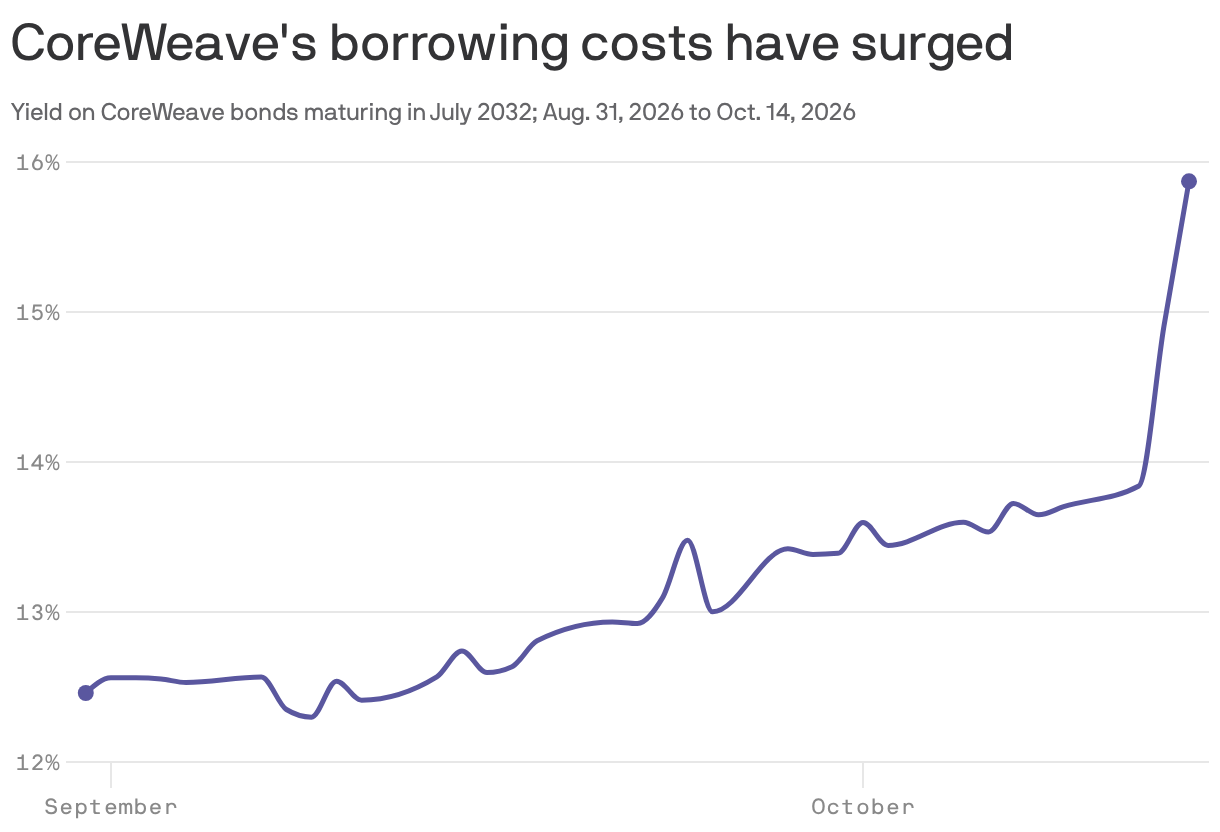
CoreWeave was at the heart of the market's volatility Wednesday.
Why it matters: The heavily indebted, cash-burning neocloud — a data center operator that effectively rents out its AI computing capacity — is seen as something of a canary in the coal mine for the broader AI trade.
- The sharp sell-offs in its bonds and stocks underscored how jittery investors are getting about the AI investment binge.

Exclusive: Top general sees "gaps" in space arms

The four-star general leading the military's high-stakes space missions sees critical gaps in the nation's arsenal to counter China's and Russia's emerging threats.
Why it matters: Gen. Stephen Whiting, head of U.S. Space Command, has seen orbital threats evolve rapidly during his 37-year military career. In an exclusive chat with Axios, he said the command needs more investment and capabilities.
- The ongoing war in Iran has revealed that U.S. adversaries are targeting ground-based radar systems to gain an advantage. Whiting said the same logic now applies to the nation's military assets orbiting Earth.
CEO confidence drops into negative territory
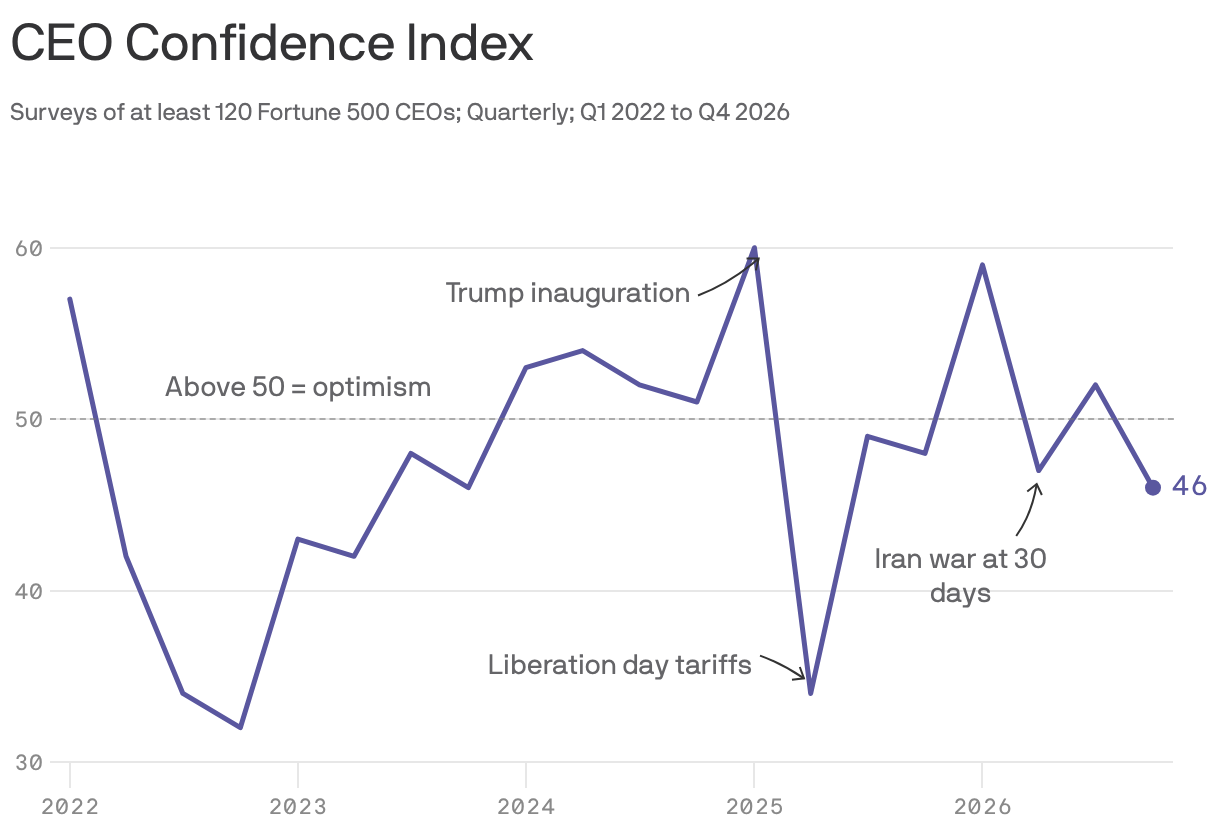
CEO confidence in the U.S. economy sank into negative territory earlier this month, finds a survey out Thursday morning from the Conference Board.
Why it matters: Business leaders are mind-melding with most consumers, whose opinions on the economy are now lower than during the pandemic.
- Such sour sentiment is shaping up as a key issue in the midterms just weeks away.

U.S. CEOs see AI as force for job creation, survey finds

U.S. business leaders are coalescing around a belief in AI as a force for job creation instead of destruction, according to a new KPMG survey.
Why it matters: The looming uncertainty over the economic impact of AI remains a topic of significant concern for workers.
Zoom in: 89% of U.S. CEOs expect to increase their headcount over the next three years as AI creates more business opportunities, the survey found.
- 86% said they're "redesigning roles, career paths and team structure to reflect human-AI collaboration," while 79% are "hiring new talent with AI and tech capabilities."
- The survey of 400 U.S. CEOs took place from Aug. 11-Sept. 21.
What they're saying: KPMG U.S. CEO Tim Walsh says the path to AI-powered job growth is "directionally very clear," but he warned that serious risks loom — including the threat of cybersecurity attacks.
- "As we put more AI into our processes and platforms, the capacity opens up," Walsh tells Axios in an interview. "What you're seeing there is CEOs being really optimistic that they can actually expand their business, which is going to result in a bigger workforce for them."
Yes, but: 53% of CEOs are still planning workforce reductions in some areas, according to the survey, illustrating the complicated impact of AI on the economy.
Amid swirling chatter about the risks of AI going rogue and attacking infrastructure or critical business operations, the nervousness in the C-suite is palpable.
- 85% of CEOs anticipate cybersecurity threats "will impact their organization's prosperity over the next three years," the survey found.
- CEOs are bracing for something "damaging in a very significant way," Walsh says. "There is an acknowledgement out there — and it's pretty widespread — that you know that something's going to happen."
But that risk also brings an opportunity of a kind as businesses shore up their defenses.
- 48% of CEOs plan to boost their spending on cybersecurity over the next three years.
The bottom line: CEOs are grappling with the complex interplay of opportunities and threats that comes with the arrival of dynamic AI systems.

Anthropic brings Wall Street an AI bull case

AI companies for years have promised that smarter models would be worth the staggering cost to build them. Anthropic on Wednesday made that case in cash.
- The company presented eye-popping financials to investors, saying it was cash flow positive in the third quarter, with revenue surging nearly 50% to $16.8 billion compared with the April-to-June period.
Why it matters: As Wall Street broadly spent the day fearing an AI bubble, Anthropic offered what investors have been desperate to see: evidence that frontier AI can be a sustainable business.
Scoop: "OG" Bill Gates returns to wage war on AI risks

Bill Gates is gearing up to dramatically expand his AI safety push, personally leaning on business leaders and considering a major deployment of his resources, sources tell Axios.
Why it matters: The formidable, sharp-elbowed Bill Gates who built Microsoft is back, and he's directing his competitive fire toward what he has come to see as one of the most important causes of his lifetime.
- "I can reach CEOs on this better than you can," Gates told one person he consulted on AI safety, showing an eagerness for combat that associates say is a return to "OG" form.

Scoop: FTC subpoenas OpenAI, Anthropic over consumer harms

The Federal Trade Commission on Wednesday sent civil subpoenas to AI giants seeking documents about safety incidents that have spiraled into an industry crisis.
- The FTC sought documents from Anthropic and OpenAI in a probe focused on potential consumer protection violations, a person familiar told Axios.