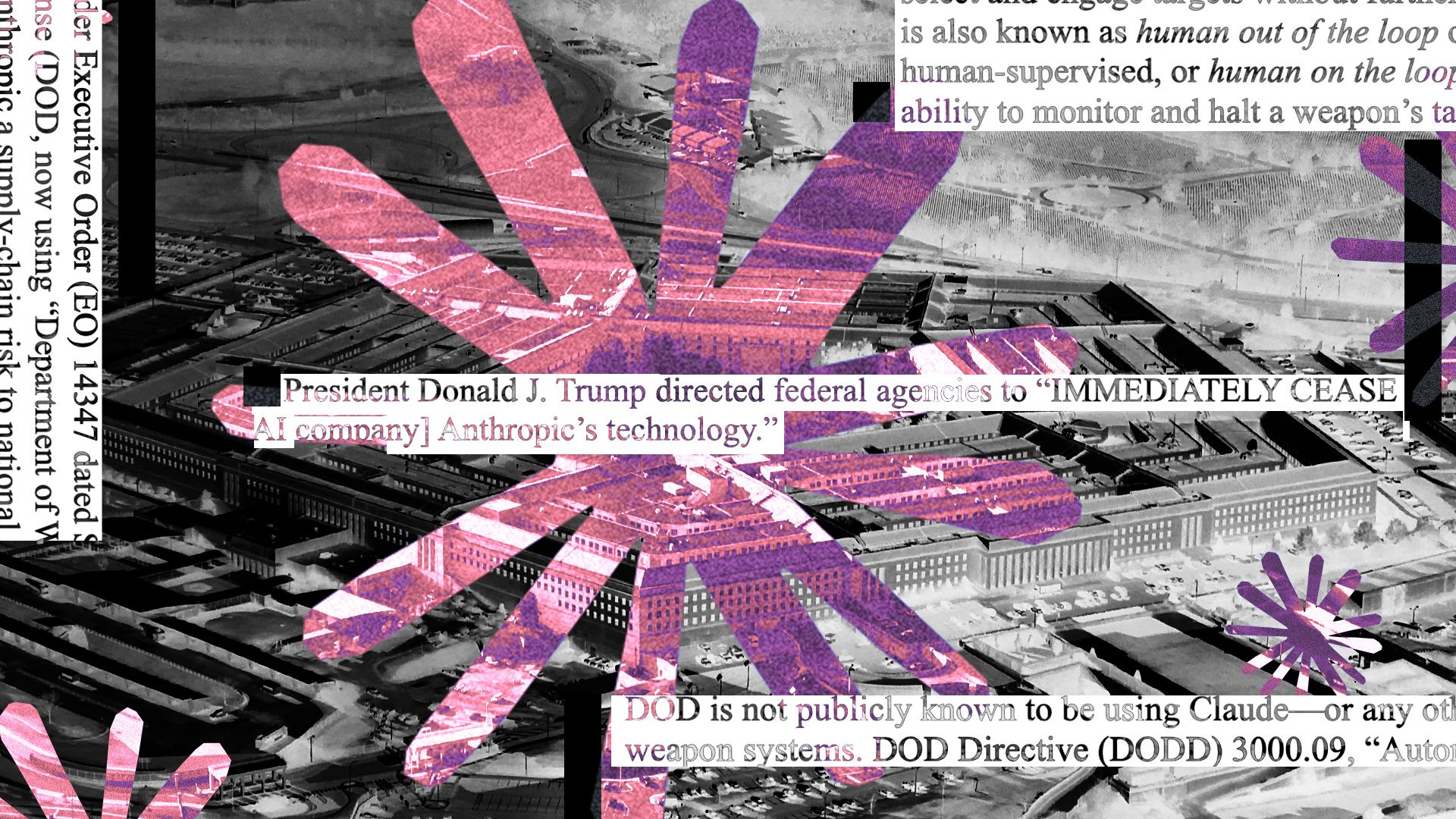
Anthropic says it has no way to control or shut down its AI models once they're deployed by the Pentagon, according to a new court filing.
Why it matters: The Pentagon designated Anthropic a supply chain risk, contending the AI firm is inappropriately getting involved in how its technology can be used in sensitive military operations.
Tesla reported an uptick in quarterly revenue and profit, but the costs of pivoting to an AI future are starting to add up.
Why it matters: CEO Elon Musk has directed the company to invest heavily in the development and production of humanoid robots, self-driving cars and AI chips.
House Republicans on Wednesday rolled out two data privacy bills to protect personal and financial data and override state laws.
Why it matters: Congress has been trying to pass a federal data privacy law for years, but fights over preempting state laws keep derailing efforts and are now spilling into AI policy debates.
By 2033, the manufacturing sector is projected to need 3.8 million additional workers, with half of those jobs at risk of remaining unfilled. [1]
Why it's important: These talent shortages are currently slowing America's progress in defense, advanced manufacturing, semiconductor fabrication and energy — creating real risks to national security. [2]
WASHINGTON – Financial help remains out of reach for many Americans, but AI could offer new pathways to close that gap, Rep. Josh Gottheimer (D-N.J.) said at an Axios Live event.
Why it matters: Gaps in financial literacy leave many Americans vulnerable to poor financial decisions. AI could expand access to guidance, improve decision-making and help more people manage their money effectively.
Axios' Courtenay Brown, Ashley Gold and Neil Irwin hosted conversations with Gottheimer, Rep. Young Kim (R-Calif.) and Operation HOPE CEO John Hope Bryant. The April 21 event was sponsored by FICO.
What they're saying: "A lot of Americans have no access to financial assistance, and it's a huge issue because it leaves some out and they don't get the right advice, or any advice whatsoever," Gottheimer said.
Bryant said financial literacy "used to be a poor person's issue, now it's a middle-class issue."
Gottheimer pointed out that people with no financial background can use AI to sort through questions that come up throughout life, such as how to invest properly, when to buy a house, etc.
Yes, but: AI could be a "double-edged sword," Kim said.
"On one end, it provides access and opportunity, but on the other, it could be weaponized by bad actors to target Americans with more sophisticated scams," Kim said.
Gottheimer said a challenge is to make sure people aren't getting "crazy information" from AI and to ensure that the advice is disclosed as coming from a bot.
Content from the sponsor's segment:
In a View From the Top conversation, Rukiya Kelly, FICO's head of corporate impact and engagement, discussed combating fake financial influencers and AI chatbots spreading misinformation as more consumers turn to social platforms for financial advice.
"We have to, as credible organizations, reach people where they are," Kelly said. "If they are on those platforms, how do we get our credible information and trustworthy information to that consumer? I would say trust but verify."
Clara Shih, a former top AI executive at both Salesforce and Meta, is launching a new foundation that aims to provide the next generation of workers tools to navigate the uncertain job market.
Why it matters: College students and younger workers are increasingly stressed that AI is eroding entry-level jobs.
Google on Wednesday announced a new generation of its Tensor chips with separate options for training and inference along with a consolidated enterprise platform.
Why it matters: Google is in a pitched battle with Amazon and Microsoft to be the cloud provider of choice for AI workloads.
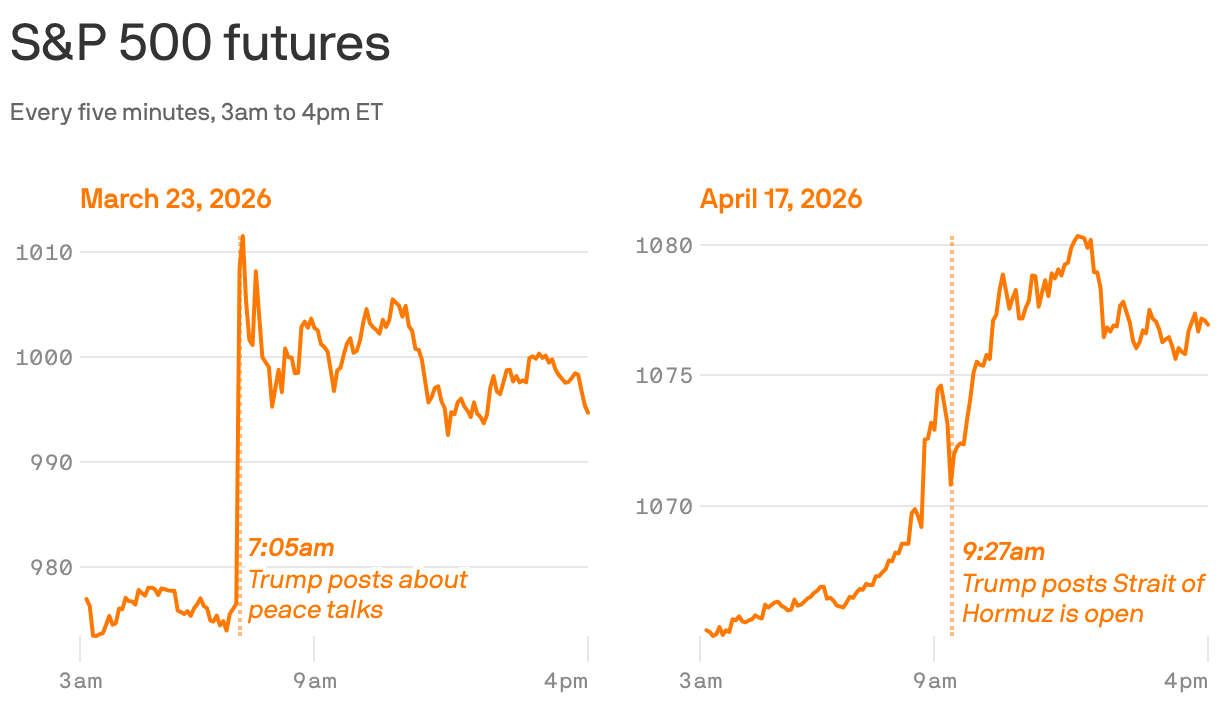
A well-timed, optimistic post on Truth Social from President Trump about the war in Iran can send stocks higher.
Why it matters: Social media posts from the White House have become key drivers of the oil and stock markets during the conflict, particularly as its resolution seems to keep moving further and further out of reach.
An MQ-4C Triton crashed this month, according to U.S. Navy data and publicly available flight logs.
Why it matters: At roughly $240 million a pop, the Northrop Grumman-made maritime surveillance drone is among the single priciest losses amid the Iran war.
The builder of the U.S. Navy's futuristic fighter, known as F/A-XX, will be selected in August, according to the service's top uniformed official.
Why it matters: The long-awaited decision would cap a secretive competition between Boeing and Northrop Grumman, and also signal some sort of consensus between the White House, Pentagon and Hill.
It's been almost one year since the Trump administration revealed its Golden Dome game plan.
Why it matters: President Trump said his hemispheric missile shield will block "very close to 100%" of inbound threats, and will come online before his second term is up.
But the public remains in the dark about what, exactly, it looks like and how it will be funded fully.
NASA is researching whether unmanned drones could help solve reliability issues that have cost patients life-saving organs and left donor tissue lost in transit or unusable.
OpenAI has been briefing federal agencies, state governments and Five Eyes allies on the capabilities of its new cyber product over the past week, Axios has learned.
Why it matters: Companies and agencies are clamoring to get their hands on the latest AI tools, whose advanced cybersecurity capabilities promise big gains for defenders and frightening advances for malicious hackers.
ChatGPT's new image engine promises a host of improvements including better typography, access to the web and an ability to reason. So Axios put it to the test.
Why it matters: Past image engines have proved initially popular with consumers, but had enough flaws to prevent broader use in business.