Hackers suspected of being backed by China have exploited a flaw in a popular email security tool to target hundreds of public and private sector organizations around the world, researchers at Google-owned Mandiant have found.
Why it matters: Almost a third of the targeted organizations are government agencies, including foreign ministries, according to the report, released Thursday.
Companies are routinely urged to think more about their cloud security, but a new set of products from Amazon Web Services' security team aims to help customers think about it less.
Driving the news: AWS unveiled its plan to add new security checkpoints to the company's cloud products earlier this week during its re:Inforce conference.
If you're thinking of buying an electric vehicle (EV), you probably should consider installing a home charger too.
Why it matters: Nobody thinks about how they'll refuel when buying a traditional gasoline-powered car. But charging is a critical factor for EV buyers.
Researchers are finding new ways for AI to be weaponized against us — and bioterrorism enabled by AI tops the list.
Why it matters: Bioattacks have been assumed to be the province of governments, but now we face the prospect of rogue individuals and organizations gaining the capability.
Several government agencies are responding to data breaches tied to a recently discovered security flaw in a popular file-transfer tool, the nation's cyber defense agency said Thursday.
MakerDAO is breaking up with Gemini by cutting its position in the exchange's GUSD stablecoin, Brady and Crystal write.
Zoom in: The decision is largely informed by a desire for MakerDAO, a decentralized autonomous organization with $8 billion in assets, to take advantage of generous interest rates on U.S. Treasuries.
Microsoft’s video game studios are adopting longer development cycles, collaborating more with each other and finally ditching last generation’s Xbox One tech, if not that console’s playerbase.
Driving the news: These shifts are part of an updated approach to making games for PC and consoles at Microsoft, the company’s game studio chief Matt Booty tells Axios.
Polygon launched a database cataloguing the different ways folks are using blockchain-related services across verticals from social impact to education.
Why it matters: The initiative was inspired to answer the question of "what is crypto's value proposition," Rebecca Rettig, chief policy officer at Polygon, tells Axios, and in part, to push back on Washington criticism enshrined in the President's economic report that its innovation has been mostly about creating "artificial scarcity."
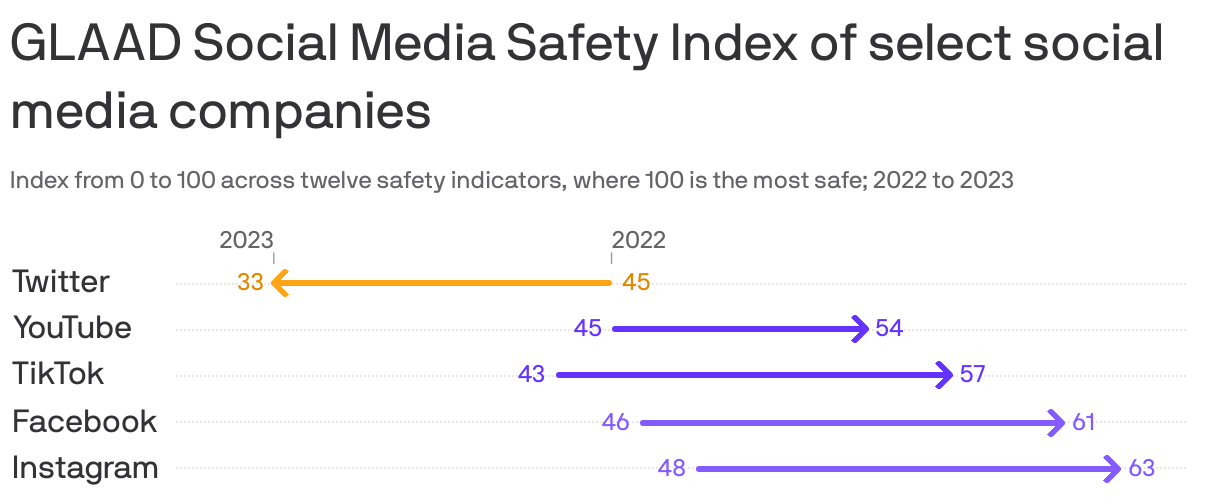
By continuing to allow harassment and hate on their platforms, Facebook, Instagram, TikTok, YouTube and Twitter are fostering an environment that has led to a wave of threats and violence against the LGBTQ community, according to a new report from GLAAD.
The social media companies "are directly responsible for the uptick in hate and violence on the LGBTQ community," GLAAD CEO Sarah Kate Ellis told Axios, pointing to more than 160 documented acts or threats of violence at LGBTQ events so far in 2023.
European leaders have spent the week doing what they do best: regulating, and promising to poke around in other people's tech.
Driving the news: The EU's legislative reconciliation process is underway to finalize the bloc's AI Act. While officials met until nearly midnight — after a supermajority of legislators approved the text Wednesday — the process will likely take months, and the law won't take force until 2025.
The National Music Publishers' Association accused Twitter in a lawsuit Wednesday of repeatedly violating copyright law by allowing users to post music to Elon Musk's platform without permission.
Driving the news: "Twitter fuels its business with countless infringing copies of musical compositions, violating Publishers' and others' exclusive rights under copyright law," alleges the NMPA's lawsuit, brought on behalf of 17 music publishers that represent some of the world's biggest artists.













/2023/06/14/1686777032427.gif?w=3840)