Pandemic-induced telecommuting is spotlighting a new war in business: the fight to dominate work-from-home technologies.
The big picture: For many firms, virtual meeting and chatting software went from nice-to-haves to must-haves as they rushed to replicate the communication and collaboration that happens in person at the office.
Patients who used telehealth during the pandemic contributed to a decrease in emergency room visits by 40% nationwide, and by 80% among those 14 years old and younger, Mario Schlosser, co-founder and CEO of Oscar Health, said Tuesday at an Axios virtual event.
Why it matters: The decrease in ER visits showed many patients were regularly using telehealth services for non-emergencies. Virtual health care visits could become a default for check-ups, prescription refills and behavioral health even after the pandemic subsides, Schlosser added.
An international coalition of news and tech companies, including the AP, The Washington Post, Facebook and others, is partnering with a different coalition led by the BBC, CBC/Radio-Canada, Microsoft and The New York Times called Project Origin to fight fake news during the U.S. election.
How it works: The project aims to place digital watermarks on media originating from authentic content creators. The watermark will degrade when content has been manipulated. The verification system will be deployed in the month leading up to the U.S. election.
YouTube Live and Facebook Live are being increasingly challenged by upstarts, including Twitch, Twitter and Snapchat.
Why it matters: Three years ago, a survey from TV analysis company Magid found that consumers cited YouTube Live and Facebook Live most often as the platforms they use to stream live video.
Educational electronics maker Kano is launching an updated version of the Kano PC, its modular $300 Windows laptop.
Why it matters: The educational electronics market has grown increasingly important in the coronavirus era with students stuck at home. Competition has also grown, as companies like Sphero shift energy there and away from the consumer market.
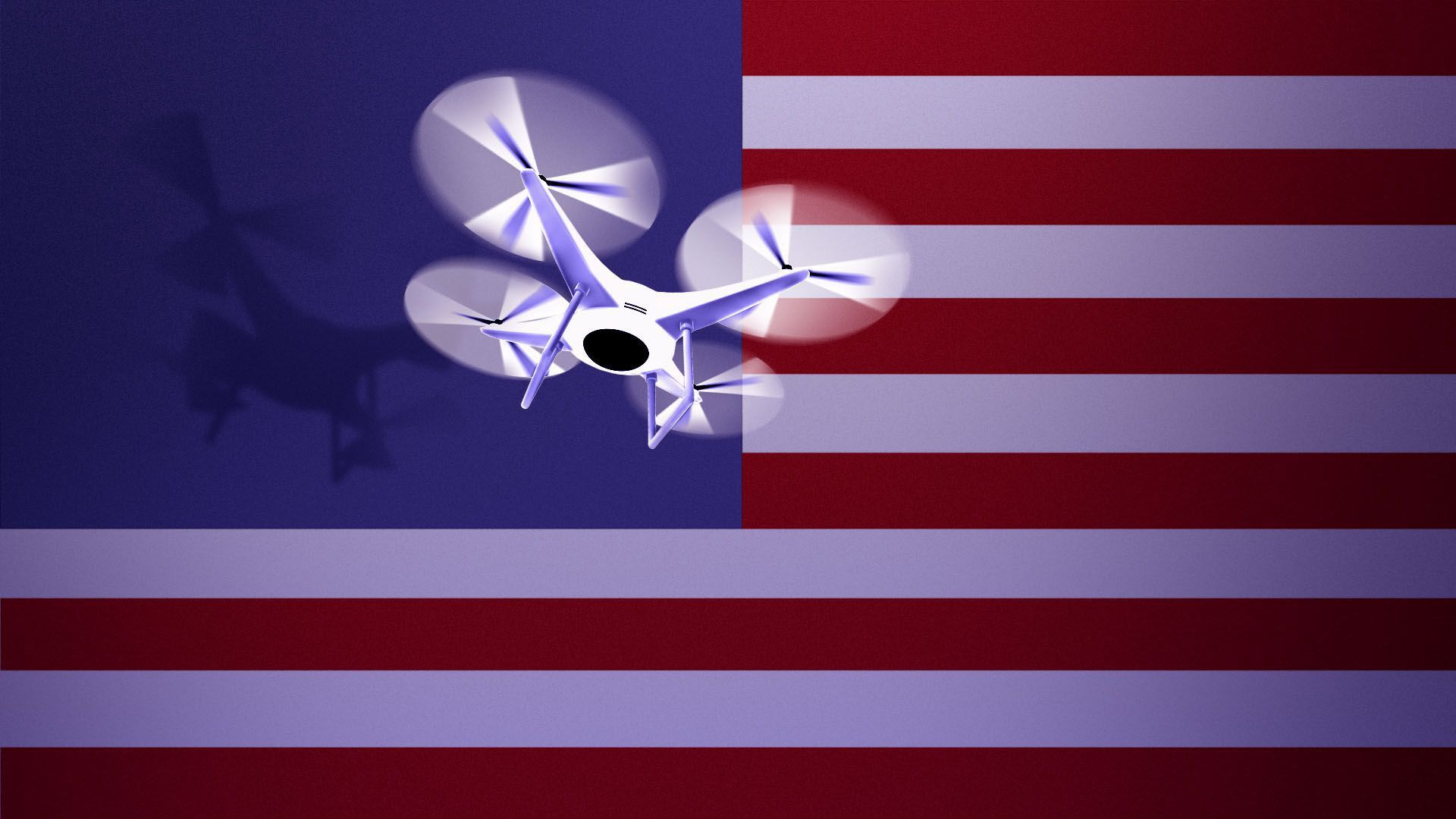
Alarmed at the prospect of relying on Chinese-made drones for public safety and monitoring critical industries, U.S. investors and the federal government are newly backing a domestic drone industry of hardware and software companies.
The big picture: The moves come as the industry continues to be led by DJI, a Chinese hardware maker — and as concerns grow both in China and the U.S. about reliance on the other country's technology.
Three years ago, a survey from TV analysis company Magid found that consumers cited YouTube Live and Facebook Live most often as theplatforms they use to stream live video, Today, that live video duopoly is being challenged by upstarts, including Twitter, Snapchat and Twitch.
The U.K. said Tuesday that it will no longer allow Chinese tech company Huawei to access its 5G network amid growing pressure on Prime Minister Boris Johnson to take a stand against Beijing, the New York Times reports.
Why it matters: It's a big win for the Trump administration, which has sought to firewall Huawei from networks around the world and put intense pressure on its closest ally to make such a move.
The school year begins soon in certain states, but we're getting further away from a national consensus on if and how schools should reopen for in-person learning.
Axios Re:Cap talks with Randi Weingarten, president of the American Federation of Teachers, to better understand where we are and where we’re going.
United States Chief Technology Officer Michael Kratsios will serve as acting undersecretary of defense for research and engineering, the Department of Defense announced today.
The big picture: In his acting role, Kratsios, a Silicon Valley alum who was formerly chief of staff for investor Peter Thiel, will take on new responsibilities at the DOD while keeping his gig at the White House, where he has overseen efforts on quantum computing, artificial intelligence and autonomous vehicles.
Google, Facebook, Microsoft and other tech companies are joining the U.S. Chamber of Commerce to push back on the Trump administration's bid to bar foreign students from staying in the U.S. if their colleges are only offering online classes in the fall.
Why it matters: Big Tech and big U.S. business at large rely on attracting top minds from around the world. The companies argue that American education and economic health would suffer if international students are forced out.
Analog Devices agreed to buy Maxim Integrated Products in an all-stock deal valued at $20.9 billion.
Why it matters: This would be the year's largest tech merger so far. Analog will pay the equivalent of $78.43 per Maxim share, which represents a 22% premium to Friday's closing price. Following the deal, Analog shareholders would hold around 69% of the combined company.
Reliance Jio continues to rack up investment from a who's who of U.S. tech giants, with Qualcomm Ventures becoming the latest to take a stake in the Indian telecom firm. Qualcomm is investing around $97 million for a 0.15% stake in Jio Platforms, according to a press release.
Platforms including Reddit, Twitter, Facebook and YouTube have been playing host to a baseless conspiracy theory that picked up steam over the weekend claiming that furniture e-tailer Wayfair is a front for human trafficking.
Why it matters: The claims caught fire among QAnon, the online group that believes President Trump is fighting a secret war against deep-state pedophiles. Since beginning in 2017, QAnon has moved slowly toward mainstream notice, and a number of supporters of the fringe belief system are now running for Congress.
Facebook last week took steadily intensifying heat from fleeing advertisers and boycott leaders and received a big thumbs-down from its own civil-rights auditors. Its response, essentially: We hear you, but we'll carry on.
The big picture: Early on in Facebook's rise, CEO Mark Zuckerberg learned to handle external challenges by offering limited concessions and soothing words, then charging forward without making fundamental changes.




/2020/07/14/1594735762309.gif?w=3840)