The United States has evidence that Chinese telecommunications giant Huawei can covertly obtain data from networks that use its equipment, White House national security adviser Robert O'Brien and other officials told the Wall Street Journal.
Why it matters: The U.S. is stepping up its campaign to pressure allies to reject Huawei equipment in their 5G networks, after the U.K. recently decided to grant Huawei limited access.
More large companies are skipping Mobile World Congress amid concerns over the coronavirus outbreak. Among the latest to pull out are AT&T, BT, Cisco, Deutsche Telekom, Facebook, Intel, Nokia and Vodafone, who join Ericsson, Sony and LG among large companies pulling out of the annual Barcelona trade show.
Why it matters: MWC is the traditional gathering place of mobile companies from all over the world — and that's the concern.
The Federal Trade Commission announced Tuesday it is investigating acquisitions made by Amazon, Facebook, Apple, Microsoft, and Alphabet/Google from 2010 on.
Why it matters: As pressure mounts to regulate Big Tech companies as monopolies, the FTC is one of two arms of the federal government empowered to enforce antitrust law, along with the Justice Department.
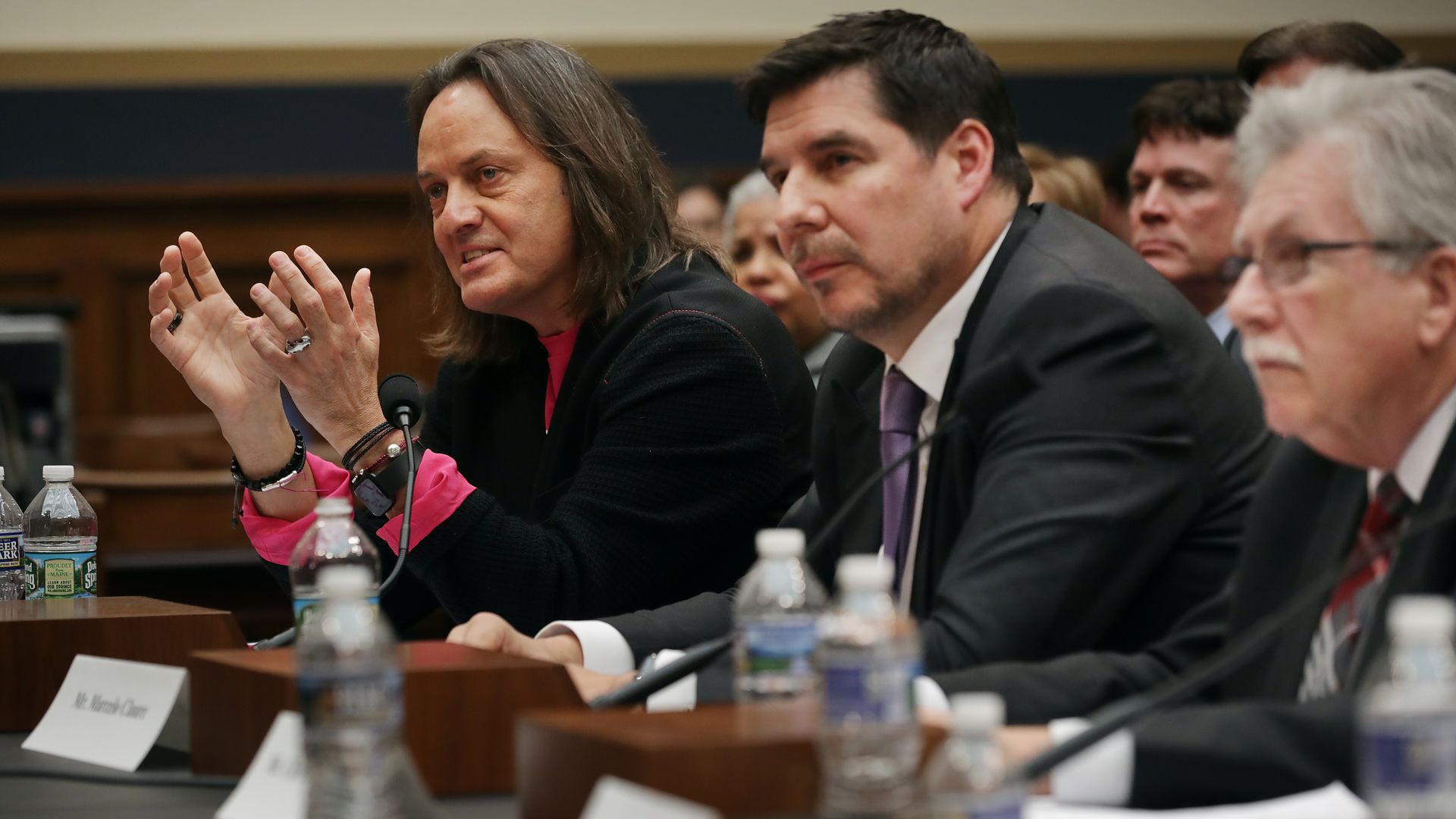
Sprint and T-Mobile on Tuesday hailed a federal judge's ruling that should pave the way for their deal to be completed, while opponents worried that consumers will ultimately end up paying more.
Why it matters: The decision turns back a legal challenge from a coalition of state attorneys general that had been the largest remaining hurdle for the deal, though it still requires a few more approvals.
A federal judge allowed the merger of T-Mobile and Sprint to move forward in a Tuesday decision, ruling against a coalition of state attorneys general who fought against the deal.
Why it matters: The deal, announced back in April 2018, reduces the number of national carriers from four to three, but creates a much larger rival to AT&T and Verizon, and was seen as vital for Sprint, which has continued to lose market share during the deal's long approval process.
For two decades, Jean Paoli worked to make Microsoft's products more standards- compliant, and along the way he helped create the XML format, a key standard for organizing data for consumption by many different platforms. Now, Paoli has raised $10 million for Docugami, a startup that aims to allow businesses to use XML to get a handle on their piles of unstructured data.
Why it matters: Only 15% of business data is stored in databases. "The rest is all this mess," Paoli told Axios.
Snapchat is launching a new set of tools and custom content around mental health and wellness, sources tell Axios. One tool includes a search function that surfaces health and wellness resources on topics including depression, suicide and anxiety.
Why it matters: It's the first product launch around what will be a bigger health and wellness push from Snapchat that will be rolled out in the next few months.
A federal judge in Los Angeles denied a request by Uber, Postmates and two drivers to halt the enforcement of California's new law that codifies strict requirements for classifying workers as independent contractors.
Why it matters: This is a major blow to the companies and drivers in the case, as they were hoping to pause the application of the law while they sue the state to get it overturned. The law went into effect on Jan. 1.
A judge is set to allow T-Mobile's purchase of Sprint to proceed, ruling against a suit by a coalition of state attorneys general, the New York Times and Wall Street Journal reported Monday. The decision is expected to be announced tomorrow, the papers reported.
Why it matters: The move creates a much larger rival to AT&T and Verizon and was seen as vital for Sprint, which has continued to lose market share during the deal's long approval process.
Eileen Naughton, Google's head of human resources, is stepping down from her role this year to take on a different, New York-based job at the search giant, the company told Fortune and confirmed to Axios.