Tuesday's technology stories

Trump promises three new "big, big, big" Apple plants in U.S.
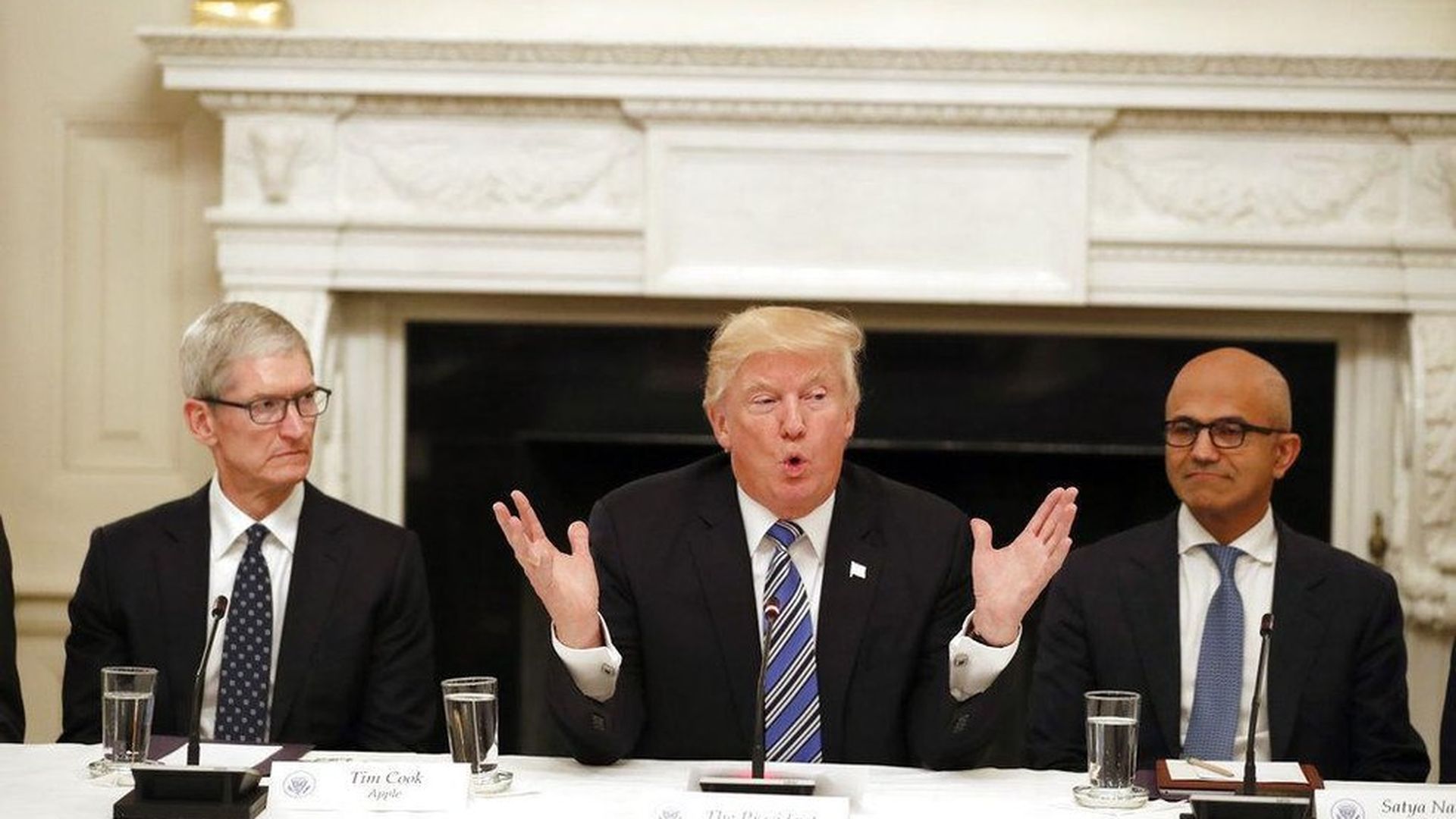
Apple is declining to comment on any plans to expand domestic manufacturing after President Trump told the Wall Street Journal that the iPhone maker was planning three "big, beautiful plants" in the U.S.
- Trump didn't say where the plants would be, but did add that they would be "big, big, big."
- Apple uses contract manufacturers, mostly in Asia, to assemble nearly all its products, while a number of its suppliers have operations in the U.S. Any domestic expansion is likely to come in conjunction with a supplier or contract manufacturer. Apple has also committed to investing another $1 billion in US manufacturers through an advanced manufacturing fund and is taking a $1 billion stake in SoftBank's $100 billion Vision Fund, which plans to make investments in US-based manufacturing.
- In the interview, Trump said he told Apple CEO Tim Cook that he wouldn't consider his administration's economic efforts a success if Apple didn't shift some work to the U.S.

A stealthy startup says it's building A.I. for robots
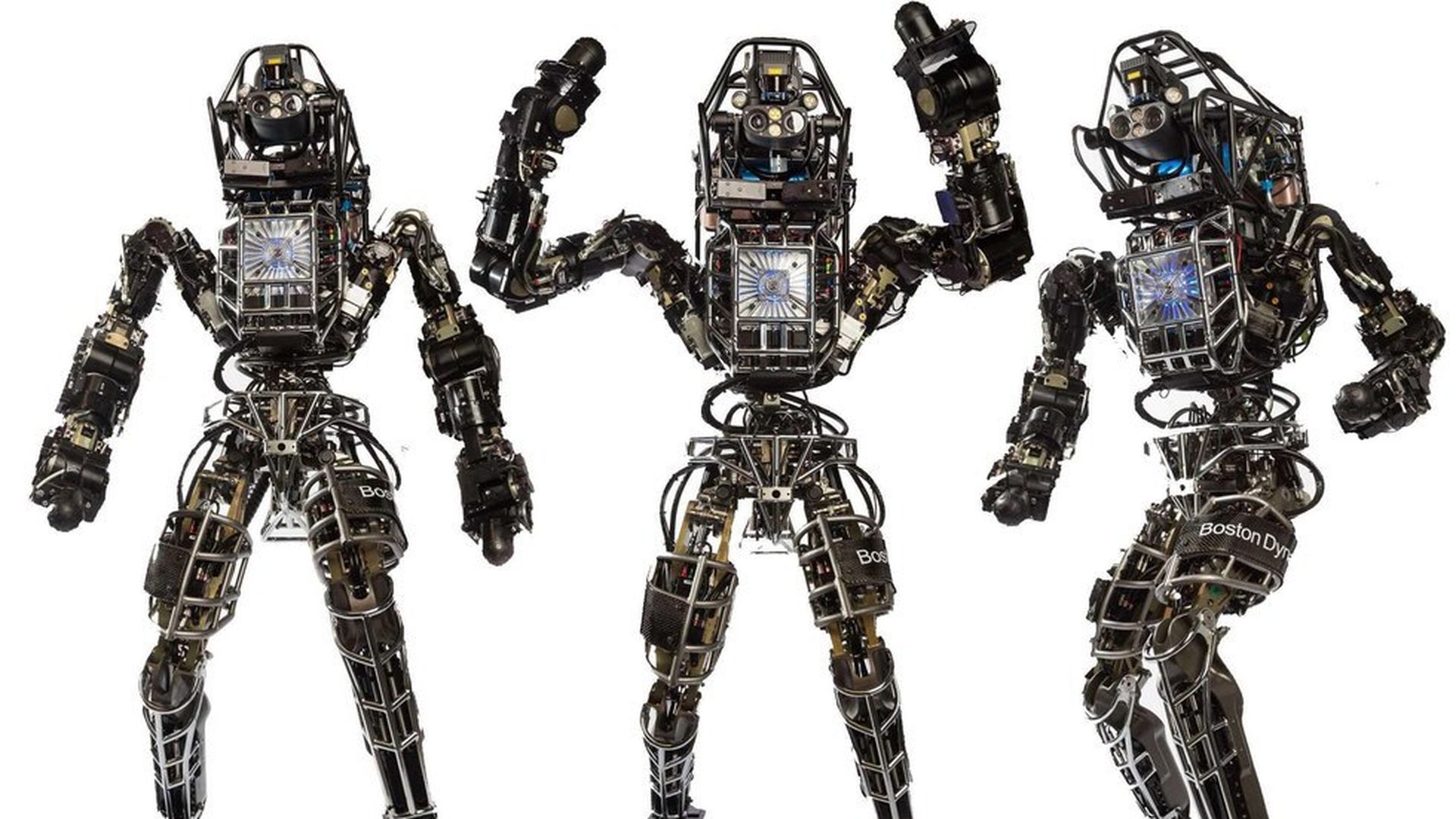
Vicarious, a seven-year-old startup in Silicon Valley startup working on artificial general intelligence, has raised $50 million Series C funding led by Khosla Ventures, bringing its total to $122 million.
A.I. for robots: What Vicarious is building is ambitious—artificial intelligence for robots, the kind you imagine with arms, that can box up orders in warehouses or help prepare food. According to co-founder and CEO D. Scott Phoenix, Vicarious's technology will be "super general and adaptable," enabling robots to use one skill, such as picking up an object, to do similar tasks.
Deployment: Vicarious is "on the cusp of starting to do field testing with customers," Phoenix tells Axios.

Fully autonomous cars will cost hundreds of thousands
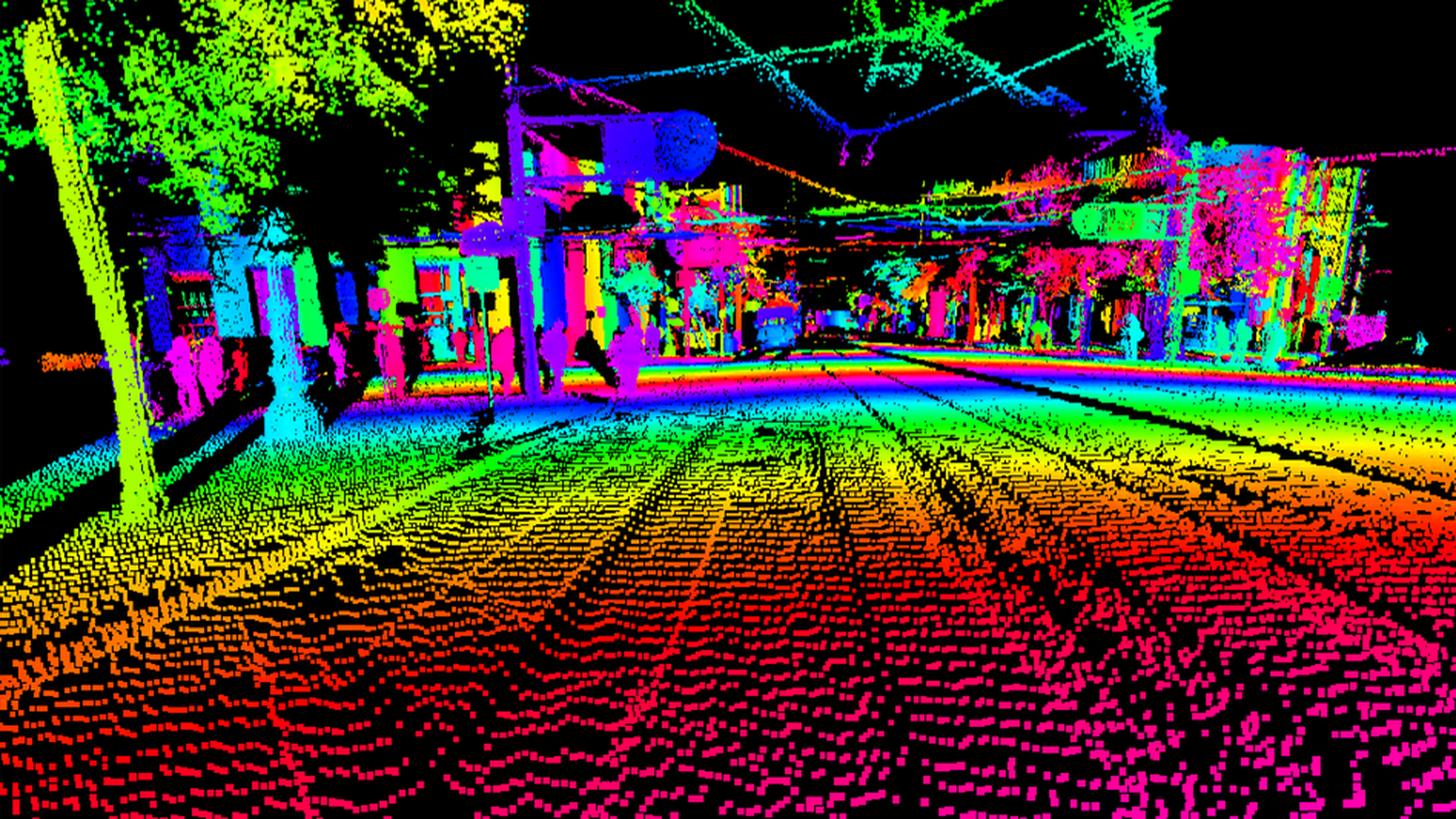
The first generation of truly autonomous cars — in which you can safely doze off through city and highway driving, and never have to touch the wheel — may cost $300,000 to $400,000, says the CEO of a Silicon Valley company that makes autonomous sensing systems.
- In other words, you and I are highly unlikely to be able anytime soon to own a car that takes us anywhere we want to go while we read the newspaper, according to Austin Russell, CEO of Luminar, a Silicon Valley startup that's developing a Lidar visual system for self-driving.
- The reason: The expense of Lidar and other sophisticated sensing devices required to make autonomous cars safe around unpredictable humans. Russell said such technology doesn't currently exist, but that when it does, it will at least initially be almost the exclusive preserve of ride-hailing fleet owners such as GM, Lyft and Uber.
- "People think that they'll go and buy and autonomous cars. That's not going to reflect reality," Russell tells Axios.
India is saying "no" to self-driving cars
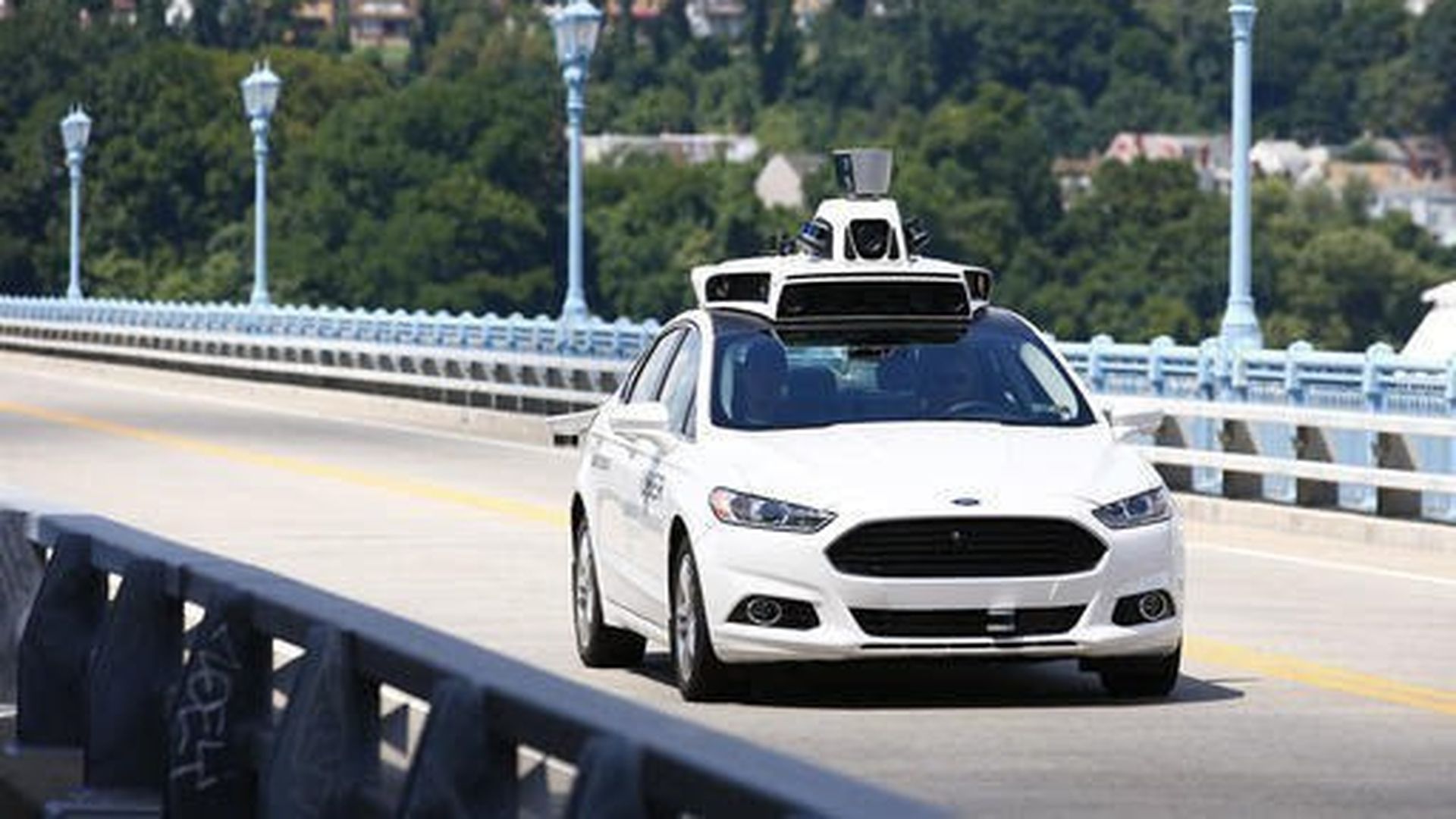
Silicon Valley and Detroit might be racing to get self-driving cars on the road but India is taking the opposite stance: It won't allow them on its roads.
Union road transport and highways minister Nitin Gadkari's comments on Tuesday, according to Hindustan Times: "We won't allow driverless cars in India. I am very clear on this. We won't allow any technology that takes away jobs. In a country where you have unemployment, you can't have a technology that ends up taking people's jobs."
Why it matters: India is a massive commercial market, so the fact that its lawmakers are categorically opposed to allowing self-driving cars is sure to worry companies banking their future on the eventual technology. Like China, India's huge population has made it a coveted commercial market for big companies across online retail, ride-hailing, consumer electronics, and everything in between.

Alphabet stock slips after EU fine puts big dent in Q2 earnings
Alphabet shares were down 3% in after-hours trading Monday, following news that the company missed on profits due to a massive European Union antitrust fine it faced in July.
Why it matters: While revenue and earnings per share beat Wall Street expectations (more below), the $2.7 billion antitrust charge caused profits to sink to $3.5 billion, withering down 27.7% from last years' $4.9 billion.
By the numbers:
- Revenue jumped 21% year-over-year to $26.01 billion, slightly surpassing Wall Street analysts' expectations.
- Earnings were $5.01 per share, which also beat projections of $4.44 per share.
- Cost per click was up 23% year-over-year and "paid clicks" (basically paid Google ads) were up 52% year-over-year.
- Revenue for "Other bets" (Google-owned side projects like Nest and Verily) increased 34% to $248 million.
Other big news:
- Executives announced that Google CEO Sundar Pichai will join its board of directors.
- Revenues from Alphabet's biggest business, Google, continued to steadily climb.

Trump: why isn't "beleaguered" Sessions going after Hillary?
President Trump made an other shot at his attorney general Jeff Sessions on Twitter Monday morning, openly asking why he hasn't gone after Hillary Clinton yet.
Background: Trump told The New York Times last week that Sessions' decision to recuse himself from the Russia investigation was "very unfair to the president" and that if he'd known he was going to recuse himself he would have selected someone else as his AG.
Robots overhyped, overfeared
We are in a robot-and-artificial intelligence bubble, and experts are starting to push back. Among their gripes: over-the-top hype of AI's capabilities, and its near-term danger to society.
One of those grumbling is Rodney Brooks, a father of modern robotics. He tells Axios that we are not near an age of super-human machines — robots are here, but not about to take over. Neither are we on the verge of truly autonomous cars in which we never touch the wheel:
- "AI is not inherently powerful. In hundreds of years, it could be different. But we aren't on the cusp of this."
- Some companies are exaggerating their AI capability. "AI washing is very, very prevalent," Brooks says, forecasting "some disappointments ahead — a bubble that bursts."
- Self-driving cars will "operate [only] in certain lanes at certain times. In 20 to 30 years, there will still be human drivers."
Automakers may need more collaboration in self-driving race
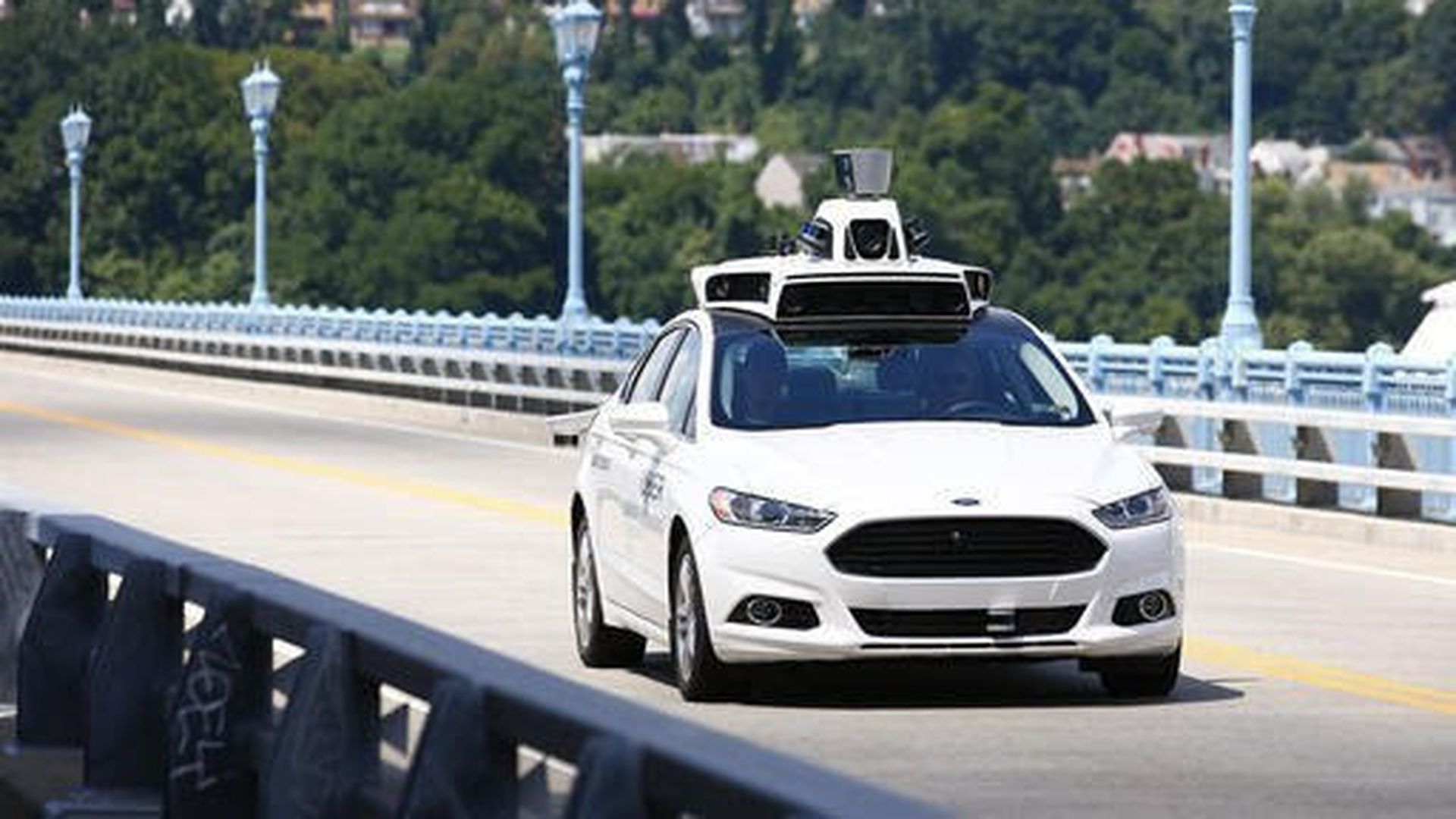
If carmakers want to beat out the software industry in the race to autonomous cars, they may need to start acting more like their Silicon Valley rivals. Alphabet's Waymo has been particularly aggressive in trying to find partners, while even Uber and Lyft have looked for ways to collaborate with self-driving partners.
- The carmakers have also been trying to find allies, but fear has slowed the pace of collaborative progress. Despite announcing a partnership to work on autonomous driving together last December, Honda and Waymo, Alphabet's self-driving car unit, haven't made much progress on that front, the companies told the Wall Street Journal.
- "Nothing concrete" has been planned yet by the two companies, Honda CEO Takahiro Hachigo told the Journal. "We are still at the study stage and haven't come up with specific research or businesses."
- Why it matters: Though Honda insists that it does collaborate well with other companies, the slow-moving partnership with Waymo highlights the divergence in approaches between the carmakers and Silicon Valley.
Attempting to build closed and proprietary autonomous driving technology could also leave automakers with the same fate as Nokia and Blackberry, which unfortunately lost the smartphone race to the platform-oriented Apple and Android, George Hotz, founder of self-driving car startup Comma.ai, recently told Axios.
Caveat: In contrast, Chrysler's partnership with Waymo has been going well, and the two were able to get sensor-equipped cars on the road within six months of striking a deal. Of course, it isn't always the carmakers that fail to partner. According to reports it was Google's parent company, not Ford, that backed out on a deal between those two companies.

AI is helping researchers understand mental illness
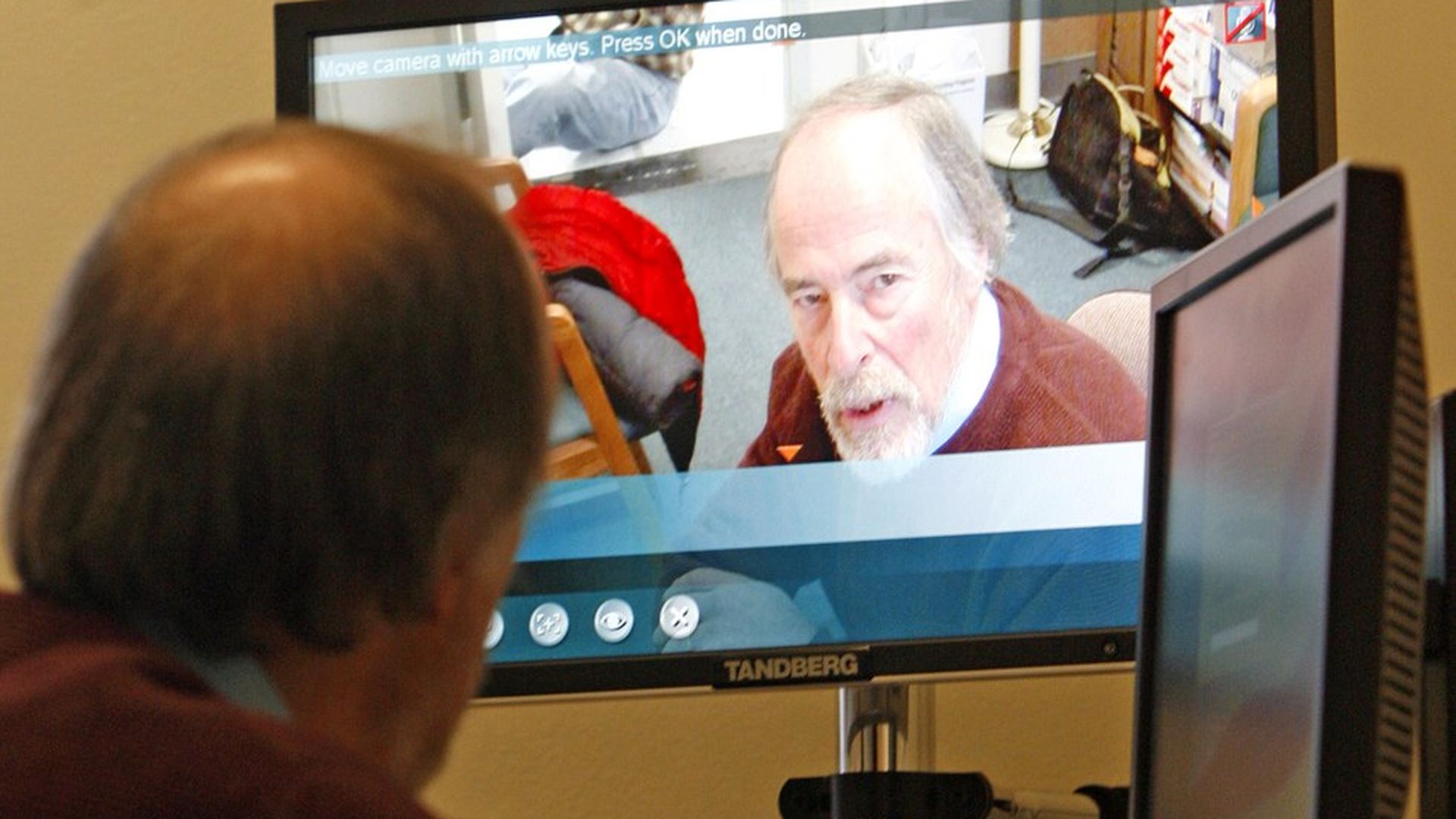
Machine learning, AI, computer games and virtual reality are helping researchers study and better understand psychiatric disorders, particularly borderline personality disorder (BPD), per MIT Tech Review. Sarah Fineberg and colleagues at Yale University are using a computer game to understand feelings of social rejection in people with BPD.
Past difficulties in studying psychiatry include a reliance on subjective observations, thus making it difficult to objectively understand the unique human behavior expressed by people with mental disorders. And the cause of BPD is still unknown — researchers understand that various social, genetic and environmental factors contribute to it, but pinning it down on a large scale hasn't been easy.
That's where machine learning and AI come in.