Thursday's technology stories

Twitter is weighing whether to build a paid version of TweetDeck
Twitter is considering whether to build premium software geared toward power users of its service.
The company already owns TweetDeck, a program geared toward those who juggle multiple Twitter accounts and spend a lot of time on the social media service. A paid version could offer extra features and bypass advertising.
Andrew Tavani, managing editor of Women in the World, first spotted a message from Twitter about the potential service.
Still pondering: It appears the idea is still in the early stages and Twitter hasn't decided if it'll build this. "We're conducting a survey to assess the interest in a new, more enhanced version of TweetDeck," a Twitter spokesperson told Axios, adding that Twitter is "exploring several ways to make TweetDeck even more valuable for professionals."
Why it matters: Twitter acquired TweetDeck in 2011 from developer Iain Dodsworth, but hasn't done much with it since as far as expanding features and capabilities. This could be a welcome option for users for whom Twitter is a critical part of doing their job.

Hackers claim to have millions of iCloud credentials, but Apple denies breach

A group called the Turkish Crime Family is claiming to have millions of passwords for Apple's iCloud, and is demanding Apple hand over money or it will delete the accounts.
Apple, while not saying what contact it has had with the group, issued a statement saying it doesn't believe its systems have been compromised. Instead, it suggests that any account information that has fallen into the wrong hands is probably the result of other well-publicized breaches and because people reuse their passwords on multiple sites.
There have not been any breaches in any of Apple's systems including iCloud and Apple ID. The alleged list of email addresses and passwords appears to have been obtained from previously compromised third-party services.We're actively monitoring to prevent unauthorized access to user accounts and are working with law enforcement to identify the criminals involved.
The upshot: Use different passwords on different sites and, whenever possible use two-factor authentication. It sounds simple, but most people don't do it. And if you haven't done so recently, change your iCloud password.

Amazon pushes transportation agenda in Washington
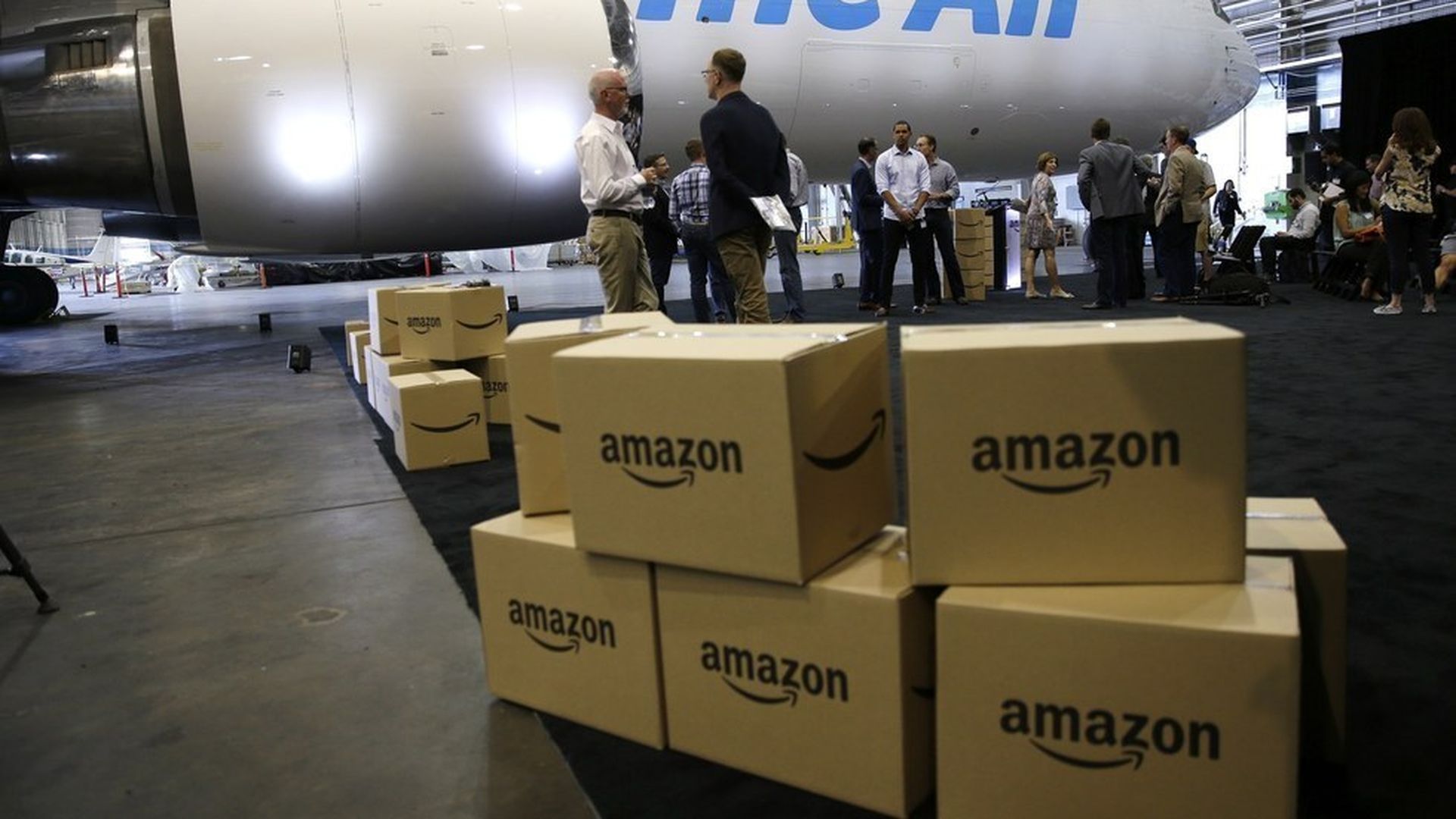
About 50 senior Amazon leaders flew in from Seattle this week to meet with the Trump administration and lawmakers on transportation issues, ranging from trucking to drones.
The team, led by SVP of Worldwide Operations Dave Clark, oversees everything that takes place from the time a you buy a product on the website to when the box lands on your doorstep — basically, a ton of transportation logistics. Last night Amazon hosted a reception for members of Congress who have Amazon jobs in their states and districts.
Why it matters: Amazon needs strong allies in Washington as it moves into delivering goods in addition to selling them. So far, it's a pretty positive story for Amazon: Last month, it announced the creation of an Air Cargo Hub in Kentucky to support its new fleet of Prime Air planes, creating some 2,000 new jobs. In January, the company said it plans to create 100,000 new jobs in the U.S. by 2018 — an effort surely not lost on Trump, who traded barbs with Amazon boss Jeff Bezos during the campaign.
How Adobe stumbled upon a new way to measure inflation

Data: Adobe; Chart: Andrew Witherspoon / Axios
For years, economists have relied on the Consumer Price Index as a proxy for the rise in inflation seen by average American households. It's made up of some 80,000 prices in 200 categories.
Adobe thinks it has a more modern approach that can surface the data — and therefore spot inflation trends — much faster. Dubbed the Digital Price Index, it draws on the tons of data that the company gets from online retailers that are part of its digital marketing cloud. It gets pricing data for 2.5 million distinct goods.
The idea to create the index occurred to Adobe after looking at the amount of holiday pricing data it had after the holiday season two years ago.
Senate backing Comcast, Google, Facebook, AT&T on privacy
Republicans in Congress are barreling ahead to overturn FCC privacy rules opposed by a rare union of broadband providers and internet companies. A vote is expected today.
The rules adopted by the FCC last fall require broadband providers to first get permission from their customers before sharing or selling sensitive personal data to advertisers and other third-parties. Rolling back the rules would be a victory to both broadband providers (like AT&T and Comcast) and internet companies (like Google and Facebook). Why? Because getting rid of the rules makes it easier to use consumer data, including web-browsing and app-use habits, to target ads.
Why it matters: Online advertising is a primary revenue stream for web companies and a growing one for ISPs. The $72 billion online advertising market is expected to grow to more than $113 billion by 2020, according to eMarketer. Right now that market is dominated by companies like Google and Facebook, but broadband providers also want a piece of that pie and say nixing the privacy rules would help them compete against the more established web players.

Small businesses drive Instagram to 1 million advertiser mark

Instagram announced Wednesday that they've reached the 1 million advertiser mark, up 200,000 advertisers in a year. The company credits its growing ads accounts to small businesses, which they've been strategically courting for a while with free "business profiles," and a new "Insights" feature, which lets business access real-time account analytics.
Next up: Instagram plans to evolve business profiles with the ability to book a service with a business directly from their profile later this year. It will also add more business insights on stories, posts saved, and multi-post images.
Why it matters: With roughly 80% of Instagrammers following a business and more than 20% of Instagrammers engaging with business accounts, Instagram has set itself up to be a top e-commerce social platform, which is key in drawing advertisers away from Snapchat, its less commerce-friendly competitor. RetailDive notes that Instagram's relationship with Facebook makes e-commcerce growth easier, by allowing retail advertisers to plug product information into Instagram's shopping platform that's already stored on Facebook.

Congress questions FBI over facial recognition database

The members of the House Oversight Committee don't always agree, but there was bipartisan outrage on the panel Wednesday over aspects of an FBI facial recognition database.
The setup: The Government Accountability Office expressed anxiety last year over the accuracy and privacy implications of the facial recognition system.
The barrage: Committee Chairman Jason Chaffetz hammered away at FBI official Kimberly Del Greco over how the FBI had dealt with the privacy implications of the system. Democrat Rep. Stephen Lynch, said that the system "is really Nazi Germany here" and that it was "corrosive of our very liberty."
Why it matters: The bipartisan frustration with the government's use of facial recognition speaks to a broader sense of unease some feel about the technology, which could also be implemented by private businesses.
LinkedIn adds a section for trending news
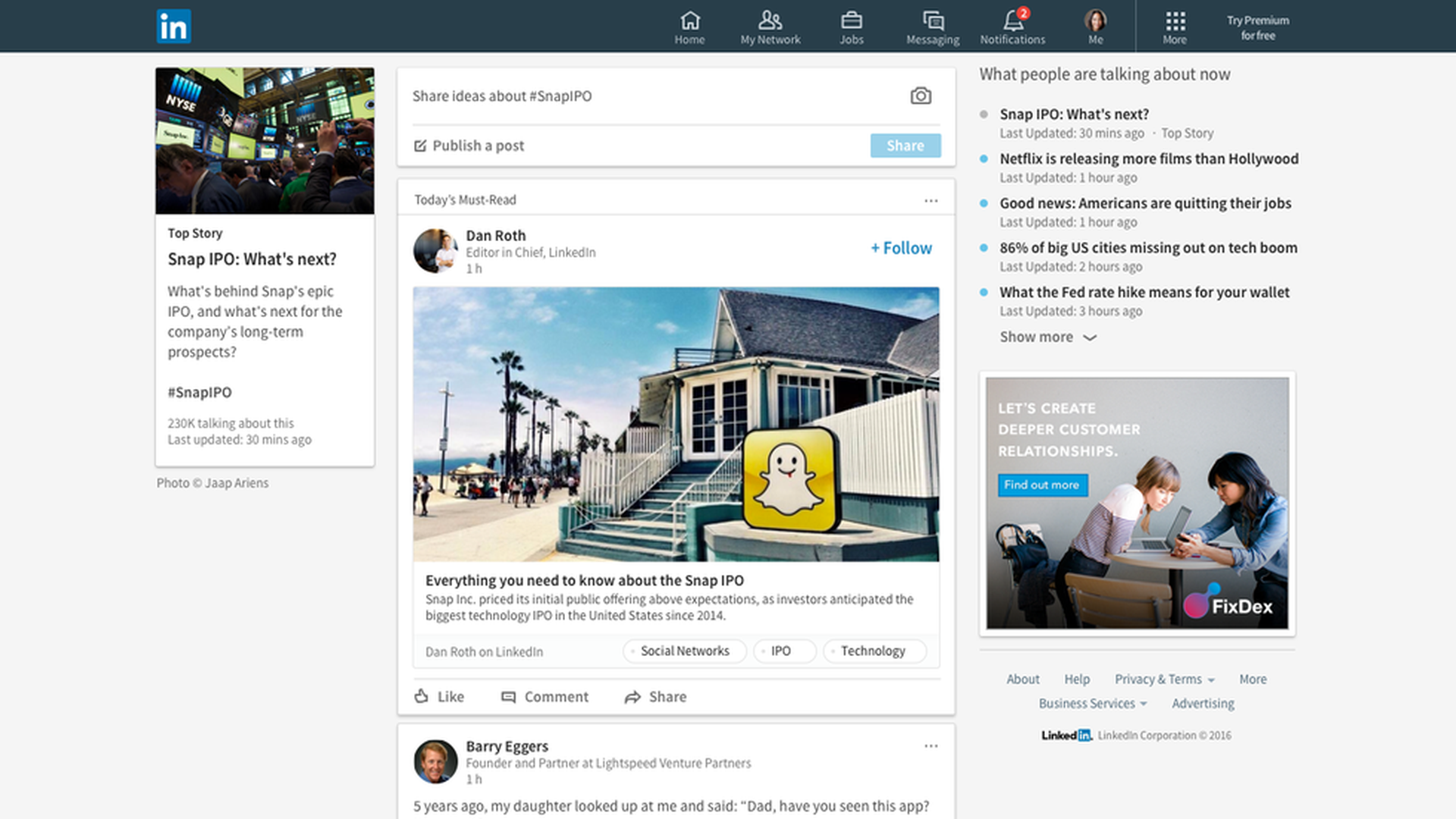
Following in the footsteps of other social networks like Facebook and Twitter, LinkedIn is adding a "Trending storylines" section to its main news feed that will feature news articles and commentary from others tailored to each user's interests.
In short, it's LinkedIn's take on Facebook's "Trending topics."
Why it matters: Consuming news has become one of people's main activities on social media, so it's no surprise that LinkedIn wants to add better ways for its users to do that on its service. It's also in line with the company's growing focus on increasing user engagement.
No fake news: Unlike other social networks like Facebook, LinkedIn isn't worried about fake news, mainly because users don't want to risk their professional reputation, as VP of product Tomer Cohen told Axios. And data seems to support this: LinkedIn was the most trusted social media service as a source of news in a recent study by the American Press Institute.
AI expert Andrew Ng steps down from China's Baidu

Artificial Intelligence expert Andrew Ng announced late Tuesday that he is stepping down as chief scientist for Chinese search giant Baidu.
Ng, who is also co-chairman and co-founder of Coursera and a Stanford adjunct professor, announced his departure in a post on Medium. Ng, who has been at Baidu since 2014, was circumspect on just what he plans to do next, but said the task of pioneering artificial intelligence "cannot be done by any single company."
His exit comes two months after Baidu hired former Microsoft search head Qi Lu to serve as company president.
I will continue my work to shepherd in this important societal change. In addition to transforming large companies to use AI, there are also rich opportunities for entrepreneurship as well as further AI research. I want all of us to have self-driving cars; conversational computers that we can talk to naturally; and healthcare robots that understand what ails us. The industrial revolution freed humanity from much repetitive physical drudgery; I now want AI to free humanity from repetitive mental drudgery, such as driving in traffic. This work cannot be done by any single company — it will be done by the global AI community of researchers and engineers. My Machine Learning MOOC on Coursera helped many people enter AI. In addition to working on AI myself, I will also explore new ways to support all of you in the global AI community, so that we can all work together to bring this AI-powered society to fruition.