Wednesday's science stories

Ukrainian drone startup is building at home

Russia's war on Ukraine has sparked a boom in global defense-tech investing, particularly around drones. But very few of those startups are actually based and building in Ukraine.
- Buntar Aerospace is an exception.
Driving the news: Buntar this week raised $16 million led by U.S.-based Freedom Fund VC, following a $10.4 million round earlier this year.

Zuckerberg teams with Google, U.S. in push to map cells
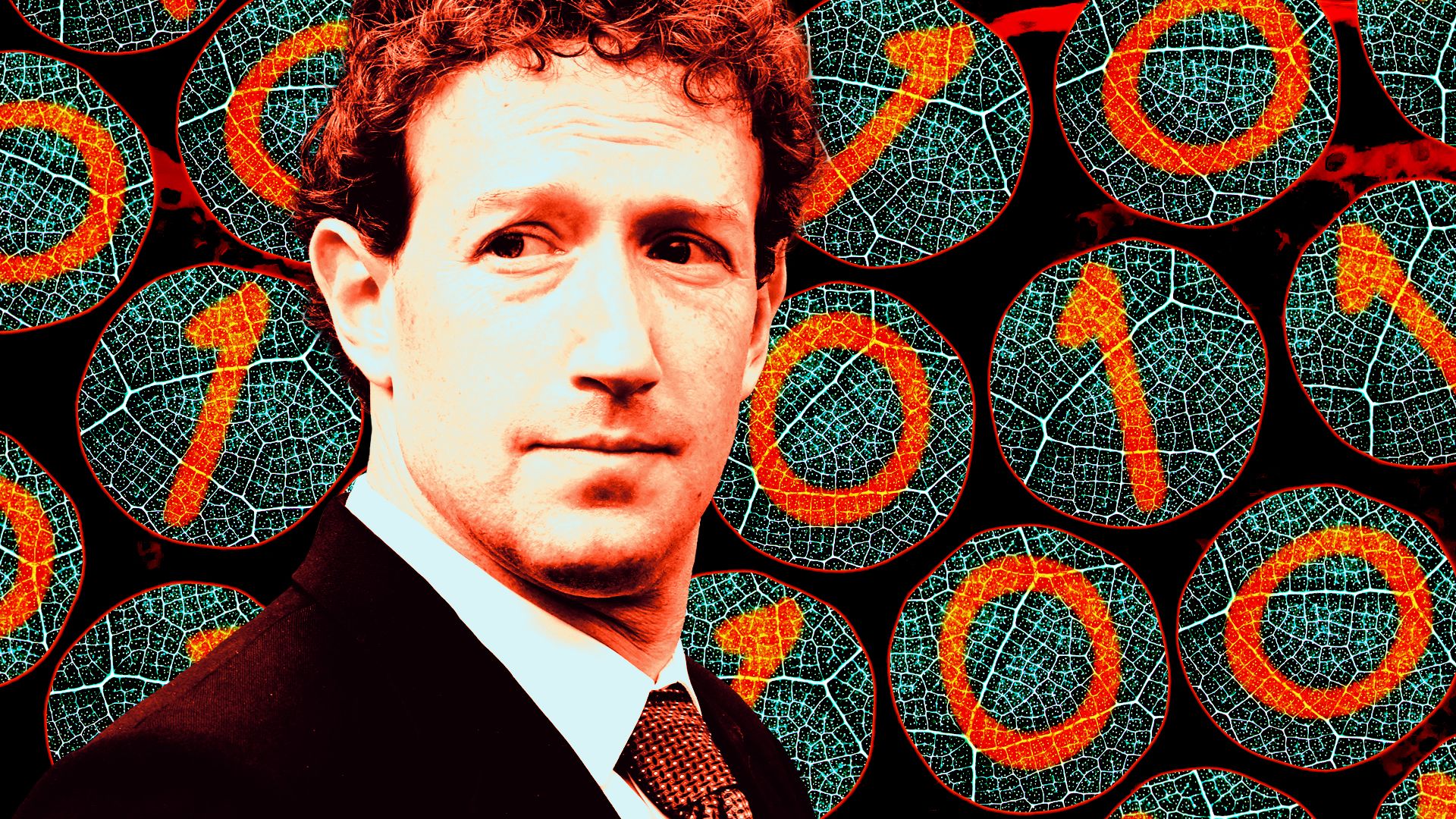
Mark Zuckerberg's Biohub is partnering with Google and the federal government in its ambitious effort to use AI for generating vast quantities of biological data that can predict how cells behave.
Why it matters: The ultimate goal is an AI model that lets scientists test potential experiments virtually, helping them identify the most promising ones before spending the time and money to perform them in the lab.
- AI is capable of understanding proteins and other pieces of biology, but modeling an entire living cell is orders of magnitude more complex — and researchers don't yet have enough of the right data to do it.

Senators question Golden Dome feasibility
Top senators are questioning the effectiveness and cost of President Trump's Golden Dome missile defense effort.
Why it matters: Trump's sprawling plan is still failing to win needed support from lawmakers — and it's in dire financial straits.

America's changing disaster risk hits energy

Hurricanes have long dominated efforts to make the power system more resilient to extreme weather. But America's energy buildout is running into growing risks from severe thunderstorms.
Why it matters: New energy infrastructure and data centers are being built in harm's way as severe weather risks shift, leaving more for developers and insurers to lose when storms hit.

Trump fears Iran could target U.S. cities. See which get extra safeguards
President Trump suggested Tuesday that the financial cost of the Iran war to Americans is a price worth paying to keep the U.S. safe.
Why it matters: Trump's comments ignited backlash, but the federal government has spent years helping high-risk U.S. urban areas detect radiological and nuclear materials that could be used in an attack.
What boiled egg pudding taught me about AI

I won't lie: The mix of food in my blender looked really gross. It was literal AI slop.
- I was in the middle of another AI experiment, one of many that have given me a handful of light bulb moments with the technology that I was profoundly skeptical about only a year ago.
Why it matters: To understand AI's transformational power, I had to try it, to noodle and experiment, to see if it could become useful — or even essential.
- Once I did, doubt turned into cautious belief — or dare I say, faith.
Zoom in: What we'll call the parable of the boiled egg pudding began with a "what if."
- Could Muse, Meta's new viral assistant, take the hundreds of high-protein recipe videos I had saved on Instagram Reels (I have a scrolling problem — don't judge!) and turn them into a tidy recipe book, with nutrition facts included?
Sure enough, it took Muse a few seconds to produce "My Recipe Book: 250 recipes from my Instagram saved collection / Collected over time, cooked with love."
- I left the title untouched — a reminder that AI still can't do everything, even if the instant PDF was impressive.
- As an always-aspiring healthy eater, I had apparently saved 250 videos with plans of making them some day, but had never revisited a single one.
🍳 The intrigue: Reels is a great medium for finding recipes, not so much for following them. You have to watch the video over and over to log the ingredients and scroll back and forth to make sure you've heard the steps right. The book made the videos instantly usable.
- Back to my blender: Once combined, the ingredients — six boiled eggs, cacao powder, maple syrup and some milk — turned into a pretty smooth-looking chocolate pudding. It actually tasted pretty good. I mean, not like creme brûlée or anything, but a decent solution to my never-ending late-night sweet tooth.
Zoom out: The surprise of that moment, and the accompanying musings on how long it'll be before we are all living in the movie Her, reminded me of my foundational conversion moment as an AI user nearly a year ago.
- I had enjoyed the chatbot era, was an early power user of Google's Notebook.lm and spent many a night working on Studio Ghibli-esque portraits of my family. I liked it. But the singularity? Give me a break, I would say to myself.
Then my Aunt Betty died. A fiery, accomplished psychologist with a penchant for quicksilver jokes and asides, Betty passed away after a long battle with multiple sclerosis at the age of 93.
- I flew to New York to help her wife Marilyn (my aunt and my mother's sister) manage the aftermath.
As many people are after a family death, we were both overwhelmed. Marilyn was shell-shocked. We needed to notify friends, organize a service and deal with all the end-of-life to-dos.
- Marilyn, a writer who had recently self-published a memoir about her pioneering, 55-year relationship with Betty, didn't feel up to the task of writing an obituary, but she also didn't want to send out a note about her wife's death without it.
I had an idea: What if I uploaded Marilyn's memoir into Notebook.lm — an AI productivity tool that synthesizes only data you compile into a notebook — and asked it to use the information to write an obituary?
- I provided a few instructions, or prompts, in AI lingo: Write an obituary of about 1,200 words that highlights Betty's work as an activist, her love for Marilyn, and her tendency for blunt and hilarious quips and one-liners.
In a few seconds, the "thinking machine" produced a lovely obituary that felt very much like it was in Marilyn's voice.
- We then worked through it together over about an hour, with her suggesting revisions, additions and finishing touches. We read it aloud together, laughing and crying. It was magical.
After that, I decided I would give AI a chance. As a writer, I couldn't dispute its utility, and I was finally convinced about its transformative power.
Reality check: When I say I am a believer, I don't mean booster. My journalistic fine-tuning is as punk rock as ever, and I intend to keep giving all the companies an equal-opportunity hard time as they shape the future, sometimes far more carelessly than any of us would wish.
- But I won't waste a lot of time pretending it's no big deal. Give me a break.