Zuckerberg and Chan bet AI can cure all disease

Add Axios as your preferred source to
see more of our stories on Google.
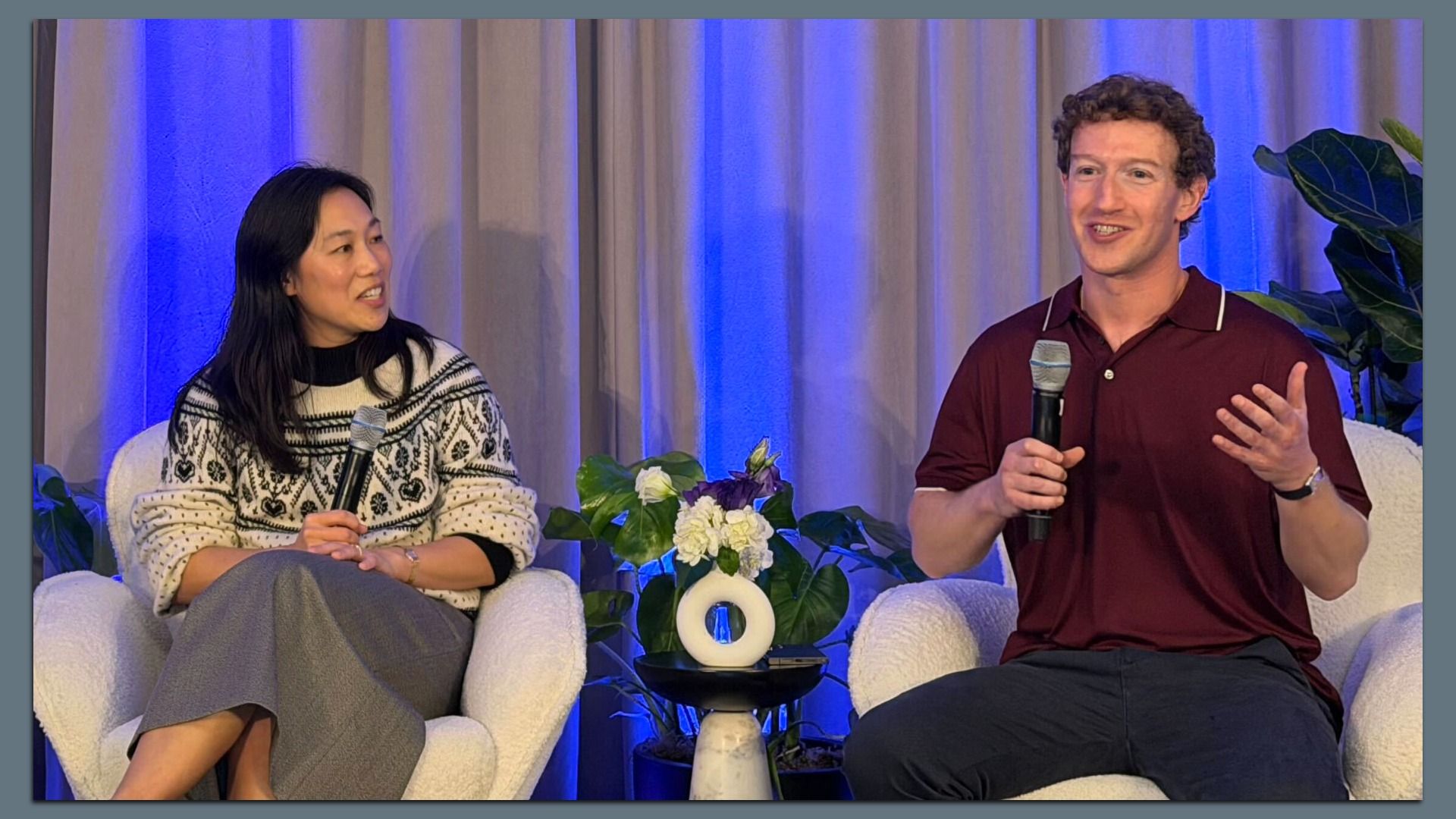
Priscilla Chan and Mark Zuckerberg. Photo: Ina Fried/Axios
Meta CEO Mark Zuckerberg and physician Priscilla Chan announced Thursday they're refocusing their philanthropy to the intersection of biology and AI to help cure disease.
Why it matters: The couple behind the Chan Zuckerberg Initiative (CZI), long known for funding education and housing, is now betting that AI can help scientists prevent, manage and cure disease faster.
Driving the news: CZI announced it's unifying its scientific efforts under the name Biohub, with a focus on using AI to speed medical and biological research.
- It's also folding in EvolutionaryScale, a previously independent frontier AI research lab and developer of AI systems for the life sciences. CZI purchased the operation but didn't disclose the financial terms.
- Alex Rives, EvolutionaryScale's co-founder, will serve as head of science for CZI, and its 50 employees will join Biohub.
The big picture: Chan and Zuckerberg hosted a gathering of about 50 leading AI researchers and tech execs to announce the news and to discuss how to bring leading-edge AI work to leading-edge biology in hopes of creating new tools for the research and medical community ranging from cell-level models to new kinds of microscopes.
- Guests included former Meta CTO Mike Schroepfer, former Meta AI researcher Joelle Pineau, investor Jim Breyer and computer scientist Aleksander Madry.
- Stripe CEO Patrick Collison, who founded biology lab Arc Institute, joined the pair on stage to riff about the current state of the art and what could soon be possible.
What they're saying: "When we started, our goal was to help scientists cure or prevent all diseases this century," Zuckerberg said. "With advances in AI, we now believe this may be possible much sooner."
- "The Biohub model has been the most impactful thing that we've done. So we want to really double down on that," Zuckerberg said at the event.
Between the lines: "We are intentionally not choosing [a specific disease] because we want to make every single scientist better, to take on more risk, to ask the most brave, curious questions so that they can find out what's true in biology," Chan said at the event last night.
- It's a continuation of a lifelong pursuit for Chan, a former pediatrician at UC San Francisco. She traces her interest in the field back to sixth grade, when her grandfather dropped her off at school one morning but had died by the time she got home.
- "I was like, 'What is going on,'" Chan recalled in a Wall Street Journal profile. "I need to understand. Science is going to explain this to me." Chan went on to teach herself the basics of oncology using a cancer biology textbook she found on Amazon.
CZI's new focus targets AI-accelerated discovery and "virtual biology," creating digital models of cells and molecules to simulate life processes, the couple outlined in a letter.
- "We believe that it will be possible in the next few years to create powerful AI systems that can reason about and represent biology to accelerate science," Chan and Zuckerberg wrote.
Yes, but: The shift, which has been underway for the past several months, has not been without controversy, particularly among the communities that have benefited from CZI's earlier projects.
- Chan opened a school in East Palo Alto, California, that offered free tuition, health care and counseling to students and their parents.
- The school is slated to close at the end of the 2025-26 school year.
The bottom line: The goal of curing all disease is a big one, but Zuckerberg and Chan think it's within reach and there's no sense not trying to achieve it.
- "It's kind of like a wild thing," Zuckerberg said at the event. "On a day to day basis we have conversations with biologists who think, 'OK, that's wildly ambitious to try to prevent and cure all diseases.' And then you talk to the AI people [and they ask] 'Why are you so unambitious? You think it's going to take decades to do this? Like, what's wrong with you?'"
- "And I do think the AI folks are gradually winning."
