New Chan Zuckerberg biohub to focus on cells' inner workings

Add Axios as your preferred source to
see more of our stories on Google.
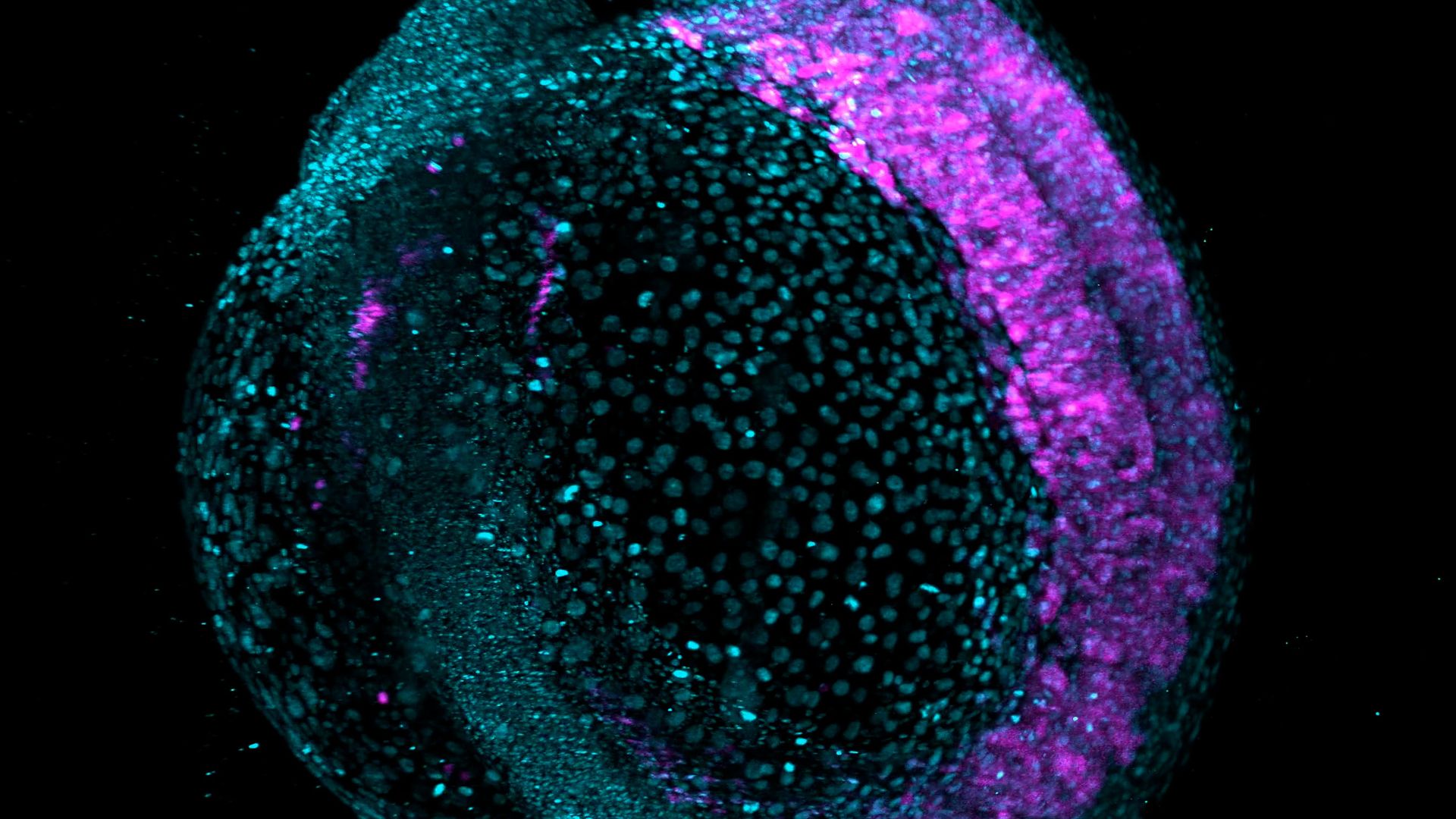
A zebrafish embryo during its first 20 hours of development, captured with a light-sheet microscope designed and built at CZ Biohub San Francisco. Credit: Royer Group
The Chan Zuckerberg Initiative is launching a biohub focused on developing new imaging technologies that allow scientists to study the inner workings of living cells.
Why it matters: Next-generation imaging tools could give researchers a better understanding of the processes that govern cells, especially when they go awry due to disease. Those insights could be used to develop new treatments.
Driving the news: The new biohub, which will be formed by combining the existing CZ Biohub San Francisco and the CZ Imaging Institute, is the latest investment from Priscilla Chan and Mark Zuckerberg's philanthropic initiative.
- CZI declined to share how much was being invested in the new research institute. Two existing hubs in New York and Chicago were each launched with $250 million investments.
- A new campus is being built in Redwood City, California, and will open in 2027, according to a press release.
- The yet-to-be-named hub will be led by biophysicist Scott Fraser, CZI's current vice president of science grant programs, who is also a professor at the University of Southern California.
"These institutes are leveraging their complementary strengths at a critical moment in biological discovery — when the right combination of technological and scientific expertise can create novel tools to illuminate hidden dynamics of complex systems, like the brain and immune system, to fully understand how they function," Priscilla Chan said in a statement.
Zoom in: The new imaging hub will be oriented around the "grand challenge" of developing imaging technologies that can be combined with genomic and other information to "capture biological processes across multiple scales — from individual proteins to whole organisms," per a press release.
- "That's what lets us tell the difference between correlation and causation" in a disease or developmental process, Fraser told Axios.
- The CZ San Francisco biohub last year published an atlas of the cells in zebrafish embryos and the genes activated as they develop. The imaging institute recently showed they could dramatically increase the speed of a current 3D imaging technique known as cryo-electron tomography.
Information from the new hub will also be used to validate models of virtual cells that could accelerate research on new drugs, vaccines and cancer treatments and reveal more fundamental information about how cells form into tissues and organs.
- "We see this as a really virtuous cycle where the hub is creating the data that helps make the models, and then the models help us interpret and collect the data, which helps us make more data. We really want to speed that whole cycle," Fraser added.
