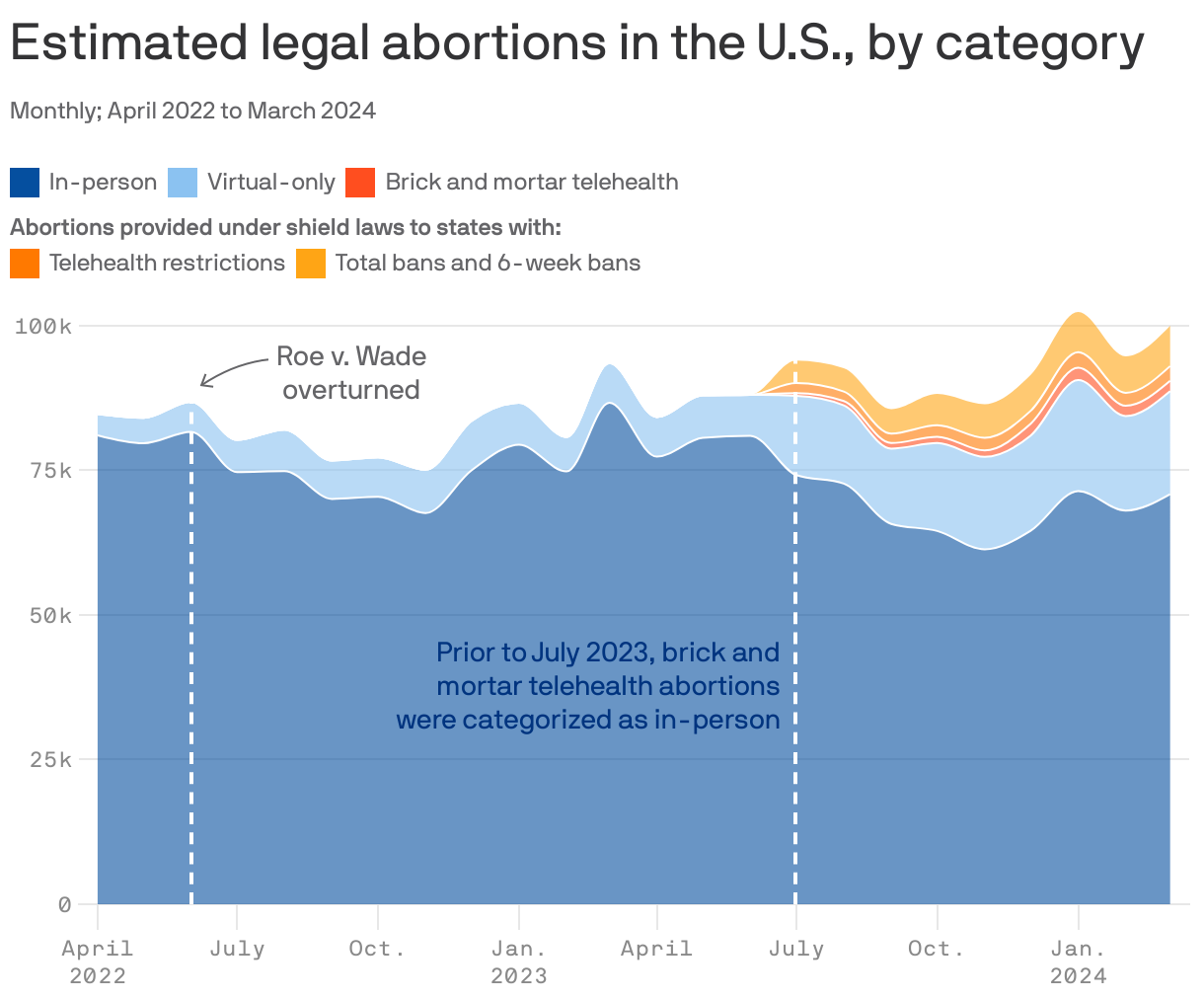
Reproduced from The Society of Family Planning; Chart: Axios Visuals
The number of women getting abortions in the U.S. continued to climb in early 2024, surpassing the number of abortions performed before Roe v. Wade was overturned, according to a national report released Wednesday.
The big picture: The increase is partly driven by access to abortions via telehealth, which allows patients to circumvent state laws banning the procedure, according to a quarterly #WeCount report from the Society of Family Planning nonprofit.
The U.S. has over two dozen silver medals going into the final week of the Olympics but whether second place is considered a win or loss is complicated for athletes.
Why it matters: Athletes who spend years preparing for their moment at the Olympics often find that second place is the hardest position to be in, if not in their own minds then from the reaction of fans and the media.
In tapping Gov. Tim Walz as her running mate, Kamala Harris added to the ticket a staunch supporter of reproductive rights who has expanded access to abortion in Minnesota — and who has a personal story with in vitro fertilization.
Why it matters: Democrats plan to make reproductive rights a top issue again this year after their 2022 successes up and down the ballot.
Discharged hospital patients can carry superbugs home and infect relatives or caregivers, even if they weren't sickened by the bacteria, per a study in Infection Control & Hospital Epidemiology.
Why it matters:The findings put an exclamation point on the concerns about the role hospitals play in the spread of antibiotic-resistant infections — and need to play in prevention, the authors say.
Lobbying around using ecstasy to treat PTSD is reaching a fever pitch this week ahead of a Food and Drug Administration deadline that could be a milestone for psychedelic drugs.
Why it matters: Psychedelics — combined with psychotherapy — have shown promise for treating a range of addictions and mental health disorders and attracted billions of dollars in investment. But no treatment has won the FDA's approval yet.
Four historically Black medical schools are getting $600 million from Michael Bloomberg's philanthropic organization to bolster their endowments.
Why it matters: The medical profession needs more diversity to ensure it's adequately serving the public and avoiding blind spots.
And Black people are particularly underrepresented among physicians.
Driving the news: Bloomberg Philanthropies today announced $175 million each for Howard University College of Medicine, Meharry Medical College and Morehouse School of Medicine, and $75 million to Charles R. Drew University of Medicine & Science.
A new medical school in New Orleans, Xavier Ochsner College of Medicine, is also getting $5 million in seed funding.
Growing demand for GLP-1 drugs like Ozempic and Wegovy and hospital consolidation could help drive up the cost of Affordable Care Act coverage next year by 9% or more, according to a preliminary review by the Peterson Center on Healthcare and KFF.
Why it matters: While most enrollees in the market get subsidies and won't have to foot the added bill, premium increases generally result in higher federal spending on subsidies, the analysis notes.
Inmates in U.S. prisons appear to not be seeking the health care they need because they can't afford co-pays, per a study inJAMA Internal Medicine.
Why it matters: Co-pays, found in up to 90% of state and federal prisons, could be a barrier to addressing the increasing prevalence of chronic health conditions among the incarcerated.
1.6 million more people lost health coverage in the first quarter of this year as states continued to cut their Medicaid rolls and unemployment ticked up, according to preliminary Centers for Disease Control and Prevention data.
Why it matters: After the uninsured rate hit a record lowof 7.2% last year, coverage gains stemming from pandemic-era policies are starting to slip — and could fall further if health costs continue to rise and enhanced Affordable Care Act subsidies aren't renewed next year.
Some of America's largest hospital systems saw their financials soar in the first half of 2024. And yet, more than 700 facilities across the country still are at risk of closing.
Why it matters: It's a familiar tale of the rich getting richer, as big, mostly for-profit health systems see improved margins while smaller facilities in outlying areas are barely hanging on.
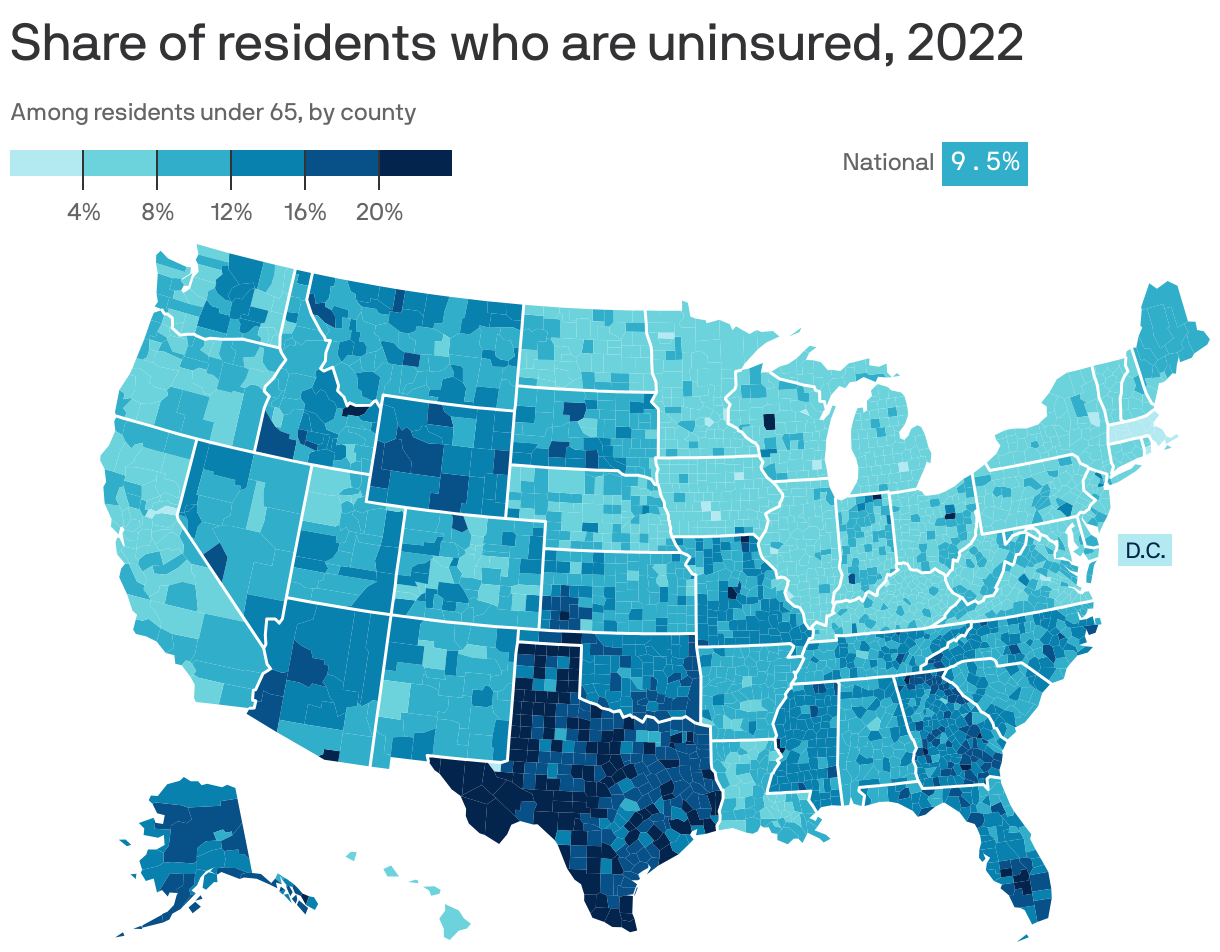
Data: U.S. Census Bureau; Note: Estimated from administrative and survey data; Map: Kavya Beheraj/Axios
Texas is home to the country's largest share of Americans under 65 without health insurance, according to new Census Bureau data, with 18.8% of residents uninsured as of 2022.
Why it matters: That's a big improvement over 2006, when 27.6% of Texans were uninsured — but still nearly double the national uninsured rate of 9.5%.







/2024/08/06/1722966860106.gif?w=3840)