Abortions exceed pre-Roe numbers as telehealth access grows

Add Axios as your preferred source to
see more of our stories on Google.
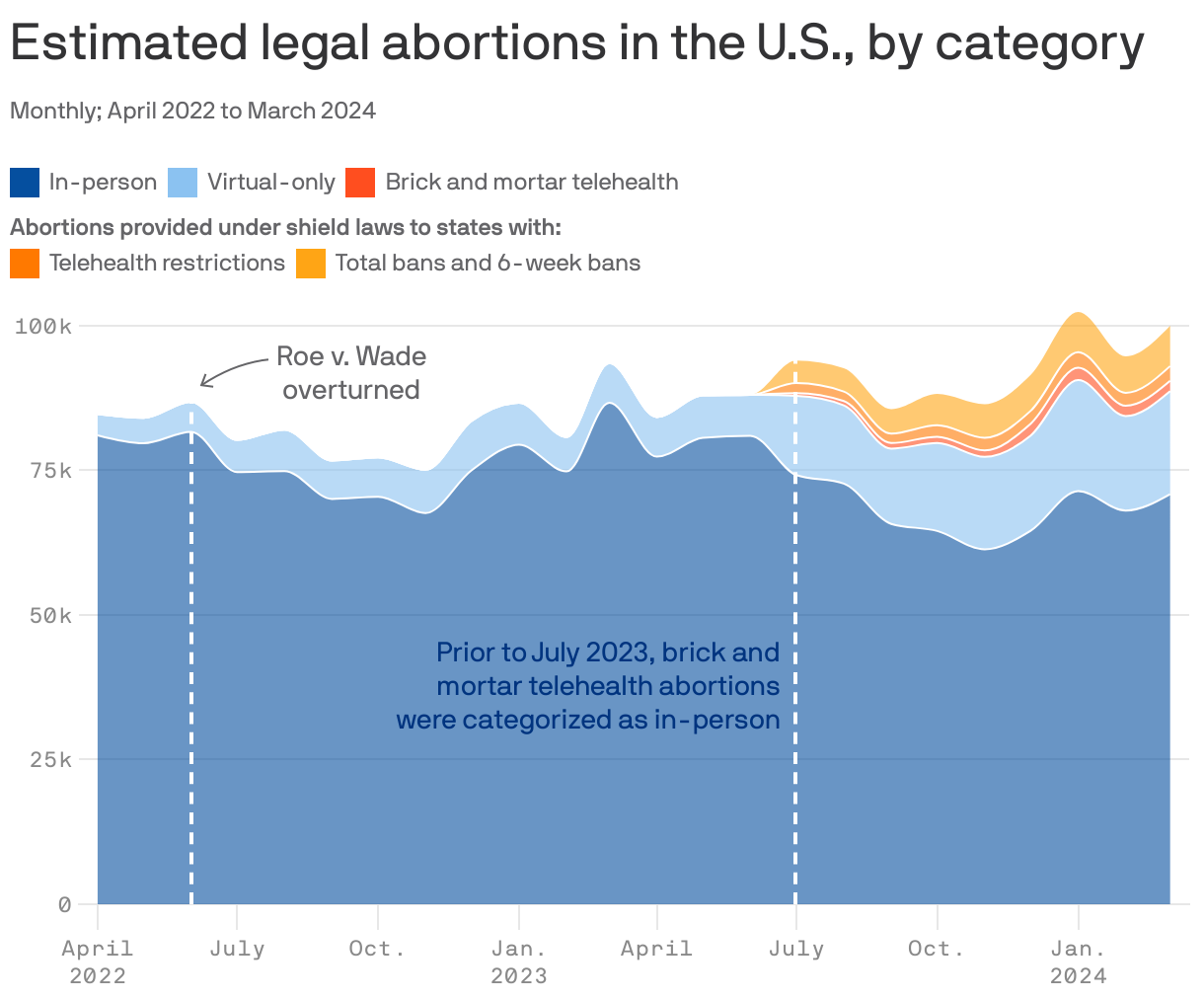
The number of women getting abortions in the U.S. continued to climb in early 2024, surpassing the number of abortions performed before Roe v. Wade was overturned, according to a national report released Wednesday.
The big picture: The increase is partly driven by access to abortions via telehealth, which allows patients to circumvent state laws banning the procedure, according to a quarterly #WeCount report from the Society of Family Planning nonprofit.
- After the Supreme Court overturned Roe, providers started offering medication abortion via telehealth under shield law protections.
- Abortions provided via telehealth rose to 20% of all abortions in the first quarter of 2024, per the report. That's about 19,700 telehealth abortions per month.
By the numbers: In January, the national monthly total of abortions exceeded 100,000 for the first time since the #WeCount reporting effort began tracking abortion volume in April 2022.
- There were between 94,670 and 102,350 abortions monthly between January and March 2024, with a monthly average of 98,990, per the report.
Zoom in: The states with the largest average number of abortions per month in that period included California, New York, Illinois, Florida and New Jersey.
- Since then, Florida instated a six-week abortion ban — one of the strictest limits in the nation. The new law that took effect in May dramatically changed Florida's role as a post-Roe refuge for people seeking care in the larger U.S. South.
- But Florida and a handful of other states have successfully, or are aiming to, put abortion on the ballot for voters in November — a winning issue for Democrats in the post-Roe era.
Zoom out: 14 states have laws in effect banning nearly all abortions, while other states vary on the gestational limits.
- Still, between July 2023 and March 2024, more than 65,000 people in states with telehealth restrictions, total abortion bans or six-week bans accessed medication abortion provided under shield laws, per the report.
What they're saying: "Telehealth abortion is making a critical difference for people seeking abortion care in this increasingly restrictive environment," said Ushma Upadhyay, co-chair of #WeCount and professor at the University of California, San Francisco.
- "Telehealth also eases the surges and cuts down on wait times at abortion clinics providing in-person abortion care, which continues to be a critical route to abortion access, accounting for 80% of all abortions," Upadhyay added.
Go deeper:
